


Canadian politics news — Canada is joining the Global Combat Air Program 2026 as an official observer, CBC News has learned, marking a bold and historic shift in how this country approaches its own defence and its relationships with both traditional allies and the United States. Defence Minister David McGuinty is expected to announce the deal next week in London alongside his British, Japanese, and Italian counterparts — formalizing Canada’s entry into a multibillion-dollar program to build the world’s most advanced sixth-generation stealth fighter jet by 2035.
By Maplestime News Desk | Canada | July 15, 2026
Sources: CBC News | Royal United Services Institute | MacDonald-Laurier Institute | Last updated: July 15, 2026
In This Article
- What the Global Combat Air Program actually is
- What observer status means for Canada
- Why Canada is doing this now
- The F-35 question — what happens to that deal
- What the United States thinks
- What this means for Canadian defence going forward
Key Takeaways
- Canada will become an official observer of the Global Combat Air Program — known as GCAP — joining the UK, Japan, and Italy in building a sixth-generation stealth fighter jet by 2035
- Defence Minister David McGuinty will sign the agreement in London next week during the Farnborough International Airshow
- Observer status carries no financial or policy commitments — it opens the door to classified conversations about what Canada can bring to the program
- This is not a replacement for the F-35 — Canada’s review of its 88-aircraft F-35 order remains ongoing
- The move sends a clear diplomatic message to the United States that Canada has choices in its defence procurement
- The U.S. ambassador has been actively pressuring Canada to complete the F-35 purchase — including flying two F-35s over his July 4 party in Ottawa as a political gesture
- A retired top NORAD commander says Canada has allowed its defence capabilities to atrophy for too long and this is a necessary correction
What Is the Global Combat Air Program
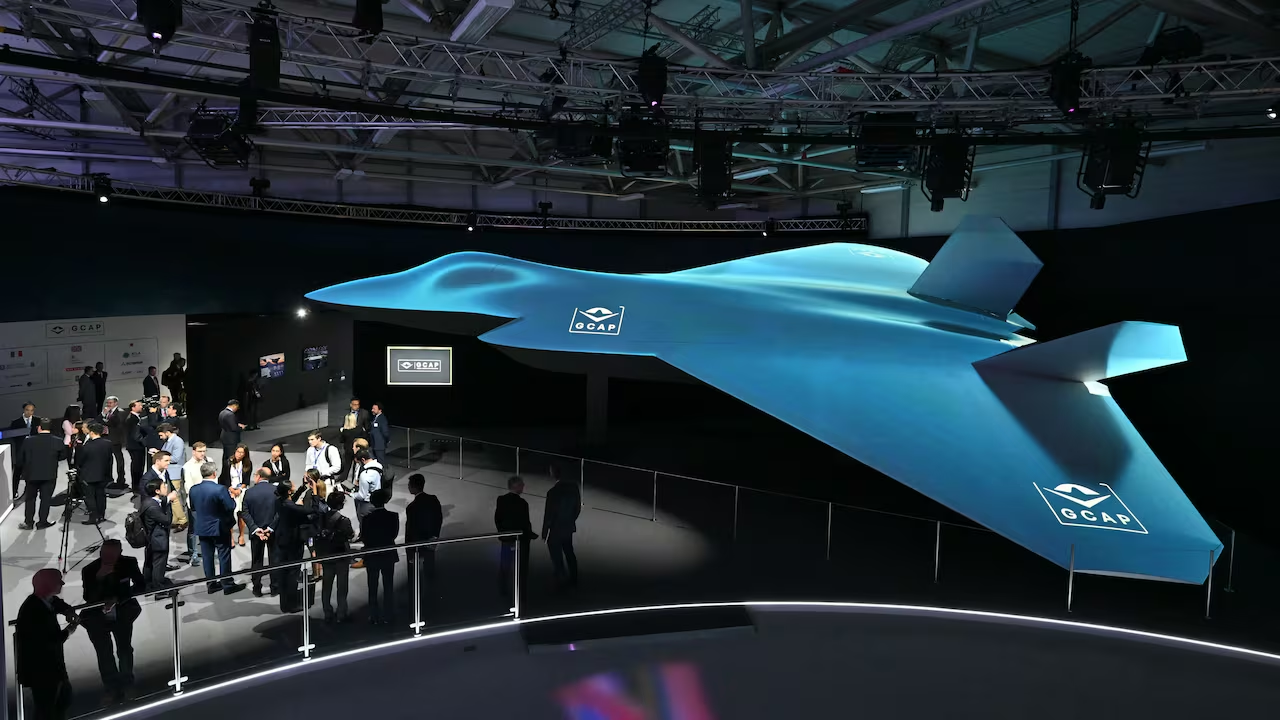
The Canada Global Combat Air Program 2026 partnership is one of the most significant defence technology collaborations in the world right now — and Canada has just stepped into the room.
GCAP is a multibillion-dollar program led by the United Kingdom, Japan, and Italy to develop and build the sixth generation of combat fighter jets by 2035. A sixth-generation aircraft goes significantly beyond the current fifth-generation platforms like the F-35 — incorporating advanced stealth, artificial intelligence integration, directed energy weapons capability, and next-generation sensor fusion into a single aircraft platform.
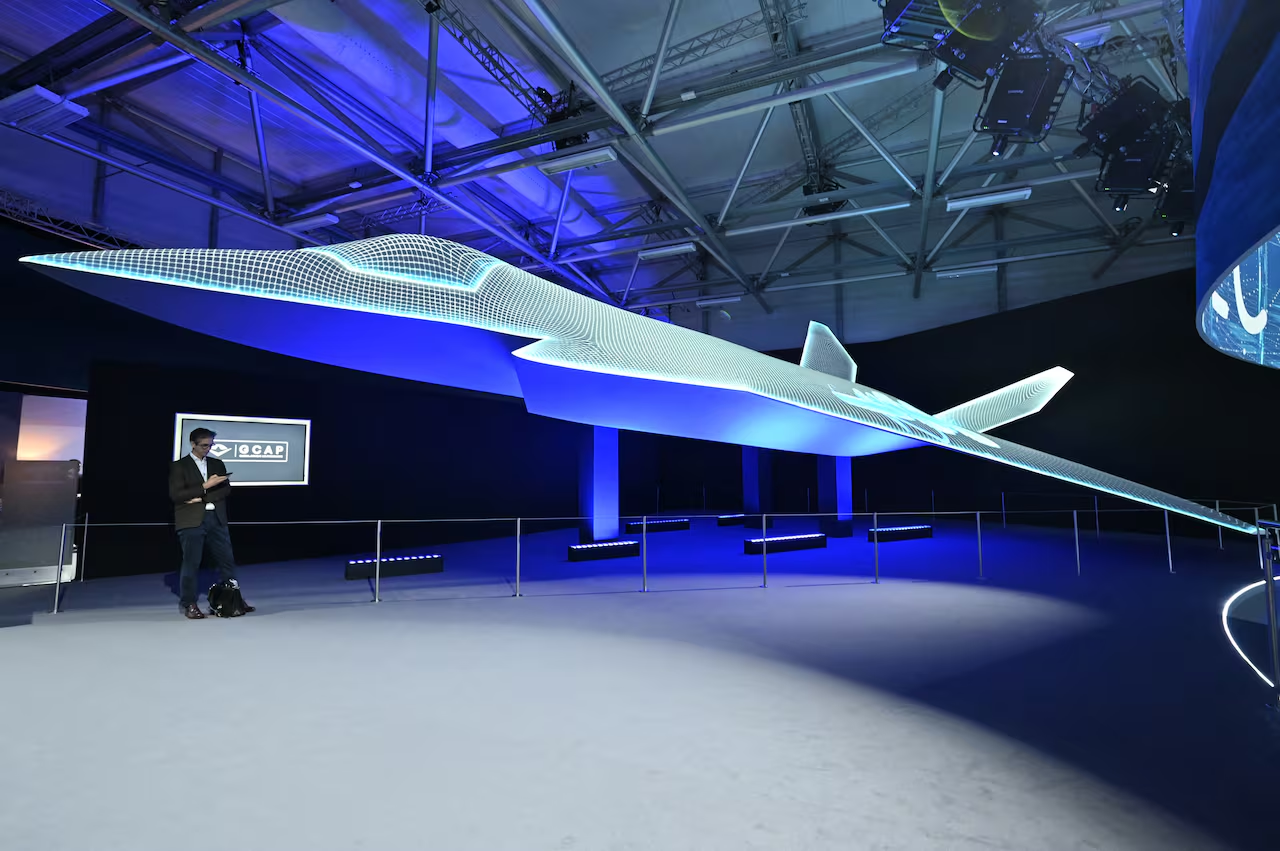
A concept design was displayed at the Farnborough International Airshow in England in 2024. The aircraft it represents would be among the most capable and lethal military platforms ever built — designed to operate in the most contested airspace on earth against the most advanced adversaries.
Canada has been watching this program develop. Next week it officially steps inside it.
Related: Canada US Relations 2026 — Trade, Tariffs and the New Reality
What Observer Status Actually Means for Canada
Canada Global Combat Air Program 2026 observer status is not full partnership — and that distinction matters.
A senior Canadian government official told CBC News that becoming an observer is a first step that opens the door to classified talks about what Canada could bring to the table. The Canadian government is making no financial commitments and no policy commitments at this stage.
Trevor Taylor, a UK defence expert at the Royal United Services Institute who directs the defence, industries and society program at RUSI, described it plainly. Observer status is like a first date.
“It’s getting to know you and getting to accept what we might be getting into,” Taylor said. “And both parties have to be cautious about this.”
Think of it this way. Canada is not yet buying into the program. Canada is sitting down at the table, reading the menu, and deciding what it wants to order. The kitchen gets to see who is at the table. Canada gets to see what is being prepared.
What happens at that table — the classified conversations about Canadian technology, Canadian industrial capability, and Canada’s potential contribution to the program — will determine whether observer status becomes something more.
One source with knowledge of the file told CBC News that Canada’s participation opens the door to purchasing the aircraft in the future. That door was previously closed. Now it is open.
6 Powerful Reasons Canada Is Doing This Now
Reason 1 — Canada’s Defence Capabilities Have Atrophied
Retired Lieutenant-General Christopher Coates, a former top NORAD commander and current director of foreign policy, national defence and national security at the MacDonald-Laurier Institute, did not mince words.
“Canada for too long has allowed its defence industry and its strategic approach to defence material, defence requirements to atrophy,” Coates said.
Canada is currently playing catch-up on fifth-generation fighter jets — the generation that has been operational with allied air forces for years. Joining the GCAP conversation now means Canada participates in shaping the sixth generation rather than spending decades trying to access technology it had no role in creating.
“It’s a good move to anticipate where we need to be in the future so that we’re not playing catch-up,” Coates said.
Reason 2 — The F-35 Review Has Created Uncertainty
Canada launched a review of its planned purchase of 88 F-35 fighter jets from the United States more than a year ago. The review was triggered directly by U.S. President Donald Trump’s annexation threats and tariffs hammering Canadian industries.
That review has created a procurement gap. Canada needs next-generation air capability. The F-35 purchase is in question. Joining GCAP as an observer gives Canada a credible alternative pathway — or at minimum a negotiating position.
The Canada Global Combat Air Program 2026 move is not a replacement for the F-35, Coates was clear about that. It is complementary and offers new capabilities. He also said Canada needs more than 88 F-35s to adequately defend itself and carry out its international duties regardless of what happens with GCAP.
Reason 3 — It Sends a Message to Washington
This is the geopolitical dimension that every defence analyst is talking about today.
Trevor Taylor at RUSI was direct about it. The move pulls Canada closer to its European and Pacific allies — but it also sends a specific message to the United States.
“They’re also sending a message to the United States that we have choice, Canada has agency in this matter,” Taylor said. “And that it is very reluctant to be forced into a particular line of action.”
The United States has been applying significant pressure on Canada to finalize the F-35 purchase. U.S. Ambassador Pete Hoekstra has been particularly vocal — and theatrical — about it. He had a pair of F-35 fighter jets roar over his July 4 party in Ottawa as a pointed political nudge at the Canadian government.
Canada joining GCAP is the equivalent of Canada looking calmly back across the table and saying — we have other options.
Reason 4 — The F-47 May Not Be Accessible to Canada
The United States has its own sixth-generation fighter jet program — the F-47. While unveiling the plan, Trump described it as the most advanced, most capable, most lethal aircraft ever built, with nothing else in the world coming close to it.
Taylor at RUSI raised a concern that matters enormously for Canada’s long-term defence planning. That jet might be so advanced that it may not be accessible even to the United States’ closest allies.
If the F-47 is not accessible to Canada — and if Canada has no involvement in GCAP — Canada could find itself with no credible path to sixth-generation air capability at all. Observer status in GCAP closes that gap.
Reason 5 — Canadian Technology Can Contribute
Canada is not entering this program as a passive observer looking to eventually buy an aircraft someone else built. The Canadian government sees this as an opportunity to upscale Canadian technology — to get Canadian aerospace and defence industry capabilities embedded in the development of the world’s next generation of combat aircraft.
Winnipeg is Canada’s largest aerospace centre in Western Canada with major companies including StandardAero and Magellan Aerospace. Canadian aerospace expertise is real and internationally recognized. Getting that expertise into a program like GCAP at the observer stage means Canadian technology shapes the aircraft — not just purchases it.
Reason 6 — NORAD Obligations Demand It
Canada co-commands NORAD — the North American Aerospace Defense Command — jointly with the United States. That obligation requires Canada to maintain credible air defence capability.
Coates, who worked alongside Americans at NORAD, said he believes U.S. military leadership would see Canada joining GCAP positively — as evidence that Canada is committing to do more to defend North America.
“It allows us, with our allies and partners, to become part of developing a vision for the future of air power, so that Canada never finds itself, as it is today, well behind in terms of years and capabilities to defend our nation and defend our allies,” Coates said.
What Happens in London Next Week
Defence Minister David McGuinty will travel to the United Kingdom next week as part of a broader Canadian ministerial delegation attending the Farnborough International Airshow — one of the most significant aerospace and defence industry events in the world.
Also attending from Canada will be Industry Minister Mélanie Joly, Secretary of State for Defence Procurement Stephen Fuhr, and Transport Minister Steven MacKinnon.
McGuinty’s announcement is expected during the same week that officials and companies from around the world gather in the London area for the air show. He will meet with his British, Japanese, and Italian defence counterparts for a signing ceremony in London to formalize Canada’s observer status.
It will be a signing ceremony. A first date. A door opening.
What comes after that depends on what happens in the classified conversations that observer status unlocks.
What This Means for Canadians
Canada’s participation in the Global Combat Air Program 2026 will not change the daily lives of most Canadians in any immediate way. There are no financial commitments. No aircraft will be purchased next week.
But the long-term implications are significant.
Canadian aerospace jobs could flow from Canadian technology being embedded in a global sixth-generation aircraft program. Canadian defence capability — which Coates and others say has been allowed to atrophy dangerously — gets a credible pathway to modernization. Canadian diplomatic leverage with the United States is strengthened by demonstrating that Canada has genuine choices in its defence partnerships.
And Canada takes a seat at a table where the future of air power is being designed — rather than waiting outside that room until the decisions have already been made and the aircraft already built.
This is a developing story. Maplestime will update this article following Defence Minister McGuinty’s official announcement in London next week.
Have information about this story? Email [email protected]
Have a correction? Email [email protected]
What do you think about Canada joining the Global Combat Air Program — is this the right move for Canadian defence and Canadian sovereignty, or should Canada stay focused on completing the F-35 purchase first? Share your view in the comments. And send this to anyone following Canadian defence and politics news today.
Discover more from MaplesTime
Subscribe to get the latest posts sent to your email.
