



Winnipeg tech news — RRC Polytech put roughly 30 Manitoba tech professionals in a room during Winnipeg Tech Week 2025 and asked them what the province’s workforce is actually missing. The answer wasn’t a coding language. It was resourcefulness, root cause analysis, documentation, and the judgment to know when AI is solving the right problem.
By Maplestime Business Desk | Winnipeg, Manitoba | September 19, 2026
Sources: RRC Polytech, Tech Manitoba | Last updated: September 19, 2026
Key Takeaways
- RRC Polytech’s School of Continuing Education and Tech Manitoba gathered ~30 developers, IT managers, consultants, architects, and nonprofit tech leads
- The most-needed skills weren’t technical: resourcefulness, adaptability, critical thinking, and the ability to translate tech into business value
- Top hard-skill gaps: AI literacy, advanced data analysis, cybersecurity, ERP systems, and cloud platforms
- SharePoint came up at nearly every table — not as tech people can’t access, but as tech nobody uses consistently
- Several participants confirmed AI is already reducing junior hiring at their organizations
- The room’s consensus: Manitoba doesn’t have a talent shortage — it has a thinking shortage
Six Questions, a Pile of Lego, and an Honest Conversation
Manitoba’s tech workforce skills gap was the subject nobody wanted to talk around — so RRC Polytech put about 30 industry professionals in a room and asked them to be blunt.
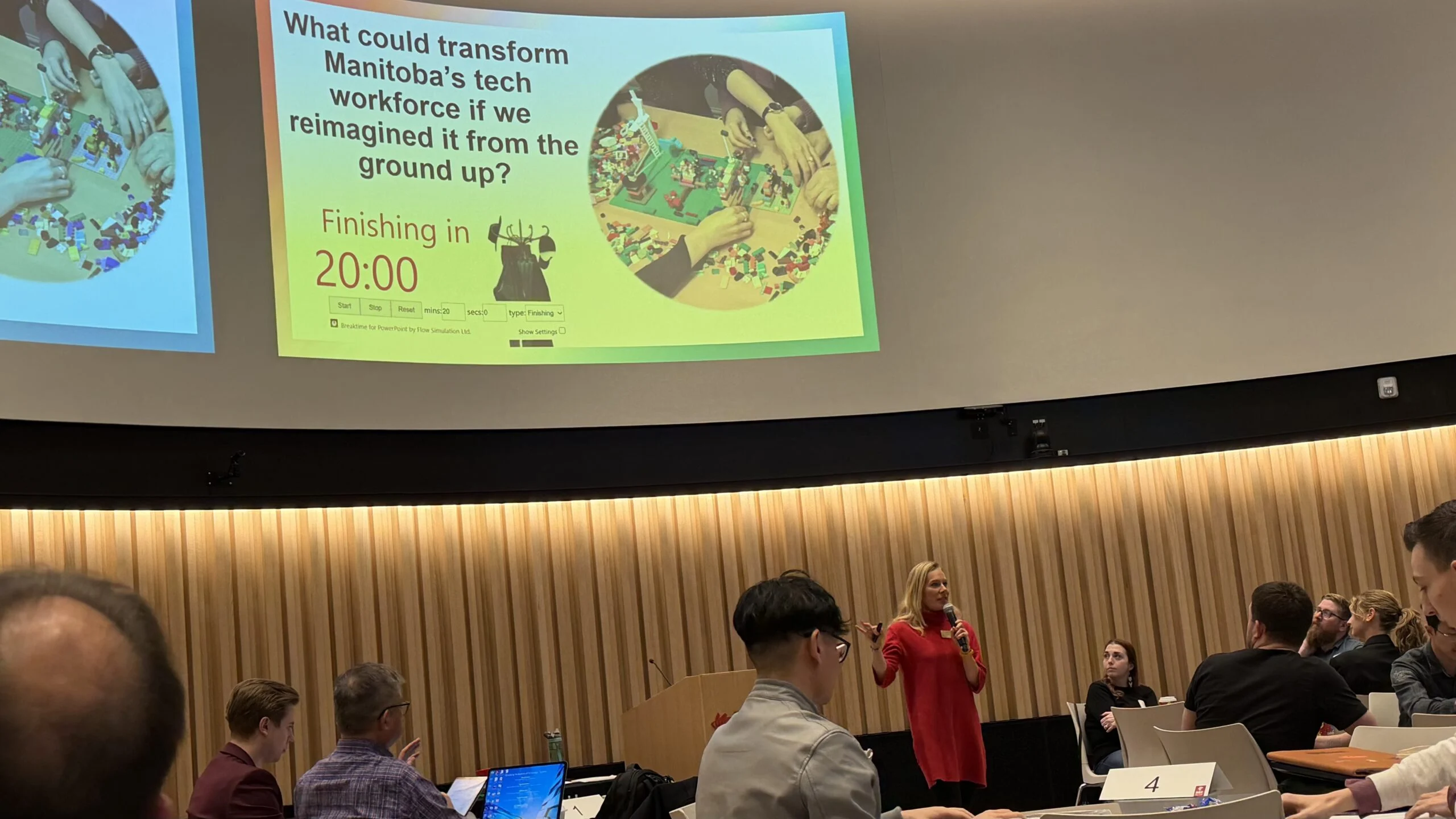
Developers, IT managers, consultants, nonprofit tech leads, enterprise architects, sales professionals — they gathered in a space at RRC Polytech on a Wednesday afternoon for an event with no headline speaker and no product demo. What it had was six questions, a pile of Lego, and an honest conversation about what Manitoba’s tech workforce is actually missing.
The event was organized by RRC Polytech’s School of Continuing Education in partnership with Tech Manitoba, with a straightforward but ambitious goal: ask the people inside Manitoba’s tech sector what skills are missing, what tools their teams struggle with, and what the industry needs from education over the next five to ten years. No packaged solution. No pre-written curriculum. Just industry, in a room, telling the truth.
The land acknowledgement at the start set an unexpected tone. Anderson, chair of professional studies, reminded the room — full of tech leaders — that the technology they design, deploy, and profit from has real environmental consequences. She asked them to think about what their choices today will mean for the next seven generations. It wasn’t what anyone expected at a workforce development session. It’s what the conversation needed.
The Skills Everyone Listed — and the Ones That Actually Matter
When the first question went up — what skills do you and your staff most need to strengthen? — every table produced a list that looked roughly the same. Communication. Adaptability. Critical thinking. Problem solving. Collaboration. Social awareness. Analytical skills. AI literacy. Leadership. Presentation skills.
Good list. Entirely Googleable. Which is exactly what one participant pointed out.
“If we just list stuff, you could Google it and get the same answer,” he said. “What I want is perspective. Which of these is actually the most important to you?”
That’s when the conversation got interesting.
One person said adaptability — without hesitation. Another said entrepreneurship. A third said resourcefulness. Not a skill you’ll find on most curriculum frameworks, but the word that kept coming back in different forms: the ability to find a way to get something done even when you don’t know how, to bring in the right people, to not just do your job description but actually solve the problem.
“The people I value most on my team are resourceful. They may not be able to do it themselves — but they’ll find a way to get it done. Whether they bring other people in, or whatever. That’s the person I want.”
— Industry participant, RRC Polytech workforce session 2025
One participant in nonprofit IT put it another way: improvise, adapt, overcome. Those three things, taken together, describe the mindset he wishes more tech graduates actually had. Not just knowing the right answer when everything goes right — but knowing what to do when it doesn’t. Which, in his experience, is most of the time.
The Skills Gap Nobody Puts on a Resume
The second question — what essential skills are currently missing and difficult to train locally — produced a more honest, more uncomfortable list.
The room talked about AI literacy, advanced data analysis, cybersecurity, ERP systems, and cloud platforms. Those are the expected answers. But the conversation kept drifting back to something harder to name and harder to teach: the ability to translate technical knowledge into business value.
Multiple people described the same situation. You have someone technically excellent — they know the systems, they can do the work — but they can’t communicate what they’re doing to a non-technical stakeholder. They can’t connect the code to the business problem. They speak in zeros and ones, and everyone else in the room is speaking English.
One enterprise architect described the deeper version: organizations suffer because the people sponsoring projects don’t know how to properly define a problem. They romance the solution, hand it to solution architects, who build exactly what they were asked for — and then everyone wonders why the same problem still exists. It’s not an IT failure. It’s a root cause analysis failure. And it starts well before the first line of code.
Her proposed fix was practical: bring business people and RRC students into the same room to work on root cause analysis together — a real problem, not a theory exercise. Learn the methodology side by side. That, she said, would do more for the gap between education and industry than almost anything else.
The Tools Everyone Uses and Almost Nobody Uses Well
Question three asked what tools teams struggle to use consistently. The answers were less exotic than anyone expected: Microsoft Teams. SharePoint. CRM platforms. ERP systems. Email. Password managers. Collaboration tools everyone has access to and almost no one uses the same way.
SharePoint came up at nearly every table — not as technology people can’t access, but as technology used in ten different ways with no shared standard, no clear file organization, no version control, no ownership rules. A digital filing cabinet nobody can navigate, full of documents nobody can find.
The bigger pattern was inconsistency across skill levels. In any organization, you have people who seem like computer wizards — every shortcut, every feature, every integration — and people who can barely send an email. No resume tells you which one you’re getting. No standard. No baseline. Just hope.
“It’s not that people can’t access the tools. It’s that everyone uses them differently. You get someone who comes in and they avoid the tool entirely because they’re embarrassed they don’t know how to use it. And the problem just gets worse.”
— Industry participant, RRC Polytech workforce session 2025
AI tools came up here too — but not about refusing to adopt AI. The concern was adopting it wrong: using AI to generate things they can’t evaluate, submitting AI-written work they can’t defend, or implementing AI just to say they have it without a single real use case. The problem isn’t fear of AI. It’s that companies don’t know what problem they’re trying to solve with it.
Related: Canadian Startup Founders Advice: What 5 Winnipeg Founders Wish They Knew
Related: Schulich Venture Academy’s Bigger Vision for Canadian Tech Startups
What’s Actually Creating Inefficiency — and It’s Not What You Think
Question four asked about inefficiency. The room expected to talk about manual processes and outdated systems. But the loudest theme was communication breakdown.
Unnecessary meetings. Reply-all emails. Five-paragraph emails about things a thirty-second conversation could resolve. Teams bypassing ticketing systems and workflow tools because the process feels too slow — creating chaos in the short term and data black holes in the long term.
One participant made the point that stayed: the problem isn’t that people are inefficient — it’s that systems are designed in ways that make inefficiency inevitable. Manual work, unclear processes, and the wrong communication tools don’t just waste time. They create learned helplessness where people stop trusting the systems and start working around them. Once that culture sets in, it’s very hard to fix.
And several participants pointed to documentation as the single most undervalued skill in the tech workforce. Not glamorous. Not in most curricula. But the ability to document what you did — clearly enough that someone else, or future you six months from now, can understand it — came up at almost every table as something critically missing.
The Next 10 Years: What Manitoba’s Tech Sector Is Actually Afraid Of
The final question asked about emerging technology over the next five to ten years. Yes, AI was mentioned. Yes, automation. But the fear underneath was more specific: companies will keep implementing AI because their competitors are, without any actual use case identified, ending up with a workforce that’s working faster and producing more — with less judgment applied to any of it. One participant described being the bottleneck on her own team because AI made everyone else faster. Output went up. Her ability to review it didn’t.
The concern about junior roles came up here too. If AI is replacing entry-level tasks — and several participants confirmed it already is at their organizations — how does the next generation of developers build the experience to become senior developers? How do you grow without the reps? Nobody had a clean answer.
One participant reframed the whole problem. Manitoba, he said, has a massive opportunity in career awareness — helping people outside the traditional tech pipeline see that tech careers exist in agriculture, construction, healthcare, nonprofits. Not just tech companies. The farmer’s kids running complex machinery their whole lives are already doing technology. They just don’t know they qualify.
“Those grandparents out in rural Manitoba who are MacGyvering parts together on equipment — that’s technology. That’s problem solving. That’s resourcefulness. We just never told them it counts.”
— Industry participant, RRC Polytech workforce session 2025
That reframe was the most important thing said all afternoon. Manitoba’s tech workforce gap isn’t just a curriculum problem. It’s a perception problem. And fixing the perception — starting early, starting in schools, starting in rural communities — might do more for the pipeline than any course redesign.
The Toddler, the Chatbot, and the Thinking Shortage
The afternoon ended on a note nobody saw coming. One participant mentioned her daughter — a two-and-a-half-year-old, barely old enough to form full sentences — telling her mom to “ask ChatGPT” when she had a question. The room laughed. Then sat with it.
That child enters the workforce in roughly 20 years. The skills she’ll need — critical thinking, adaptability, the ability to evaluate AI output rather than accept it, the judgment to know when technology is solving the right problem — won’t be built by giving her better tools. They’ll be built by teaching her how to think.
That’s what the room kept coming back to, across six questions and three hours. Not better software. Not more certifications. Just people who know how to think when things go wrong — because things always go wrong.
Manitoba’s tech workforce skills gap won’t be closed by better software or more certifications. Manitoba’s tech sector doesn’t have a talent shortage. It has a thinking shortage. And RRC Polytech, apparently, is paying attention.
Frequently Asked Questions
What is RRC Polytech’s School of Continuing Education? It provides flexible, part-time upskilling, cross-skilling, and reskilling programs for working professionals across Manitoba — evenings, weekends, online, and hybrid. The school works directly with industry to identify skills gaps and build curriculum that reflects what employers actually need.
What is Tech Manitoba? A nonprofit sector council supporting the growth and development of Manitoba’s technology industry. They run annual workforce surveys, advocate for the tech sector, and connect education and industry. Their survey data consistently flags post-secondary tech curriculum as a top area needing improvement.
What are the biggest tech skills gaps in Manitoba right now? Critical thinking and root cause analysis topped the list, followed by translating technical work into business value, adaptability and growth mindset, and AI literacy beyond basic tool use. Tool-specific gaps include ERP systems, SharePoint, CRM platforms, and collaboration tools — not because people can’t access them, but because there’s no consistent standard for using them.
Is AI really replacing entry-level tech jobs in Manitoba? Several participants confirmed AI is already affecting junior hiring — not always through layoffs, but through reduced hiring. The room’s consensus: the solution isn’t to avoid AI, but to make evaluating, questioning, and directing AI output a core skill from day one of any tech education program.
What do upskilling, cross-skilling, and reskilling mean? As defined at the session by RRC Polytech’s Brad: upskilling means deepening expertise in your current role; cross-skilling means moving horizontally into a related area; reskilling means a bigger transition — learning a new skill set to move into a different industry or role. RRC’s continuing education programs support all three.
Maplestime will provide updates on Manitoba’s tech workforce and industry events as announcements are made.
Have a tip about Manitoba’s tech sector? Email [email protected]
Have a correction? Email [email protected]
Is Manitoba’s tech gap really about skills — or about employers who won’t pay to train anyone? Tell us in the comments. And share this with every Manitoban working in tech or trying to break in.
Enjoying Maplestime? Support independent Canadian journalism — no paywall, no corporate owners.