



[ez-toc]
Canada military Gulf states 2026 – Nobody in Ottawa is going to say this plainly, so let’s just say it: Canada is being pulled into a war it never signed up for, faster than anyone expected.
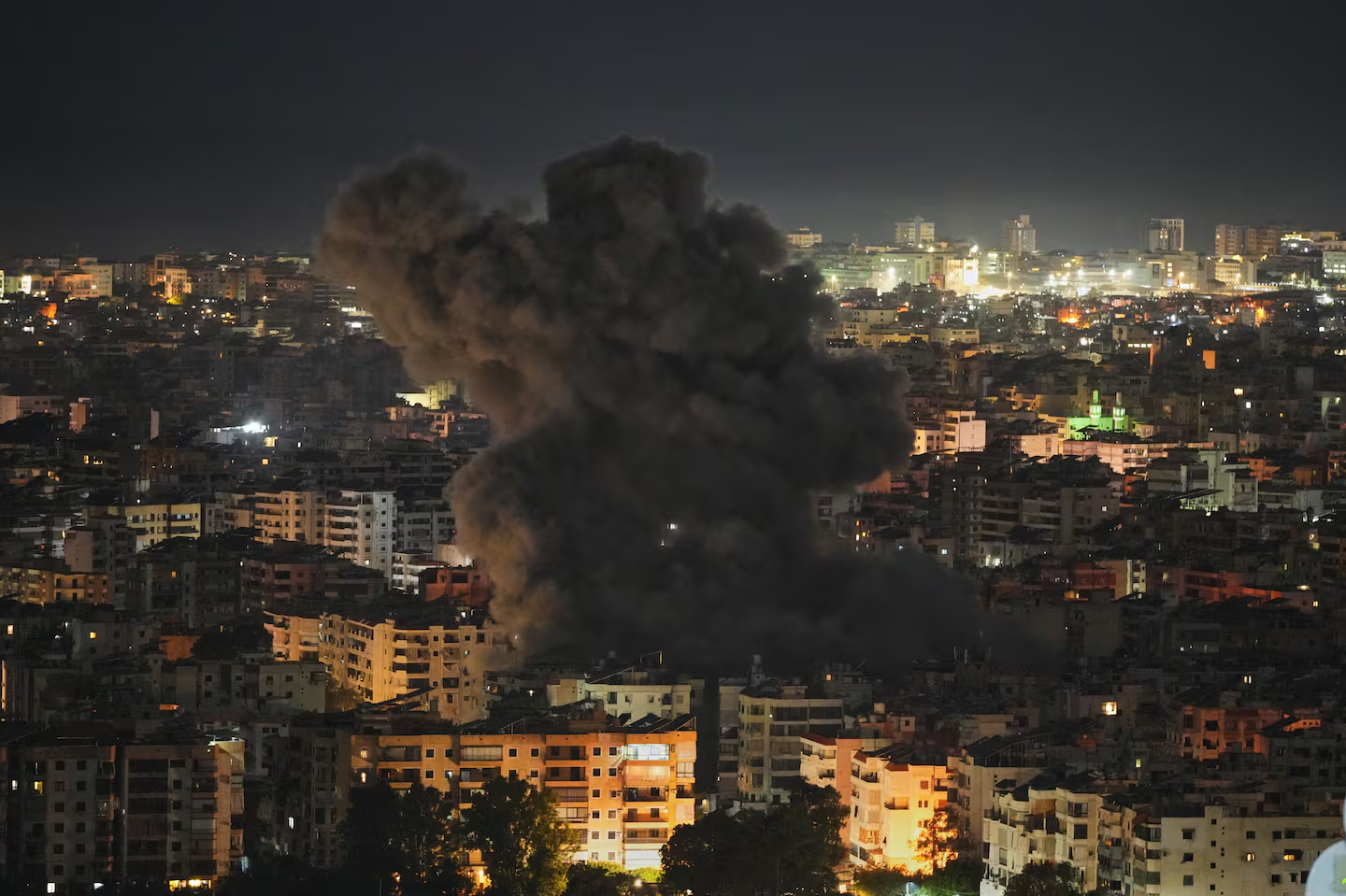
On Thursday, Prime Minister Carney stood in Australia and called potential military involvement a “fundamental hypothetical.” By Thursday night, it wasn’t hypothetical anymore. Canada’s military is now in active talks with Gulf states about defensive support — and Israel has opened a second front, launching fresh strikes into Lebanon while the rest of the world is still processing what’s happening in Iran.
If you’ve been following this story, we covered Carney’s initial position in detail yesterday.He refused to rule out military involvement, called it a “fundamental hypothetical,” and flew to Tokyo. Within 24 hours, the hypothetical had a phone number attached to it.
So here’s where Canada actually stands right now — and why every Canadian should be paying attention.
Canada Military Gulf States 2026: How Did We Get Here This Fast?
Less than a week ago the world woke up to news that American and Israeli forces had struck Iran and killed Supreme Leader Ayatollah Ali Khamenei. Canada wasn’t in the room. Canada wasn’t on the phone. Carney found out the same way you did — after it happened.
His first response was to support the strikes. Then he walked that back. Then he said he couldn’t rule out military involvement. And now — before he’s even landed in Tokyo — Canada’s military is sitting at a table with Gulf states talking about what a defensive role might look like.
That’s five days. Five days from “we weren’t consulted” to “we’re in talks.”
The reason it moved this fast isn’t complicated. The war didn’t stay in Iran.
Israel launching strikes into Lebanon changes everything about the regional picture. Lebanon means Hezbollah. Hezbollah means Syria gets nervous. Syria gets nervous and suddenly Qatar, the UAE, and Saudi Arabia — countries sitting on the most important oil shipping lanes on the planet — are looking at a conflict that could knock on their door within days.
And they remembered that Carney spent the last several months flying to their capitals asking for investment deals.
That bill is now coming due.
What “Defensive Talks” Actually Means For Canadians
Let’s cut through the military language here because “defensive talks” sounds a lot more abstract than it actually is.
This is not Canada declaring war. No deployment order has been signed. No ships have left port. But here’s the uncomfortable truth about how these things work — talks like these don’t stay talks. They turn into agreements. Agreements turn into deployments. Deployments turn into incidents. And incidents have a way of escalating regardless of what anyone’s original intentions were.
What a Canadian defensive role in the Gulf would actually look like in practice is something Ottawa hasn’t told Canadians yet. But based on what Canada has and what Gulf partners would need, the most realistic options are a naval frigate presence in Gulf waters as a deterrence signal, radar and air defence coordination given Iran’s missile capabilities, intelligence sharing through the Five Eyes network, and military training and logistics support for Gulf armed forces.
None of those options are small. All of them cost money. All of them put Canadian personnel in or near an active war zone. And as of right now, not one of them has been debated in Parliament.
That last point matters more than it’s getting credit for.
The Lebanon Piece That Canadian Media Is Underplaying
Here’s the part of this story that isn’t getting nearly enough attention in Canadian newsrooms.
Lebanon is not just another Middle East country getting caught in the crossfire. Canada has one of the largest Lebanese diaspora communities in the world — somewhere between 250,000 and 300,000 Canadians of Lebanese descent, plus thousands of dual citizens who move back and forth regularly. When Israeli strikes start hitting Lebanese territory, “Canadians caught in a war zone” stops being a talking point and becomes a very real logistical emergency.
We already know more than 2,000 Canadians have requested government help leaving the broader Middle East region since this started. That number is going to go up — fast — now that Lebanon is in play.
Think about what that means operationally. Canada’s Foreign Affairs department is simultaneously trying to evacuate thousands of citizens from an expanding war zone while the Canadian military is sitting at tables negotiating defensive commitments with countries bordering that same war zone. Those two things are going to start pulling in opposite directions very quickly.
The Political Problem Carney Cannot Solve From Tokyo
Carney’s carefully constructed position — “we support our allies but we’re not party to the offensive actions” — made sense for about 48 hours. It doesn’t make sense anymore.
You cannot credibly say Canada is not participating in this conflict while your military is negotiating to provide a defensive shield for the countries most central to it. The line between offensive and defensive involvement doesn’t hold up once missiles are crossing multiple borders simultaneously. At that point you’re either in or you’re out — and Canada is clearly not out.
Conservative foreign affairs critic Michael Chong called Carney’s stance “inherently incoherent” even before today’s news. Imagine what he’s saying now.
The Prime Minister is in the air heading to Tokyo as this is being written. He’s going to land to a completely different set of questions than the ones he boarded with. His trade agenda — which was supposed to be the centrepiece of this Asia-Pacific tour — is going to get buried under Middle East questions at every press conference.
That’s the cost of “studied ambiguity” when events move faster than the strategy.
The Questions Canadians Have Every Right To Ask
Forget the diplomatic language for a moment. Here’s what Canadians actually deserve to know right now.
Has Parliament been consulted? Canada has a tradition — not always perfectly followed, but a tradition — of parliamentary debate before military commitments. That hasn’t happened. The government is committing Canadian military resources in real time based on decisions made in hotel rooms during a foreign trade trip. That should concern every Canadian regardless of their position on the war itself.
What is this going to cost? Defensive naval operations in the Gulf run tens of millions of dollars per month. This country is already navigating a housing crisis, a healthcare system under pressure, and an economy being squeezed by American tariffs. Where exactly is the money for a Gulf deployment coming from?
What does getting out look like? Western military involvement in the Middle East has a well-documented history of starting as something limited and temporary. What is Canada’s defined mission, what does success look like, and who makes the call to come home?
Does Canada’s involvement actually protect Canadians or make them a target? Adding a Canadian military presence to an active war zone while thousands of Canadians are trying to evacuate from that same region is not straightforwardly safe. It makes Canada a visible participant — and visible participants attract attention.
These aren’t the questions of someone who wants Canada to abandon its allies. They’re the questions of someone who understands that commitments made quickly in the middle of a crisis are the hardest ones to walk back.
Where This Is Headed
Five days into this conflict, Canada has gone from bystander to negotiating partner faster than anyone’s foreign policy framework was built to handle.
The Canada military Gulf states 2026 story is the clearest sign yet that this war is not going to stay abstract for Canadians. The Lebanon escalation, the Gulf talks, the 2,000+ Canadians trying to get home, the Prime Minister’s shifting positions — all of it points in one direction.
Canada is getting drawn in. The only real question left is how deep and on whose terms.
Carney lands in Tokyo tomorrow. The answers Canadians need aren’t going to come from there.
Frequently Asked Questions
[jnews_faq faqStyle=”style-1″ elementId=”jnews_1772774313026_ais134al”][faq_item question=” Is Canada’s military being deployed to the Gulf states?”]
As of March 5, 2026, Canada’s military is in active talks with Gulf states about potential defensive support — but no official deployment has been announced or confirmed. Talks are ongoing and the situation is developing quickly.
[/faq_item][faq_item question=”Why is Canada involved in defending Gulf states?”]
Prime Minister Carney spent months building economic and investment relationships with Qatar, the UAE, and Saudi Arabia as part of Canada’s strategy to reduce dependence on the U.S. Defence experts warned from the start that those relationships could come with a security expectation. That expectation appears to now be arriving.
[/faq_item][faq_item question=”What is Canada’s official position on the Middle East war 2026?”]
Canada has stated it does not support the offensive actions taken by the U.S. and Israel without prior consultation. However, PM Carney has refused to rule out future military involvement, and Canada’s military is now in active defensive talks with Gulf state partners.
[/faq_item][faq_item question=”How does the Israel-Lebanon escalation affect Canadians directly?”]
Canada has one of the world’s largest Lebanese diaspora communities — an estimated 250,000 to 300,000 Canadians of Lebanese descent. Israeli strikes into Lebanon dramatically increase the risk to dual citizens in the region and add serious pressure to Canada’s already stretched evacuation operation.
[/faq_item][faq_item question=”Has Parliament voted on Canadian military involvement in the Middle East?”]
No. As of March 5, 2026, there has been no Parliamentary vote or public debate on Canadian military involvement in the Middle East conflict. Decisions are being made by the executive without a democratic mandate.
[/faq_item][/jnews_faq]
Discover more from MaplesTime
Subscribe to get the latest posts sent to your email.
