



By Ayomikun. O | August 2025 | Updated: August 2025 | No Comments | 6 Mins Read
Canadian business news — Ten thousand flight attendants walked off the job, half a million passengers were stranded, and Ottawa crushed the strike within 72 hours. But ask the union, the airline, and the government what happened in August 2025, and you will get three completely different stories about unpaid work, corporate power, and whether the fix was in from the start.
By Maplestime Business Desk | Canada | August 2025
Sources: Air Canada | CUPE | Wikipedia — 2025 Air Canada flight attendants strike | Last updated: August 2025
Key Takeaways
- Air Canada’s 10,000 flight attendants walked out on Saturday, August 16, 2025, after a 99.7% strike vote.
- The core dispute: unpaid ground work — hours of boarding, deplaning, and waiting that attendants say they work for free — plus wages the union calls poverty-level.
- Within hours, Jobs Minister Patty Hajdu invoked Section 107 of the Canada Labour Code, sending the dispute to binding arbitration and ordering a return to work.
- The union defied the order, calling it unconstitutional; the CIRB then declared the continued strike illegal.
- A tentative deal was reached August 19, ending the strike — but the fight over who was right never ended.
- Roughly 500,000 passengers had flights cancelled during the disruption.
How It Started — A 99.7% Strike Vote
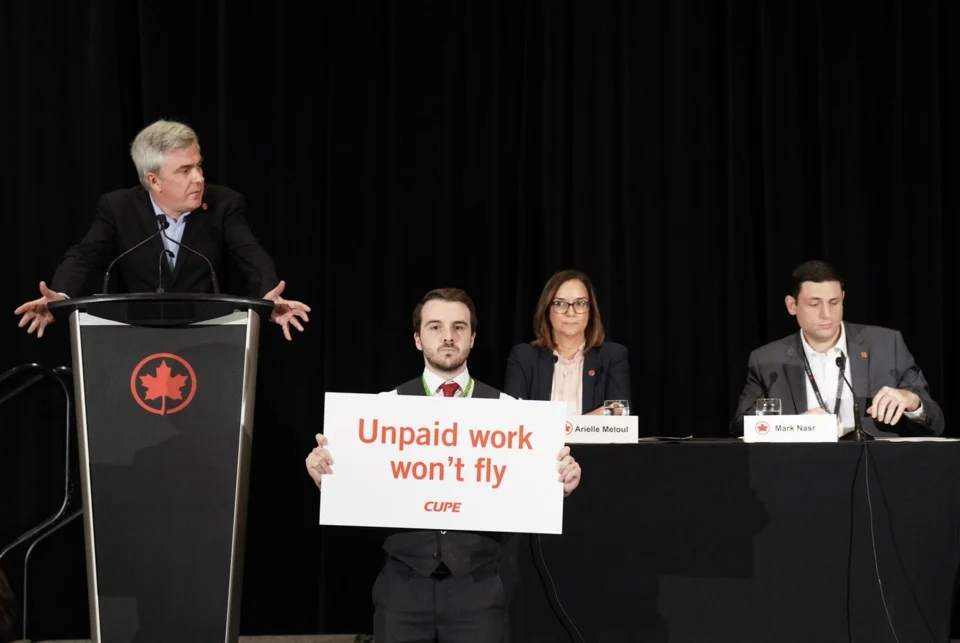
On August 5, CUPE’s Air Canada component announced its members had voted 99.7% in favour of strike action — a number that should have told everyone how this was going to go. The union said the vote reflected deep frustration after months of negotiations without result, “due to the airline’s refusal to fairly negotiate on key issues like unpaid work, work rules, and poverty-level wages.”
On August 13, CUPE issued a 72-hour strike notice. Air Canada responded with a 72-hour lockout notice of its own. The strike began on the morning of August 16, and the airline suspended operations at 1:30 AM EDT — more than 700 flights grounded before most Canadians had their coffee.
The Union’s Narrative — “Hours of Unpaid Labour”
Ask the flight attendants what the strike was about and the answer is blunt: they work hours they are not paid for.
Boarding, deplaning, delays on the tarmac, waiting between flights — much of a flight attendant’s working day happens on the ground, and the union says the airline’s pay structure treats those hours as free. CUPE’s Air Canada component president Wesley Lesosky put it this way: the government was “giving Air Canada exactly what they want — hours and hours of unpaid labour from underpaid flight attendants.”
CUPE National Secretary-Treasurer Candace Rennick went further, calling Ottawa’s intervention “absolutely shameful and a blatant betrayal” — a decision to intervene “on behalf of an already wildly profitable employer, while a predominantly female workforce fights tooth and nail for a path out of poverty.”
The Airline’s Narrative — “A Fair, Competitive Offer”
Air Canada’s version is the standard corporate one: the company made a fair offer, the union’s demands were unreasonable, and the travelling public should not be held hostage. The airline framed the government’s binding arbitration referral as the responsible path — “the most stable way to conclude this process,” as Hajdu herself put it.
From the airline’s perspective, the strike was an illegal disruption of a service Canadians depend on, and the CIRB’s orders vindicated that view. Air Canada estimated some 500,000 customers had flights cancelled — a number designed to make the union, not the company, the villain of the story.
Ottawa’s Narrative — “We Had No Choice”
Jobs Minister Patty Hajdu acted within hours of the strike beginning, exercising her authority under Section 107 of the Canada Labour Code to direct the Canada Industrial Relations Board to order the parties back to work and into binding arbitration.
“These parties have had months at the negotiation table. They’ve had support through the federal mediation service and they have been unable to cross the finish line,” Hajdu said. “Arbitration is the most stable way to conclude this process for Canadians.”
The CIRB ordered flight attendants back by 2:00 PM EDT on August 17. When the union refused, the Board declared the continued strike unlawful on August 18 and ordered a return by noon. Labour experts noted that Canadian unions had not been this defiant of a back-to-work order since 1978.
The Defiance — “If It Means Going to Jail, Then So Be It”
This is where the story stopped being a labour dispute and became a constitutional standoff. CUPE called the return-to-work order unconstitutional, vowed to continue the strike, and challenged the CIRB order in Federal Court. CUPE National President Mark Hancock refused to comply: “If it means folks like me going to jail, then so be it. If it means our union being fined, then so be it.”
Air Canada cancelled its planned Sunday restart. Passengers were told not to come to airports unless they had confirmed rebookings on other airlines — including Star Alliance partner United. In Calgary, the strike coincided with the Country Thunder music festival; hotels and flights were fully booked for days, and passengers trying to rebook on August 16 were told the earliest departure on other airlines was August 19.
The Timeline — August 2025
| Date | What happened |
|---|---|
| Aug 5 | CUPE announces 99.7% strike vote |
| Aug 13 | Union issues 72-hour strike notice; airline issues lockout notice |
| Aug 16, 1:30 AM EDT | Strike begins; Air Canada suspends operations |
| Aug 16 | Hajdu invokes Section 107; CIRB referral to binding arbitration |
| Aug 17, 2:00 PM EDT | CIRB return-to-work deadline — union defies it |
| Aug 18 | CIRB declares continued strike unlawful; orders return by noon |
| Aug 19 | Tentative deal reached; strike ends |
Related: WestJet Strike Vote 2026 — Flight Attendants Vote 99.4% Yes, August Long Weekend Now at Risk
Related: NordSpace Launch 2026 — Canada’s First Rocket Flight
Related: Newfoundland Wind Storm 2026 — Weekend Gusts Knock Out Power Across the Island
Who Was Right?
That is the question nobody in Ottawa wants to answer. The union says the government crushed a legal strike to protect a profitable corporation from a predominantly female workforce demanding pay for all hours worked. The airline says the union held half a million travellers hostage and defied the law. The government says arbitration was the only stable path.
What is not in dispute: the strike ended with a tentative deal on August 19 — meaning the two sides could, in fact, reach an agreement. They just needed the largest labour confrontation in recent Canadian aviation history to get there.
Maplestime will provide updates from the Air Canada labour story as arbitration outcomes and contract details are announced.
Have a tip about the Air Canada strike? Email [email protected]
Have a correction? Email [email protected]
The government ended a legal strike within hours to protect travellers — or to protect a profitable airline from paying its workers for every hour they work? Tell us in the comments. And share this with every Canadian who got stranded that weekend.
Enjoying Maplestime? Support independent Canadian journalism — no paywall, no corporate owners.