


By Ayomikun. O | November 2025 | Updated: November 2025 | No Comments | 5 Mins Read
Canadian politics news — Danielle Smith announced a grand pipeline bargain with Mark Carney, lost a federal cabinet minister over it within days, and is now surrounded by speculation she will call an early election before Albertans notice the pipeline to Prince Rupert may never get built. The next fixed election date is October 2027. Nobody in Edmonton believes she will wait that long.
By Maplestime News Desk | Canada | November 2025
Sources: Alberta Politics | Environmental Defence Canada | Last updated: November 2025
Key Takeaways
- Premier Danielle Smith announced a pipeline deal with Prime Minister Mark Carney to ship Alberta crude to the B.C. coast — Prince Rupert or Kitimat.
- Former federal environment minister Steven Guilbeault swiftly resigned from cabinet over the announcement.
- Critics argue the pipeline to Prince Rupert is unlikely ever to be built — and that Smith will call an early election before voters realize it.
- Alberta’s next fixed election date is October 2027, but speculation points to a possible vote as early as spring 2026.
- Ottawa reportedly prefers a southern route alongside the Trans Mountain expansion over the northern Prince Rupert route.
- Tens of thousands of Canadians have told Ottawa a new oil pipeline is not in the national interest.
The Grand Bargain — And the Resignation
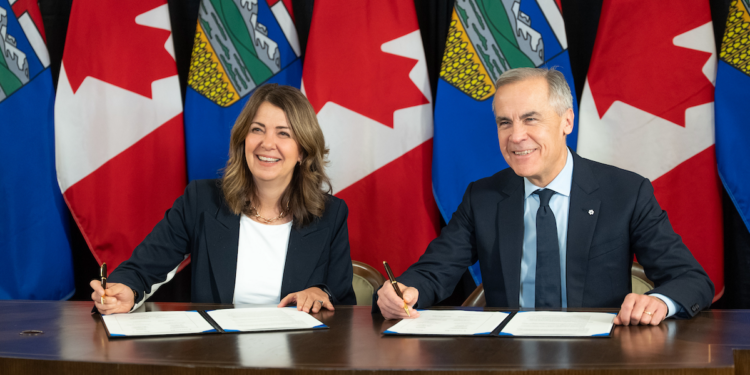
Danielle Smith must have experienced a strong feeling of déjà vu when she announced her grand pipeline bargain with Liberal Prime Minister Mark Carney — after all, she has switched teams before. But this was not a floor crossing. It was a handshake deal: Alberta would get its long-sought pipeline to tidewater, shipping crude from Alberta to Prince Rupert or Kitimat, opening routes to Asia and Europe. Tankers could cross the Pacific directly to Asian markets or sail south through the Panama Canal to reach Europe.
Smith pledged $14 million for early planning and suggested federal approval could come as early as next month, with final approval by May 2026. Alberta produces about 4.3 million barrels of oil per day, and oil and gas make up more than a quarter of its GDP. With pipelines forecast at full capacity by 2030, Smith argues new projects are essential.
The political cost arrived fast. Former federal environment minister Steven Guilbeault’s swift resignation from the federal cabinet was greeted with cheers in the Alberta Legislature — but it signalled something serious: the pipeline deal is already fracturing the federal Liberals, particularly their West Coast caucus in green-tinged Vancouver ridings.
Why the Pipeline May Never Be Built
Here is the uncomfortable part for the premier’s supporters: the economics and politics of a major new pipeline to Prince Rupert remain daunting.
- Indigenous opposition is real and organized. The Prince Rupert Gas Transmission pipeline and the Ksi Lisims LNG project have faced opposition and legal concerns from Gitanyow and Gitxsan hereditary leaders and environmental organizations — over salmon habitat, greenhouse-gas impacts, and the adequacy of consultation. Several First Nations have signalled they are prepared to take legal action.
- Ottawa is already backing away. Reports suggest the Liberals prefer a southern route from Alberta to southern B.C., running alongside the existing Trans Mountain expansion, rather than the ambitious northern route to Prince Rupert.
- Public opposition is measurable. At least 18,600 comments were submitted to the federal Major Projects office during a comment period open for less than two months, and over 43,800 emails opposing the pipeline have been sent to the federal government since the southern route was announced.
- B.C. is not on board. Premier David Eby called Smith’s pipeline scheme “an entirely political creation in the lead-up to their election for wedge politics at the expense of British Columbia and Canada’s economy.” Smith called Eby’s position un-Canadian. The war of words is not how pipelines get built.
The Early Election Theory
Alberta’s next fixed election date is not until October 2027. But speculation about a snap election has been circulating for months — and the theory is brutally simple: expect an early election call before Smith’s less devoted voters realize the pipeline everyone was celebrating is unlikely ever to be built.
Call it in spring 2026, campaign on the pipeline deal and standing up to Ottawa, and win a fresh mandate on the promise — before the promise has to survive contact with Indigenous title litigation, federal regulatory reality, and the brutal economics of building a megaproject no private company has committed to finance.
Layered underneath: fiscal pressures that will not disappear, separation rhetoric that tests party unity, and an opposition led by Naheed Nenshi waiting for the government to stumble. As one analysis put it, 2026 is shaping up not as a year of bold moves but as a year of managing uncertainty — and elections are how premiers try to convert uncertainty into mandates.
Related: Alberta Issues Invitations To Apply Under Law Enforcement Pathway
What To Watch
- The federal decision. Ottawa is expected to designate the pipeline project under the Building Canada Act — watch whether it is the northern or southern route that survives.
- The courts. Indigenous legal challenges could define the project’s timeline more than any press conference.
- The legislature calendar. If Smith starts clearing the decks — delaying inconvenient reports, spending big on announcements — take it as a signal.
- Spring 2026. The window the speculators keep naming.
Maplestime will provide updates from Alberta’s energy and election story as announcements are made.
Have a tip about Alberta politics? Email [email protected]
Have a correction? Email [email protected]
Is Danielle Smith about to call an early election on a pipeline that may never be built — or is this just how energy politics works in Canada now? Tell us in the comments. And share this with every Albertan who deserves to know what is actually happening before they vote.
