


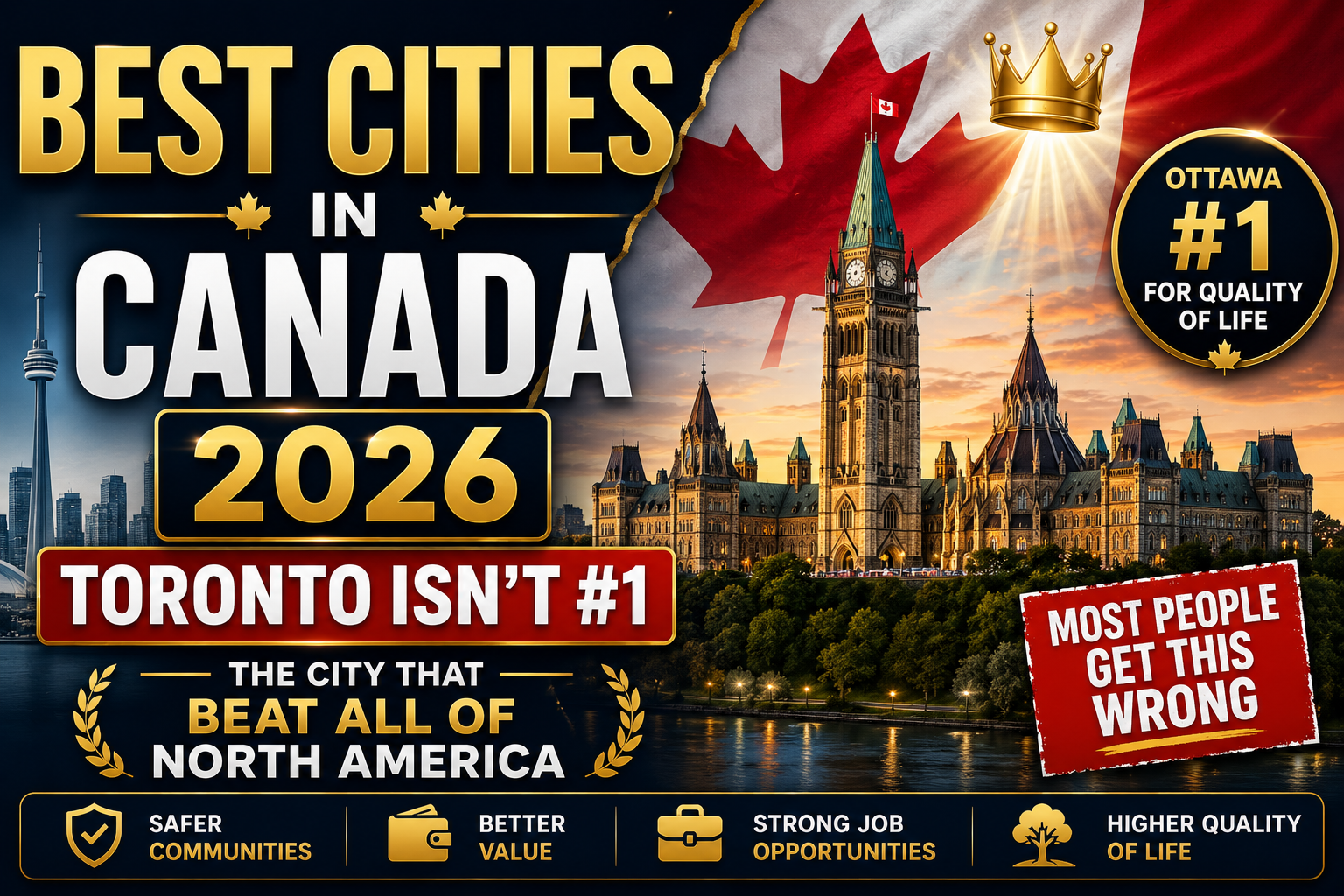
Canadian lifestyle news — here is what nobody tells you when you are deciding where to live in Canada. The cities everyone talks about are not necessarily the cities where life is best. Toronto has the most jobs. Vancouver has the best weather. But Ottawa just ranked number one for quality of life in all of North America — beating every American city on Numbeo’s index. And the best places to live in Canada right now according to a major 2026 study are not Toronto, Vancouver, or Montreal. They are smaller cities most people overlook. Here is the honest city-by-city breakdown — cost, jobs, safety, and whether the numbers actually make sense for your life.
By Maplestime Lifestyle Desk | Canada | May 25, 2026 Sources: Numbeo Quality of Life Index 2026 | WealthNorth | Moving2Canada | Narcity | Last verified: May 25, 2026
Key Takeaways
- Ottawa ranks first among all cities in North America for quality of life on the 2026 Numbeo Quality of Life Index — beating every Canadian and American city
- Quebec City is the safest city in Canada and the safest in all of North America in the 2026 rankings
- A major 2026 Canadian study found that the best quality of life in Canada is hiding in smaller cities — not the expensive major metros everyone assumes
- Calgary average detached home prices sit at $641,844 versus Toronto at $1.1 million and Vancouver at $1.2 million — the same salary goes dramatically further in Alberta
- The same $80,000 salary yields $61,200 take-home in Alberta versus $57,100 in Quebec because of provincial tax differences
- Winnipeg consistently ranks among the most affordable major cities in Canada — a genuine underrated option for newcomers and families
- Remote workers have the biggest advantage — pairing a Toronto-level salary with Prairie-level costs is the fastest path to financial independence in Canada right now
- Brandon, Manitoba’s second-largest city, continues to rank as one of the most affordable places to live in Canada
The Question Everyone Gets Wrong
When people ask where to live in Canada, they usually mean one of two things. They either mean where they have heard the name before — Toronto, Vancouver, Calgary — or they mean where the jobs are. Both of these are reasonable starting points. Neither is the complete picture.
The complete picture includes what your money actually buys you once you get there. How long your commute will be. How safe the neighbourhood feels. Whether you can afford to own a home or whether you will rent indefinitely. What the winters are like. Whether the city has a community that feels like yours.
A newcomer from Nigeria who arrives in Toronto with nursing qualifications and a strong support network in the Scarborough community is making a completely rational decision. A remote software developer from BC who moves to Winnipeg and buys a house for $380,000 — while keeping their Vancouver salary — is making one of the most financially intelligent decisions available to any Canadian right now.
There is no single best city in Canada. There is the best city for your income, your industry, your family situation, your risk tolerance, and what you actually want your daily life to look like. This guide gives you the data to figure out which one that is.
Related: How to Buy a House in Canada 2026 — Complete First Time Buyer Guide
Ottawa — The City That Surprised Everyone
The nation’s capital is not just Canada’s best city for quality of life — it is also ranked number one in all of North America, beating every American city on Numbeo’s 2026 Quality of Life Index. It scores highest in Canada for purchasing power, second-best for safety, and ranks well across the board in affordability, pollution, and housing.
That is not a small thing. Beating every American city — including cities with decades of marketing behind them as world-class destinations — on a comprehensive quality of life measurement says something real about what daily life in Ottawa actually looks like.
As Canada’s capital, Ottawa benefits from stable public sector jobs, providing income security and economic resilience. Residents enjoy shorter commute times, lower pollution, and excellent healthcare access. Extensive parks, trails, and proximity to Gatineau Park provide ample recreation opportunities.
The federal government is the anchor employer — which means Ottawa’s job market never experiences the boom-and-bust cycles that affect resource-dependent cities. Tech has also grown significantly in Ottawa over the past decade, with Shopify, Nokia, and a cluster of cybersecurity companies establishing a real presence. The city is genuinely bilingual in a way that opens both English and French-language career paths.
Housing sits well below Toronto and Vancouver but above Winnipeg and Prairie cities. A family that wants urban amenities, stable employment, Canada’s best measured quality of life, and a housing market that does not require a two-income household earning $200,000 to participate — Ottawa is the most compelling answer available in Canada right now.
Best for: Public sector professionals, tech workers, bilingual Canadians, families prioritizing safety and quality of life over nightlife and size.
Calgary — The Affordability Sweet Spot
Calgary lands inside most top-ten lists for its mix of opportunity and relative affordability, with average detached pricing near $641,844 against Vancouver’s $1.2 million and Toronto’s $1.1 million. Calgary continues to attract professionals, families, and immigrants seeking opportunity without the housing pressures seen in larger coastal cities.
The Alberta advantage goes beyond just housing. Provincial tax differences amplify the gap — the same $80,000 salary yields $61,200 take-home in Alberta versus $57,100 in Quebec. Alberta has no provincial income tax, which means every dollar of income goes further in Calgary and Edmonton than the same income in Ontario, BC, or Quebec.
The 2026 Quality of Life Index data shows that Calgary scores well across most categories with the cost of living and climate as the main drags on the overall position. Healthcare access, safety, and commute times all sit at or above the Canadian average.
The climate caveat is real. Calgary winters are genuinely cold and the city is exposed to prairie winds that make it feel colder than the thermometer reads. But Calgary also gets more hours of sunshine than almost any other major Canadian city — the famous Chinook winds that bring sudden warm spells in January are real and regular. People who grew up in cold climates and are not afraid of winter find Calgary more manageable than its reputation suggests.
Best for: Energy professionals, entrepreneurs, remote workers who want urban infrastructure at prairie price points, families prioritizing home ownership over proximity to ocean or mountains.
Quebec City — Canada’s Safest City
Quebec City scored as the safest city in Canada and the safest in all of North America in the 2026 rankings. The city pairs that with high purchasing power scores and overall affordability that places it among the better-balanced Canadian markets. Quebec City’s housing market sits well below Montreal’s — average detached pricing in 2026 runs in the high $400,000s, which is roughly half of Toronto’s and a meaningful discount to Calgary.
The quality of life in Quebec City is genuinely exceptional for people who either already speak French or are committed to learning it. The old city, the arts scene, the food culture, the outdoor activities — skiing in the Laurentians in under an hour, summer festivals that attract hundreds of thousands of visitors — and a housing market that is still accessible to middle-income families make Quebec City one of the best quality-of-life propositions in the country.
The trade-off is the language requirement, which makes the city a stretch for relocators not already comfortable in French. The local job market is concentrated in provincial government, healthcare, education, and tourism.
For newcomers who qualify for the French-language Express Entry draws — which have been cutting at CRS scores as low as 379 in 2026 — relocating to Quebec City as part of a French language immigration strategy is genuinely compelling. The lower housing costs, exceptional safety, and strong community make the language investment worthwhile.
Best for: French speakers or committed French learners, families prioritizing safety above all else, newcomers pursuing the French-language immigration pathway, people who love European-style urban culture.
Vancouver — Beautiful, Expensive, Worth It for Some
Vancouver and Victoria deliver Canada’s two best climate profiles, with Victoria scoring as the cleanest city and the best climate by a notable margin. Both cities pay for those advantages with the highest housing costs in the country relative to local incomes.
This is the honest Vancouver summary. The city is objectively gorgeous. Mountains visible from downtown. Ocean access. Mild winters where it rains instead of snows. A cosmopolitan food scene that rivals any city in North America. A tech sector that has matured into genuine depth, with Amazon, Microsoft, Apple, and dozens of Canadian tech companies employing tens of thousands.
But housing in Vancouver in 2026 remains the most expensive in Canada at average detached prices of $1.2 million. The affordability math simply does not work for most middle-income Canadians without family wealth, significant savings, or a high-income dual-earning household. Many people who love Vancouver find themselves in the uncomfortable position of having to choose between the city they love and the financial security they need.
For high earners in tech, finance, or medicine — people whose income genuinely supports Vancouver prices — the city delivers everything it promises. For most Canadians who are not in that income tier, Vancouver is a city best appreciated as a visitor while building wealth somewhere more affordable.
Best for: High-income tech and finance professionals, people who absolutely cannot tolerate cold winters, those with family support networks or existing property in the city.
Toronto — The Trade-Off Capital
Toronto is where most of the jobs are. It is also where most of the financial stress of Canadian urban life concentrates.
The Greater Toronto Area is Canada’s economic engine — the country’s largest financial centre, the hub of Canadian media, advertising, tech, healthcare, and professional services. If your career is in any of these fields, the Toronto job market offers a depth of opportunity that no other Canadian city can match.
Toronto ranks at the bottom of the 2026 livability study — scoring zero out of 100. The cities punching hardest on livability are not the expensive ones. The best quality of life in Canada right now is hiding in smaller cities.
The zero score does not mean Toronto is unliveable — it means that on the specific combination of financial security, safety, and livability indicators measured, Toronto underperforms dramatically relative to its size and economic output. High rent, long commutes, and the grinding financial pressure of living in Canada’s most expensive rental market weigh heavily on everyday quality of life.
Major centres like Vancouver are expensive, while mid-sized cities like Montreal, Calgary, Ottawa, and Edmonton are more affordable.
The rational approach to Toronto in 2026 is to use it intentionally — live there while building career capital and income that eventually supports a transition to a more affordable city. Many Canadians spend their late twenties and early thirties building careers in Toronto and then move to Hamilton, Kitchener-Waterloo, London, or Winnipeg once they have remote flexibility. The career foundation is built in Toronto. The actual life is built somewhere cheaper.
Best for: Career-focused young professionals in finance, tech, media, and professional services who prioritize income growth over lifestyle balance in their early career years.
The Hidden Gems — Where Quality of Life Is Actually Hiding
Quality of life in Canada for 2026 is hiding in smaller cities, according to the dNOVO Group study. After the top ten, the next most liveable cities in Canada are Burnaby, Gatineau, Saskatoon, Kitchener, London, Halifax, and Quebec City.
Winnipeg — The Underrated Option
Winnipeg does not get the attention it deserves as a Canadian city option. Regina and Winnipeg are top contenders for most affordable cities given cheaper housing, lower cost of living, and city lifestyles.
The honest Winnipeg pitch goes like this. You can buy a detached house in a good neighbourhood for $350,000 to $450,000. The commute across the whole city takes twenty-five minutes on a bad day. The city has a genuine arts scene, a professional sports team, a diverse and growing newcomer community, and a cost of living that lets a household on two average Manitoba salaries actually save money every month.
The Nigerian community in Winnipeg has grown significantly over the past decade and continues to grow — making it one of the more welcoming cities in Canada for West African newcomers specifically. The city’s Newcomer Welcome Network and immigration settlement infrastructure are well-developed. Manitoba’s Provincial Nominee Program has historically had lower CRS thresholds than Ontario and BC streams.
The winters are real. Winnipeg winters are among the most extreme in any major Canadian city. But Winnipeggers will tell you that once you have the right gear — which takes one winter to figure out — the cold becomes manageable and the summers are genuinely spectacular.
Best for: Newcomers from Africa, South Asia, and the Philippines building community in Canada, families prioritizing home ownership and financial security over city size, remote workers seeking the best affordable Canadian city lifestyle.
Halifax — Atlantic Canada’s Rising Star
Halifax has quietly become one of the most talked-about Canadian cities among young professionals and newcomers over the past three years. The combination of ocean access, a genuine university town energy, lower housing costs than central Canadian cities, and an increasingly strong tech and healthcare job market has driven significant interprovincial and international migration.
Cities like Moncton, Saint John, as well as Winnipeg and Regina, offer lower housing costs, affordable rent, and a good quality of life. These areas often have less traffic, lower taxes, and a strong sense of community.
Halifax specifically offers something the Prairies cannot — proximity to the Atlantic Ocean, a milder winter than central Canada, and a genuinely walkable downtown that feels European in scale. Housing is not as cheap as it was three years ago — the migration surge has pushed prices up — but it remains significantly below Ontario and BC.
Nova Scotia’s Provincial Nominee Program has been one of the more accessible pathways for skilled newcomers in Atlantic Canada, and the federal Atlantic Immigration Program provides an additional route specifically designed to address labour market gaps in the region.
Best for: Young professionals in tech, healthcare, and professional services, newcomers seeking Atlantic Canada’s immigration pathways, people who want ocean access at Canadian Prairie prices.
Kelowna — The Outdoor Lifestyle City
Kelowna ranks at the top of the 2026 livability study among all Canadian cities measured.
Kelowna in BC’s Okanagan Valley offers something genuinely unique in Canada — a sunny, dry climate closer to what you would expect in the Pacific Northwest of the United States, surrounded by lakes, mountains, and one of Canada’s premier wine regions. The city has grown significantly over the past decade as remote workers discovered they could enjoy BC’s outdoor lifestyle without paying Vancouver prices.
Housing in Kelowna is still expensive by national standards but meaningfully below Vancouver. The trade-off is a smaller job market concentrated in tourism, healthcare, retail, and agriculture — meaning Kelowna works best for remote workers, retirees, entrepreneurs, and people in industries with sufficient local demand.
Best for: Remote workers in tech and professional services, retirees seeking warm and sunny Canadian conditions, outdoor lifestyle enthusiasts who cannot stomach Vancouver prices.
The Remote Worker Advantage — The Most Underused Canadian Strategy
Remote workers have the biggest advantage — pairing a Toronto-level salary with Prairie-level costs is the fastest path to financial independence in Canada right now.
This is the Canadian lifestyle arbitrage opportunity of 2026. A software engineer earning $130,000 remotely for a Toronto company who lives in Winnipeg pays $350,000 for a house instead of $900,000 for a condo. They save $2,000 to $3,000 per month on housing costs alone. Over ten years, that difference compounds into a retirement account or investment portfolio that a Toronto-based peer with the same salary cannot build — because all the discretionary income is going to rent or mortgage.
Remote work has normalized significantly since 2020. If your job can be done from anywhere — and many can — choosing your city based on quality of life and affordability rather than proximity to an office is one of the most financially impactful decisions available to any Canadian right now.
The Quick Comparison — Six Cities at a Glance
| City | Avg Home Price | Take-Home ($80K) | Quality of Life Rank | Best For |
|---|---|---|---|---|
| Ottawa | ~$650,000 | ~$58,200 | #1 Canada, #1 N. America | Stability, families, federal jobs |
| Calgary | ~$641,844 | ~$61,200 | Top 5 Canada | Affordability, take-home pay |
| Quebec City | ~High $400Ks | ~$57,100 | Safest in N. America | Safety, French speakers |
| Vancouver | ~$1,200,000 | ~$59,000 | Top climate | High earners, mild winters |
| Winnipeg | ~$380,000 | ~$57,400 | Best value | Newcomers, families, affordability |
| Halifax | ~$500,000 | ~$57,000 | Rising | Young professionals, Atlantic Canada |
Sources: Numbeo Quality of Life Index 2026 | WealthNorth — Best Cities to Live in Canada 2026 | Moving2Canada — Most Affordable Cities Canada 2026 | Narcity — Best Cities Canada 2026 | liv.rent — Most Affordable Places Canada 2026 | Ansari Law — Top Canadian Cities Quality of Life | Data current as of May 2026.
This article is for informational purposes only. Costs, rankings, and conditions change — always verify current data before making any relocation decision.
Have a correction or a city we missed? Email [email protected]
Where are you living in Canada right now — and where do you wish you were? If you could move anywhere in Canada tomorrow, which city would you choose and why? Tell us in the comments. And share this with every newcomer or Canadian who is trying to figure out where life actually makes sense in 2026.
