




Canadian lifestyle news — the first time someone asked Kemi if she wanted a double-double, she thought they were talking about a burger. They were standing in line at Tim Hortons. They were talking about coffee. She smiled, nodded, and ended up with a drink she did not order and no idea what had just happened. This is how Canadian slang works. It is not dramatic. It is not rude. It just exists quietly in everyday conversation, assuming everyone already knows — and leaving newcomers nodding along and quietly confused. This guide fixes that.
By Maplestime Lifestyle Desk | Canada | May 25, 2026 Sources: Berlitz Canada | Remitly | True Canadian Finds | Last verified: May 25, 2026
Key Takeaways
- “Eh” is not a joke — it is a genuine grammatical tool Canadians use to invite agreement, soften statements, and keep conversation flowing
- A loonie is a one-dollar coin named after the loon bird printed on it — a toonie is a two-dollar coin
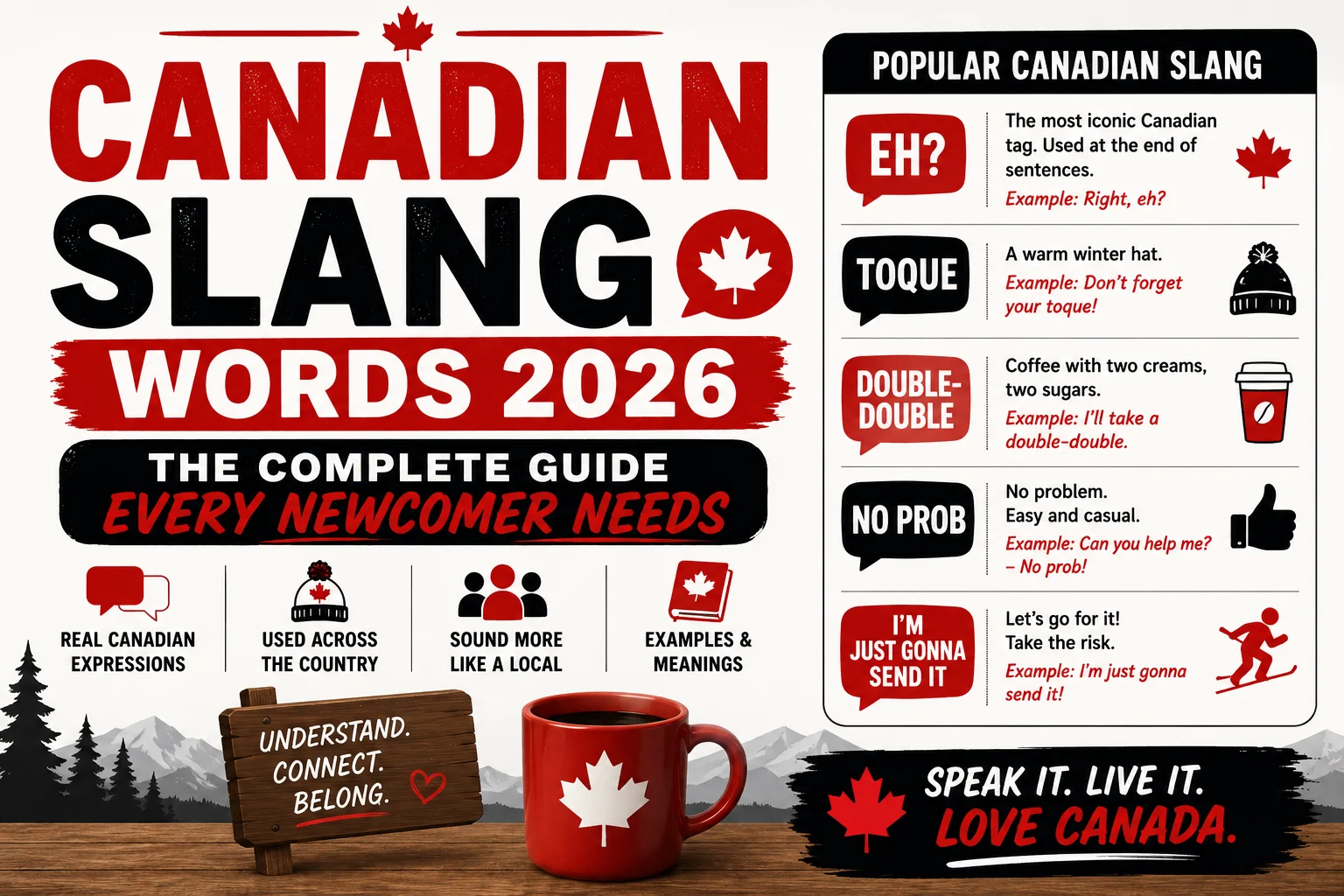
- A double-double is a coffee with two creams and two sugars — ordering one at Tim Hortons marks you as someone who has figured things out
- A toque is a knitted winter hat — not knowing this word is fine until January hits and someone asks if you have yours
- “Sorry” in Canada is not always an apology — it is social lubrication that keeps the peace and means roughly “excuse me” or “I acknowledge you”
- Regional slang varies significantly — “bunny hug” is a hoodie in Saskatchewan, “dep” is a convenience store in Quebec, and “skookum” means excellent in British Columbia
- Classic Canadianisms remain part of daily vocabulary — loonie, toonie, double-double, and toque appear in casual conversation across the country
- The fastest way to sound unnatural is to use too much slang at once — start with five words and use them correctly before adding more
The Story That Explains Everything
Kemi had been in Canada for three weeks when her colleague invited her to grab Timmies before their morning meeting. She did not know what Timmies was. She did not want to ask because she had already asked too many questions that week and she was tired of feeling like the person who did not know things.
She said yes. She followed her colleague to a coffee shop with a red and white sign. A Tim Hortons. She ordered based on what her colleague ordered — a medium double-double. She sat down with her coffee, took a sip, and discovered it was significantly sweeter than anything she had ever voluntarily put in her body.
She drank it anyway. She smiled and said it was great. Her colleague seemed pleased.
Six months later Kemi knew exactly what a double-double was, had developed an opinion about whether timbits were overrated (they are not), and used “eh” at the end of sentences without thinking about it. The language had absorbed into her life the way all language does — through repetition, small confusions, and eventually the quiet pleasure of understanding.
This is the guide she wished someone had given her on day one.
Related: How to Survive a Canadian Winter — The Complete Honest Guide for Newcomers
Related: Dating in Canada 2026 — The Honest Guide to Apps, Culture and What to Actually Expect
The Essential Canadian Words — Learn These First
Start with eh, loonie, toonie, double-double, washroom, and pop. These are widely recognized and easy to use without sounding forced.
Here is every one of them explained properly.
Eh — The Word That Defines a Nation
This iconic and distinctive element of Canadian slang is often used as a conversational filler or question tag at the end of a statement. It holds a unique place in Canadian culture, instantly recognizable and endearing to both Canadians and visitors.
“Eh” is pronounced exactly like the letter A. It appears at the end of a sentence — not the beginning, not the middle — and it does several different things depending on the context.
It can invite agreement: “Nice day today, eh?” — meaning “don’t you think?”
It can check comprehension: “So we take a left at the light, eh?” — meaning “are you following me?”
It can soften a statement: “That was a pretty tough meeting, eh” — meaning “I acknowledge this was difficult and I assume you feel the same.”
“Eh?” functions as a question tag inviting agreement, turning statements into gentle questions, or simply checking if the listener is following along.
The key is that “eh” is never aggressive. It is friendly. It assumes you and the other person are on the same page and invites them to confirm it. Using it correctly marks you as someone who has figured out how Canadians communicate — which is warmly, indirectly, and always with an implicit invitation for the other person to participate.
Do not force it. Listen for it first. When you naturally hear yourself thinking “eh” at the end of a sentence — use it. That is when it sounds right.
Loonie and Toonie — Your Daily Coins
Loonie: $1 CAD and Toonie: $2 CAD coins. “Parking is $2, do you have a toonie?”
The loonie is the Canadian one dollar coin. The name comes from the loon bird shown on the coin, and the word is now so normal that many Canadians barely think about it as slang anymore.
These are not slang in the elevated sense — they are just what Canadians call their coins. If you ask for a dollar coin and call it a “one-dollar coin” nobody will be confused. But if someone asks if you have a loonie for the parking meter and you look blank — you will lose thirty seconds of your day while they explain it.
Keep a few loonies and toonies in your pocket. You will often need them for shopping carts at the grocery store, parking meters, or coin laundry — many of which do not accept cards for small transactions.
This is genuinely practical advice. Freshco, No Frills, and many Canadian grocery stores require a loonie deposit to use a shopping cart. You put the coin in, the cart unlocks, and you get it back when you return the cart. Arriving at a grocery store in Canada with no loonies is a quietly humbling experience.
Double-Double — The Coffee Order That Identifies You
Double double means a coffee with two creams and two sugars. It is closely tied to Canadian coffee culture and especially to the well-known coffee and donut routine that many people recognize right away.
A double-double is a Tim Hortons order. Two creams. Two sugars. Served in a red cup. If you order one correctly at Tim Hortons you will receive a small nod of recognition from the person behind the counter — the quiet acknowledgment that you have figured out one of Canada’s most beloved shorthand phrases.
Variations include a single-single (one cream, one sugar), a triple-triple (three of each — for people who are serious), and a black which requires no special terminology at all.
Tim Hortons — universally called Timmies — is where Canadians have conversations, kill time between appointments, and drink coffee that is genuinely unremarkable but somehow irreplaceable. Understanding the double-double order is your entrance fee to Canadian coffee culture.
Toque — The Hat That Keeps You Alive
In many parts of Canada, winter is not just a background detail — it shapes daily life. So a toque is not merely a hat. It is part of surviving the cold with a little dignity and style.
Pronounced “took” — not “toke” and not “toh-kway.” A toque is a knitted winter hat. What most people from warmer climates would call a beanie, a winter hat, or simply a hat — Canadians call a toque.
The importance of the toque is directly tied to the reality of long, cold Canadian winters. It is a practical piece of survival gear that has become a defining symbol of Canadian coziness.
If someone tells you not to forget your toque before you go outside in January in Winnipeg — listen to them. This is not small talk. This is a genuine public health recommendation delivered in casual language.
Washroom — Not Bathroom, Not Restroom
This one catches people off guard because it is not obviously slang — it just sounds like a normal word. In Canada the public toilet is a washroom. Not a bathroom — that has a bath in it. Not a restroom — nobody is resting. Washroom.
If you ask for the bathroom in a Canadian restaurant, everyone will understand. But washroom is what you will hear, and using it yourself is one of the quietest ways to signal that you are paying attention.
Pop — It Is Not Called Soda Here
In Canada, carbonated soft drinks are called “pop” not “soda.” You will hear this in everyday conversation across most of the country.
Ask for a soda at a Canadian convenience store and they will understand. Ask for a pop and you sound like you grew up here. The distinction matters more in casual conversation than in formal settings — but knowing it means you will not do a double take the first time someone offers you a pop.
Timmies — The National Institution
Short for Tim Hortons, Canada’s beloved coffee and donut chain. “Let’s grab breakfast at Timmies.”
Tim Hortons is not just a coffee chain. It is a cultural institution with the same emotional weight in Canada that certain fast food chains carry in other cultures. Calling it Timmies is affectionate shorthand that signals familiarity.
You do not need to love Tim Hortons to live in Canada. But you do need to know what Timmies means — because you will hear it in the first week.
Keener — The Enthusiastic One
A person who is very eager or enthusiastic, especially about school or work. “She is such a keener — always has her homework done early.”
Keener can be said with affection or with gentle teasing depending on the tone. If your Canadian colleague calls you a keener for arriving early to a meeting — take it as mild ribbing rather than a genuine criticism. It means they have noticed your enthusiasm.
Beauty — The Highest Compliment
Beauty is used to say something is good, or in place of awesome. “What a beauty” — or if you really want to sound Canadian: “Beauty, eh?”
Beauty is a compliment applied to people, situations, plays in hockey, and anything else that exceeds expectations. A beautiful goal in hockey is “what a beauty.” A friend who does you a favour is “what a beauty.” The sunset over Lake Ontario is — also a beauty.
“Beauty, eh?” said together is the most Canadian sentence that can be constructed in the English language.
Hydro — Your Electricity Bill
Hydro means electricity. This is a common term in Ontario. “The hydro bill came today.”
In most of Ontario and several other provinces, electricity comes from hydroelectric power — power generated by water. Over time “hydro” became the word for electricity itself regardless of how it was generated. Your electricity bill in Ontario is your hydro bill. The electricity company is Ontario Hydro or Hydro One. If your landlord asks whether the hydro is included in your rent — they are asking about electricity.
Click — A Kilometre
Click means kilometre. “The trail is five clicks long.”
Borrowed originally from military usage, a click is a kilometre. You will hear this most in casual conversation about distances — how far away something is, how long a drive takes — rather than in formal contexts. If a Canadian tells you something is “about ten clicks away” they mean ten kilometres.
The 6ix — Toronto’s Name for Itself
Toronto’s nickname, popularized by rapper Drake. “Welcome to the 6ix!”
The 6ix refers to Toronto’s original area codes — 416 and 647. Drake popularized the term globally through his music and it stuck. Torontonians use it with varying degrees of irony. If you are in Toronto and someone mentions the 6ix — you are in the right place.
Regional Slang — Canada Is Not One Country Linguistically
This is where Canadian language gets genuinely interesting. The country is enormous and the regional variations are significant enough that a phrase that makes perfect sense in Saskatchewan will confuse someone from Nova Scotia.
Quebec — The Dep
Dep is short for dépanneur, meaning convenience store in Quebec.
Quebec has its own entire linguistic universe — a fact that surprises newcomers who expected Canada to be uniformly English. In Montreal and the rest of Quebec, a convenience store is a dep. The culture around the dep — open late, selling beer in Quebec where convenience stores can sell alcohol — is distinctly Québécois and worth understanding if you live anywhere near Quebec.
Saskatchewan — The Bunny Hug
Bunny hug means hoodie in Saskatchewan.
A hoodie — a hooded sweatshirt — is called a bunny hug in Saskatchewan. Nowhere else in Canada uses this term with any regularity. If you move to Saskatoon or Regina and someone asks to borrow your bunny hug — they want your hoodie, not anything involving rabbits.
British Columbia — Skookum
Skookum means great or strong in British Columbia.
Borrowed from Chinook Jargon — a trade language developed between Indigenous peoples and European settlers in the Pacific Northwest — skookum means strong, excellent, or impressive in BC. If a BC local calls something skookum, they mean it is genuinely great. If they call you skookum — you have done something right.
Atlantic Canada — The Kitchen Party
Kitchen party is a term from Atlantic Canada describing an informal gathering.
In Atlantic Canada — Nova Scotia, New Brunswick, Prince Edward Island, and Newfoundland — a kitchen party is an impromptu gathering in someone’s kitchen involving music, food, and company. The kitchen is where Maritime social life happens. Being invited to a kitchen party is the warmest possible welcome into Atlantic Canadian culture.
Newfoundland specifically has an entire dialect of English — Newfoundland English — that is distinct enough to genuinely confuse even other Canadians. If you move to or visit Newfoundland, expect a linguistic adjustment period all its own.
The “Sorry” Phenomenon — Canada’s Most Misunderstood Word
“Sorry” isn’t always an apology. It functions as social lubricant maintaining harmony — not an admission of fault.
This is one of the most culturally important things to understand about Canadian communication. In many cultures, “sorry” is a meaningful word reserved for genuine regret. In Canada, “sorry” is used the way punctuation is used — frequently and without particular emotional weight.
A Canadian who bumps into a door that was already closed will say sorry to the door. A Canadian who almost gets hit by a car will apologise to the driver. This is not weakness. It is a deeply ingrained social reflex that prioritises harmony and acknowledges the presence of others.
When a Canadian says sorry to you, they are usually not admitting fault — they are acknowledging that something happened and that your experience of it matters to them. Understanding this saves significant confusion.
Canadian Workplace Language — The Indirect Style
Indirect communication defines Canadian workplace culture. Softened language masks direct disagreement, requests, and criticism.
This is the area where newcomers often miss the most signals — because the gap between what a Canadian says and what they mean can be significant.
Understatement characterises Canadian feedback. “Not bad” means good. “Pretty good” means excellent.
A manager who says your report was “not bad” is giving you a genuine compliment. A colleague who says something is “a bit of a challenge” means it is a serious problem. “I wonder if we might consider” means “please do this.” “That is an interesting approach” often means the speaker disagrees with you.
Learning to read Canadian workplace indirectness is one of the most valuable cultural skills a newcomer can develop — and it takes time and attention to get right.
The Words to Avoid — A Brief Warning
Trying to use too much slang at once is one of the fastest ways to sound unnatural. Instead of constructing a sentence with “hoser,” “toque,” and “two-four,” just start small.
A few Canadian slang terms have aged out of comfortable usage. “Hoser” — a mild insult popularised by the old SCTV sketch characters Bob and Doug McKenzie — sounds dated and slightly performative when used in 2026. “Giv’er” — meaning to go hard at something — works in certain contexts but sounds forced when used by someone who did not grow up hearing it.
The simple rule is this. Listen first. Notice which words the Canadians around you actually use in their daily conversation. Add those words to your vocabulary. Skip the ones that sound like someone trying to sound Canadian rather than actually being Canadian.
Canadian slang is usually about warmth, not performance. It sounds best when it feels natural, polite, and easy. Listen first, copy the rhythm, and use the words in the right setting. That is where the real magic happens.
The Quick Reference Guide — All the Words
| Word | Meaning | Example |
|---|---|---|
| Eh | Question tag or agreement invite | “Cold today, eh?” |
| Loonie | One dollar coin | “Got a loonie for the cart?” |
| Toonie | Two dollar coin | “Parking is a toonie” |
| Double-double | Coffee with 2 creams 2 sugars | “One medium double-double please” |
| Toque | Knitted winter hat | “Grab your toque — it’s cold” |
| Timmies | Tim Hortons | “Meet me at Timmies” |
| Washroom | Public toilet | “Where’s the washroom?” |
| Pop | Carbonated soft drink | “Want a pop?” |
| Keener | Eager enthusiastic person | “Such a keener, already finished” |
| Beauty | Excellent, impressive | “What a beauty, eh?” |
| Hydro | Electricity | “Hydro bill is due” |
| Click | Kilometre | “About five clicks away” |
| Bucks | Dollars | “That’ll be twenty bucks” |
| The 6ix | Toronto | “Grew up in the 6ix” |
| Dep | Convenience store (Quebec) | “Grab it at the dep” |
| Bunny hug | Hoodie (Saskatchewan) | “Toss me my bunny hug” |
| Skookum | Great, excellent (BC) | “That hike was skookum” |
| Kitchen party | Informal social gathering (Atlantic) | “Kitchen party Friday night” |
| Sorry | Acknowledgement, not always apology | “Sorry, just squeezing past” |
| Runners | Sneakers/athletic shoes | “Wear your runners” |
| Two-four | Case of 24 beers | “Grab a two-four for the weekend” |
| Pogey | Employment insurance | “He’s on pogey right now” |
| Chesterfield | Sofa or couch (older usage) | “Sit on the chesterfield” |
| Going to the cottage | Spending time at a lakehouse | “Cottage country this weekend” |
Sources: Berlitz Canada — Modern Canadian Slang 2026 | Remitly — Common Canadian English Slang | True Canadian Finds — 50 Canadian Slang Words | Contiki — 59 Canadian Slang Words | Rishi Immigration — Canadian Slang for International Students | Data current as of May 2026.
Have a correction or a regional expression we missed? Email [email protected]
Which Canadian slang word confused you most when you first arrived — or which one do you use every day now without thinking? Share in the comments. And send this to every newcomer in your life who is still nodding along to things they do not fully understand yet.
Enjoying Maplestime? Support independent Canadian journalism — no paywall, no corporate owners.