


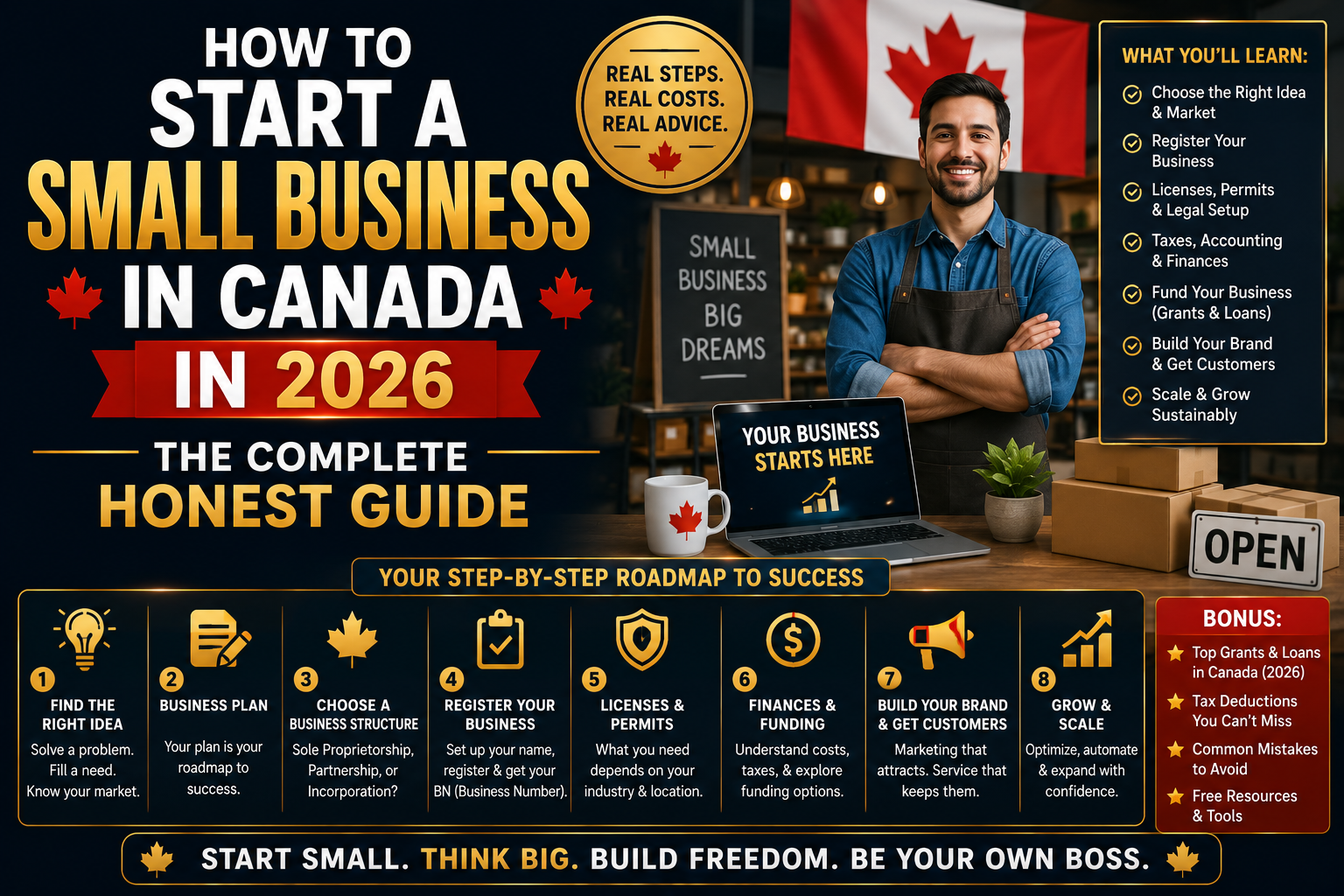
Canadian business news — somewhere between the idea and the first invoice, most people get stuck. Not because starting a business in Canada is actually that complicated. But because the information is scattered across a dozen government websites, everyone online has a different opinion, and the anxiety of doing something wrong with real money on the line makes the whole thing feel bigger than it is. Here is the straightforward truth — a sole proprietorship in Canada can be registered in one to three days for as little as $35. A corporation takes a bit longer and costs more. Neither requires a lawyer unless you want one. Here is every step, explained honestly, so you can stop planning and start.
By Maplestime Business Desk | Canada | May 25, 2026 Sources: Canada.ca Business | WealthNorth | CIC News | Corpify| Last verified: May 25, 2026
Key Takeaways
- Registering a sole proprietorship in Canada takes one to three days and costs as little as $35 in Quebec to $100 in Manitoba — the fastest and cheapest way to start operating legally
- Incorporation costs $200 federally or $150 to $400 provincially — but unlocks the small business tax rate of roughly 12 to 13% on the first $500,000 of profit versus your personal marginal rate of 30 to 50%
- The general rule is to start as a sole proprietorship until your business consistently earns $50,000 to $75,000 in annual profit — at that point incorporation’s tax advantages start outweighing the added cost
- Once annual revenue exceeds $30,000 you must register for GST/HST and collect sales tax from customers
- Canada Pension Plan contributions for self-employed individuals in 2026 are 5.95% of net earnings — you pay both the employee and employer share
- Permanent residents can start and run a business in Canada without restriction — work permit holders need to check their permit conditions carefully before launching
- The Business Development Bank of Canada offers financing and advisory services specifically for small and medium Canadian enterprises
- Retrofitting messy bookkeeping records at tax time costs far more than setting up a system properly from day one
The Day Marcus Decided to Stop Waiting
Marcus had been doing graphic design work on the side for two years. Small jobs here and there. A logo for a restaurant in his neighbourhood. A website for a friend’s landscaping company. Social media assets for a local boutique. The work was good. The clients kept referring him to other clients. And then one afternoon a marketing agency in Calgary emailed and asked if he had a business number.
He did not. He had been operating in a grey area — doing real work, earning real money, and paying taxes on it as employment income on his personal return. The Calgary agency would not work with him without a business number. They needed to pay a registered business, not an individual.
Marcus registered his sole proprietorship that same afternoon. It took about forty-five minutes online and cost $60. Three weeks later he was invoicing the Calgary agency for $3,200 on his first contract.
The business was always there. What changed was the paperwork.
This guide is for every Canadian — newcomer or born here — who has an idea, a skill, or a side hustle that is ready to become something real.
Related: Best Side Hustles in Canada 2026 — Real Income, Real Platforms
Step 1 — Validate the Idea Before You Register Anything
The first step in starting a business in Canada is not registration. It is making sure someone will actually pay you for what you plan to offer.
This sounds obvious. It is not. A significant number of people spend weeks choosing a business name, registering it, designing a logo, and building a website before ever having a single real conversation with a potential customer. Then they discover the market does not want what they built — or that seventeen competitors are already doing it better.
Before you register anything, answer three questions honestly.
Who specifically would pay for this? Not “small businesses in Canada” — that is two million companies. Who specifically? A 45-year-old restaurant owner in Winnipeg who needs help with Instagram? A Nigerian newcomer who needs accounting help in their first year? The more specific the answer, the more real the market.
What are they paying similar services right now? Find your three closest competitors. What do they charge? What do they do well? Where are the gaps you can fill? This research takes a weekend and saves months of building something nobody wants.
Can you reach these people? A great service offered to an unreachable market is still a failure. Think about where your potential customers actually are — which Facebook groups, which Reddit communities, which neighbourhoods, which professional associations — and whether you can actually get in front of them.
If you can answer all three questions specifically and honestly, you have a real business idea. If you cannot, spend more time on the idea before spending money on the registration.
Step 2 — Choose Your Business Structure
This is the decision most people overthink. There are really only two practical options for most small business owners in Canada starting out — a sole proprietorship or a corporation. Here is the honest breakdown.
Sole Proprietorship — Start Here Unless You Have a Specific Reason Not To
A sole proprietorship is the simplest business structure in Canada. One person owns and runs the business with no legal separation between them and the business. All business income is reported on the owner’s personal T1 return, and the owner is personally responsible for all debts and legal obligations the business incurs.
The advantages are speed, simplicity, and cost. You can be registered and operating within a day or two. The paperwork is minimal. The accounting is straightforward — your business income goes on a T2125 Business Income form attached to your personal tax return.
The disadvantages are liability and taxes. Because there is no legal separation between you and the business, a client who sues the business is suing you personally. And because business income is taxed at your personal marginal rate, once your business is consistently profitable you start paying more tax than you would through a corporation.
The practical rule is straightforward. Start as a sole proprietorship unless your business consistently earns $50,000 to $75,000 in annual profit, at which point the tax deferral from incorporation starts to meaningfully outweigh the added accounting costs.
Corporation — When the Numbers Justify It
A corporation is a separate legal entity from its owner. That separation limits the shareholder’s personal liability and allows the corporation to be taxed at lower corporate rates — roughly 12 to 13% on the first $500,000 of profit versus your personal marginal rate of 30 to 50%.
That tax difference is the core argument for incorporation. On $100,000 in business profit, a sole proprietor in Ontario at a 43% marginal rate pays roughly $43,000 in tax. The same profit earned through a corporation pays roughly $13,000 in corporate tax — leaving $87,000 inside the corporation to reinvest, grow, or eventually pay yourself through dividends when your personal tax situation is more favourable.
The costs of incorporation include $200 federally or $150 to $400 provincially, plus $1,000 to $3,000 if you use a lawyer, and $1,000 to $5,000 per year for a corporate tax return versus $200 to $800 for a T2125 on a personal return.
The math only works in your favour once the tax savings exceed those additional costs. Below $50,000 in annual profit, the accounting fees eat the tax savings. Above $75,000 in annual profit, incorporation is almost always worth it.
One important note for newcomers: permanent residents can start and run a business without restriction and are treated like any Canadian entrepreneur when it comes to ownership, taxes, and liability. Work permit holders need to tread carefully — most permits are tied to an employer, which can make launching your own business off-limits unless you are on an open permit or get explicit approval.
Step 3 — Register Your Business Name
Once you have chosen your structure, you need a name.
If you operate as a sole proprietor under your own legal name — Marcus Williams doing business as Marcus Williams — you do not need to register a business name in most provinces. The moment you choose a name that is different from your own — Marcus Williams doing business as MW Design Studio — you need to register that name provincially.
Register your business name provincially, get a CRA Business Number, open a separate bank account, and set up basic bookkeeping from day one — retrofitting messy records at tax time costs far more than doing it right from the start.
How to register by province:
Ontario — ServiceOntario at ontario.ca/page/register-your-business — approximately $60 online
British Columbia — BC Registry Services at bcregistry.gov.bc.ca — approximately $30
Alberta — Alberta Corporate Registry at alberta.ca — approximately $30
Manitoba — Companies Office at companiesoffice.gov.mb.ca — approximately $60
Quebec — Registraire des entreprises at registreentreprises.gouv.qc.ca — approximately $35
The name search — do this before you commit
Before registering any name, search the Canadian Intellectual Property Office database at cipo.ic.gc.ca to confirm no one has already trademarked the name you want. Also search Google, social media platforms, and your provincial registry. Choosing a name that conflicts with an existing trademark can result in a cease and desist letter that forces an expensive rebrand later.
If you are incorporating federally, you need a NUANS report — a name search that checks the federal corporate registry for similar names. This costs approximately $13.80 and is required before submitting your Articles of Incorporation.
Step 4 — Get Your CRA Business Number
The Business Number becomes your key to accessing various tax accounts as your business activities expand.
Every business in Canada needs a Business Number from the Canada Revenue Agency. This is the nine-digit identifier that connects your business to the CRA for tax purposes. You need it to file business taxes, collect and remit GST/HST, hire employees, and open a business bank account.
Register for your Business Number at canada.ca/en/revenue-agency/services/tax/businesses/topics/registering-your-business.html. The process is free and takes about fifteen minutes online. You will need your SIN, your business name and address, your business structure, and the date your business started operating.
Once you have your Business Number, you can register for the specific tax accounts you need:
GST/HST account — required once your revenue exceeds $30,000 in a single calendar year. Optional before that threshold.
Payroll deductions account — required if you hire employees.
Import/export account — required if you buy or sell goods internationally.
Corporate income tax account — required if you incorporate.
Step 5 — The GST/HST Question
Once annual revenue exceeds $30,000 you must register for GST/HST and collect sales tax from customers.
This is the threshold most new business owners misunderstand. Below $30,000 in annual revenue, registering for GST/HST is optional. Above $30,000, it is mandatory — and the clock starts on a single calendar year basis, not from your business launch date.
The practical implication is that if your business earns $15,000 in November and $20,000 in December of the same year, you have crossed the $30,000 threshold and must register for GST/HST. You then charge GST/HST on all taxable sales and remit the net amount to the CRA quarterly or annually.
The voluntary registration argument
Even below the $30,000 threshold, registering for GST/HST voluntarily makes sense if your clients are other businesses. Business clients can claim back the GST/HST you charge them as an input tax credit — meaning charging them GST/HST costs them nothing net. And registering allows you to claim back the GST/HST you pay on your own business expenses — which can be a meaningful refund if your startup costs are significant.
GST/HST rates by province:
| Province | Rate |
|---|---|
| Ontario | 13% HST |
| British Columbia | 12% HST |
| Alberta | 5% GST only |
| Manitoba | 5% GST + 7% PST separately |
| Quebec | 5% GST + 9.975% QST separately |
| Nova Scotia | 15% HST |
| New Brunswick | 15% HST |
Step 6 — Open a Dedicated Business Bank Account
This is the step most sole proprietors skip and then regret at tax time.
Mixing personal and business finances in one account turns a simple tax return into a forensic accounting exercise. Every transaction has to be categorized. Every personal purchase has to be excluded. What should take two hours at tax time turns into a weekend of misery.
Open a dedicated business chequing account the week you register. Every dollar of business income goes in. Every business expense goes out. At tax time, the bank statement is your complete financial record.
Canada’s Big Five banks all offer small business accounts. For lower fees, consider Tangerine Business, RBC’s digital business banking, or a local credit union. Many banks offer free business banking for the first year to new business customers — ask specifically about first-year fee waivers when you open the account.
For newcomers, many banks require Canadian credit history to open a business account. Newcomer banking programs at Scotiabank, RBC, and CIBC can help bridge this gap — the same programs that help newcomers get their first personal credit card also often provide access to business banking.
Step 7 — Understand Your Tax Obligations as a Self-Employed Canadian
This is the part that catches most new business owners off guard. As a sole proprietor you are responsible for taxes that employers normally handle invisibly on your behalf.
Income tax on business profit
Your net business income — revenue minus allowable business expenses — is added to your personal income and taxed at your marginal rate. If you earn $60,000 in employment income and $30,000 in business profit, you are taxed on $90,000 total.
Set aside 25 to 30% of every business payment for income tax. Not when you file. From every payment. The moment the money arrives. This is the habit that separates business owners who get a manageable tax bill from business owners who get a devastating surprise every April.
Canada Pension Plan — The Self-Employed Reality
Canada Pension Plan contributions for self-employed individuals in 2026 are 5.95% of net earnings — you pay both the employee and employer share.
An employee pays 5.95% of their earnings toward CPP and their employer matches that. A self-employed person pays both sides — essentially 11.9% of net self-employment income up to the annual maximum. This is one of the most financially significant differences between employment and self-employment in Canada and one that most new business owners discover only when they get their first T1 bill.
Tax instalments — Paying Quarterly
Once your net self-employment income exceeds $3,000, the CRA may require quarterly tax instalments rather than one annual payment in April. The CRA sends instalment reminder notices. Pay them. Ignoring instalments results in interest charges on the unpaid amount.
The Liaison Officer Initiative
The CRA’s Liaison Officer Initiative provides small business owners with direct support to understand filing requirements, deduction eligibility, and remittance schedules. A CRA liaison officer will visit your business for free, review your books, and answer tax questions without judgment or audit risk. This service is genuinely underused and genuinely useful for first-time business owners. Request it at canada.ca/cra-liaison.
Step 8 — Track Every Business Expense From Day One
Every dollar you spend to earn business income is a deductible business expense that reduces your taxable profit. The list of what qualifies is longer than most people expect.
Common deductible business expenses for Canadian small businesses:
Home office expenses — if you use a dedicated space in your home exclusively for business, you can deduct a proportional share of rent or mortgage interest, utilities, internet, and property tax.
Vehicle expenses — if you use your personal vehicle for business, track every business kilometre. You can deduct the business-use percentage of gas, insurance, maintenance, and depreciation.
Equipment and technology — computers, phones, cameras, software subscriptions, and tools used for business are deductible.
Professional development — courses, books, conferences, and subscriptions that keep your skills current.
Marketing and advertising — website costs, social media advertising, printed materials, and business cards.
Professional fees — accountant fees, legal fees, and the cost of any professional advice related to the business.
Business meals — 50% of the cost of meals with clients or business contacts is deductible with proper documentation.
The receipt habit
Keep every receipt. Not in a shoebox. In an organized system — whether that is a free app like Wave, a paid service like Quickbooks or FreshBooks, or even a simple folder system where every expense is photographed and categorized the day it happens.
The CRA can audit business returns up to six years back. Receipts that no longer exist cannot support a deduction that the CRA challenges.
The Funding Reality — What Is Actually Available
Starting a business does not always require outside funding. Most successful Canadian small businesses launch with personal savings, early client revenue, or a modest line of credit. But when outside funding makes sense, here is what exists in Canada.
Business Development Bank of Canada (BDC)
The BDC offers financing and advisory services specifically for small and medium Canadian enterprises. Unlike a commercial bank, the BDC’s mandate is economic development — meaning they will consider businesses that commercial banks might decline. BDC loans range from $10,000 to several million dollars with flexible repayment terms. Advisory services are available at subsidized rates. Visit bdc.ca.
Canada Small Business Financing Program
The CSBFP allows small businesses to borrow up to $1.15 million from a participating financial institution to finance equipment, leasehold improvements, and real property. The federal government guarantees 85% of the loan — reducing the lender’s risk and making approval more accessible than a standard commercial loan.
Provincial grants and programs
Every province has its own suite of small business funding programs. Manitoba has the Manitoba Cooperative Development Program. Ontario has Starter Company Plus. British Columbia has the BC Employer Training Grant. Search your provincial government’s small business portal for programs specific to your industry and location.
The Start-up Visa Program for newcomers
The federal Start-up Visa Program connects approved entrepreneurs with designated Canadian venture capital funds, angel investor groups, or business incubators who have committed to supporting an innovative business idea. This is not for every newcomer — it is specifically for entrepreneurs with genuinely innovative ideas who secure commitments from designated organizations. But for the right person with the right idea, it is one of the fastest paths to Canadian permanent residence through entrepreneurship.
The 2026 Tax Advantage Worth Knowing
The 2026 Productivity Super-Deduction now allows you to write off 100% of the cost of manufacturing equipment, patents, and data network infrastructure in your first year.
This is essentially a government-funded discount on your startup technology. If your business requires equipment, server infrastructure, or technology investment — purchasing it in 2026 and claiming the full deduction immediately reduces your taxable income by the full purchase price in year one rather than depreciating it over several years. Talk to your accountant about how this applies to your specific startup costs.
Common Mistakes That Cost Canadian Business Owners Real Money
Not separating business and personal finances. This is the most expensive administrative mistake a new business owner makes. Separate accounts from day one.
Not setting aside tax money immediately. The quarterly instalment system exists precisely because self-employed people kept spending money they owed the CRA. Treat tax money as untouchable the moment it arrives.
Registering a business name someone else already owns. A trademark conflict discovered after you have built a brand around a name is expensive and painful. Search before you register.
Hiring employees without understanding payroll obligations. You must remit CPP, EI, and income tax deductions to CRA by the 15th of the month following payment. Failure to remit payroll deductions is a serious offense — the CRA can hold directors personally liable for unremitted amounts.
Not registering for GST/HST when required. The CRA will assess back-taxes, interest, and penalties if they determine you should have been collecting GST/HST and were not.
Treating every purchase as a business expense without documentation. An expense without a receipt is an expense you cannot deduct. Keep every receipt.
The Resources Worth Bookmarking
| Resource | What It Offers | Link |
|---|---|---|
| Canada.ca — Start a Business | Federal government business hub | canada.ca/business |
| BDC — Business Development Bank | Financing and advisory for small business | bdc.ca |
| CRA — Register Your Business | Business Number registration | canada.ca/cra-register |
| Canada Business App | Federal business registration tool | cbaweb.canada.ca |
| CIPO — Trademark Search | Search existing trademarks before registering | cipo.ic.gc.ca |
| CRA Liaison Officer Initiative | Free tax support for small business | canada.ca/cra-liaison |
| Wave — Free Accounting | Free bookkeeping software for small business | waveapps.com |
Sources: Canada.ca — Starting a Business | WealthNorth — How to Register a Business Canada 2026 | CIC News — Starting a Small Business as a Newcomer | Corpify — How to Start a Business in Canada 2026 | BrightTax — Starting a Business in Canada | LaunchABusiness.ca — Start a Business as an Immigrant | Data current as of May 25, 2026. Tax rules and registration fees change — always verify current requirements directly at canada.ca before making decisions.
This article is for informational purposes only and does not constitute financial, tax, or legal advice. Consult a licensed accountant or business lawyer for advice specific to your situation.
Have a correction? Email [email protected]
Are you running a small business in Canada right now, or is 2026 the year you finally make the leap? What stopped you before and what changed? Share your story in the comments — and send this to every Canadian entrepreneur who has been planning long enough and is finally ready to start.
