


Every year, thousands of Canadians and newcomers lose money — sometimes their entire immigration case — to unlicensed or dishonest immigration consultants. In 2026, Canada is doing something serious about it. But the new rules only protect you if you know how to use them. Here is the complete guide to finding legitimate help and recognizing fraud before it costs you everything.
By Maplestime Immigration Desk | Canada | May 23, 2026 Sources: IRCC | College of Immigration and Citizenship Consultants | CIC News | Last verified: May 23, 2026
Key Takeaways
- New Canadian regulations for immigration consultants take effect July 15, 2026 — the strongest enforcement framework in the program’s history
- Anyone who takes payment to prepare an immigration application or give immigration advice must be licensed by the CICC or a provincial law society — no exceptions
- An average of more than 9,000 suspected immigration fraud cases were investigated per month in 2024 alone
- A new compensation fund for victims of fraud by licensed consultants is also part of the July 15, 2026 regulations — covering losses dating back to November 23, 2021
- Always verify your consultant at college-ic.ca before signing anything or paying any money
- Ghost consultants — unlicensed people posing as immigration experts — are a serious and growing problem across Canada
Why This Guide Could Save You Thousands of Dollars
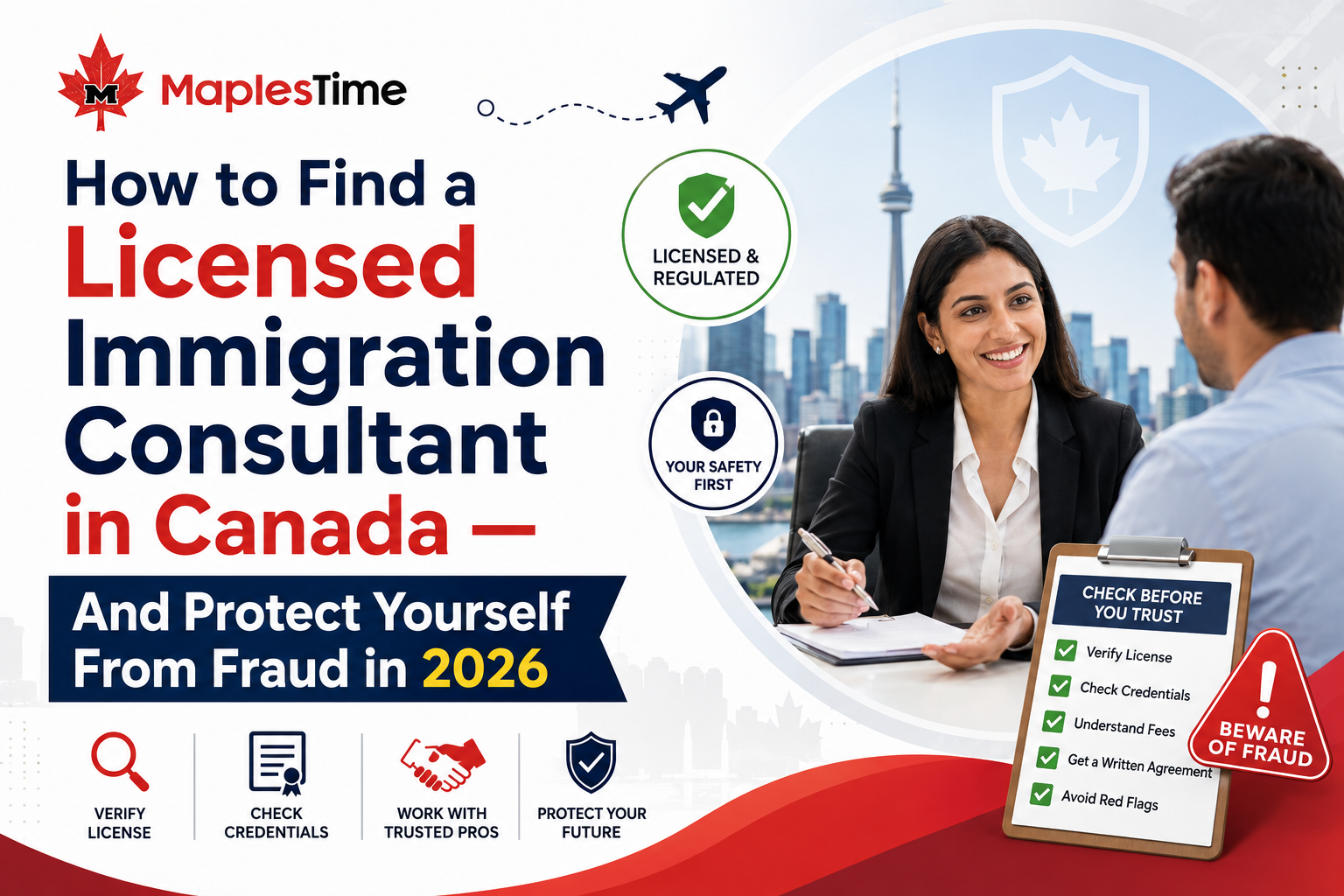 Getting immigration help in Canada is expensive. A single work permit application with a licensed consultant can cost $1,000 to $3,000 CAD. A permanent residence application can run $3,000 to $8,000 or more. For many newcomers and temporary foreign workers, that represents months of savings.
Between May 2019 and April 2024, the Canada Border Services Agency charged 153 individuals with immigration consultant-related fraud offences across the country. An average of more than 9,000 suspected immigration fraud cases were investigated per month in 2024 alone.
The people targeted most often are the most vulnerable — newcomers unfamiliar with the Canadian system, workers with language barriers, and families desperate to stay together. The fraud takes many forms: fake job offers used to anchor LMIA applications, falsified documents, money collected for applications that are never filed, and consultants who simply disappear after being paid.
This guide gives you the tools to protect yourself and the people you care about.
Related: Newcomer Hub — Your Complete First Steps Guide to Canada 2026
The July 15, 2026 Regulations — What Just Changed
On May 6, 2026, Immigration Minister Lena Metlege Diab announced new regulations designed to strengthen the authority of the College of Immigration and Citizenship Consultants and improve protections for people seeking immigration help. The measures come into force on July 15, 2026.
This is the most significant reform of immigration consultant oversight in Canada’s history. Here is exactly what changed:
Stronger Penalties for Misconduct
The updated regulations allow the College to impose stiffer penalties in cases of consultant misconduct. Licensed consultants who provide misleading advice, engage in fraud, or fail to follow ethical standards face harsher consequences than they did before.
Federal Intervention Power
The immigration minister now holds the power to appoint an administrator to take over College board duties if the board fails to protect the public. This creates a clearer path for federal intervention if the College’s leadership is judged not to be doing its job.
This is a significant shift. Previously, the federal government had limited tools to intervene if the College’s own oversight was inadequate. That gap has been closed.
The Compensation Fund — New Protection for Fraud Victims
This is the most important new protection for everyday applicants.
A compensation fund has been established for victims of financial loss caused by dishonest acts committed by licensed consultants. The fund covers losses from dishonest acts committed on or after November 23, 2021, meaning historical victims from the past several years may be eligible.
To qualify for compensation, you must:
- Have used a CICC-licensed consultant (not an unlicensed person)
- Have filed a formal complaint through the College’s complaints process
- Have received a discipline committee finding that links your financial loss to the consultant’s dishonest conduct
- The discipline committee’s final decision must have been issued on or after July 15, 2026
The CICC will provide detailed guidelines on claims, payments, timing, and application steps once the fund is fully operational. Complaints closed before July 15, 2026 and duplicate complaints are not eligible.
Critical limitation: The fund applies only to licensed CICC members. It does not cover losses caused by unlicensed practitioners or so-called ghost consultants. This is why verifying your consultant’s licence is essential — not just for quality assurance, but because unlicensed consultant fraud leaves you with no compensation path.
Enhanced Public Register — Coming April 2027
Beginning April 2027, more information will be required on the College’s public register of licensed consultants. This change is intended to help applicants verify whether a consultant is legally authorized to provide immigration advice.
Who Is Legally Allowed to Give You Immigration Advice in Canada
This is simpler than it sounds. There are exactly two categories of people who can legally accept payment to help you with a Canadian immigration application.
Category 1 — Regulated Canadian Immigration Consultants (RCICs)
Licensed and regulated by the College of Immigration and Citizenship Consultants (CICC). Must pass a national exam, maintain ongoing professional development, hold professional liability insurance, and follow the CICC’s Code of Professional Ethics.
Only consultants with the RCIC-IRB licence can represent clients before the Immigration and Refugee Board of Canada. Standard RCICs handle most immigration applications but cannot appear in federal court.
Category 2 — Immigration Lawyers
Licensed by a provincial or territorial law society. Can represent clients in federal court and handle complex legal immigration matters including judicial reviews. Immigration lawyers can also help with all the same applications as RCICs.
Under Canadian law, anyone who accepts payment in exchange for preparing an immigration application or providing immigration advice must be licensed by either a provincial or territorial law society or the CICC. There are no exceptions to this requirement.
Everyone else is operating illegally. This includes: family members who charge you fees, travel agents who offer immigration services, settlement workers who help applicants outside their scope, and anyone who calls themselves an “immigration agent,” “visa consultant,” or “immigration specialist” without showing you their CICC membership number.
How to Verify Any Immigration Consultant in Canada — Step by Step
This takes less than five minutes. Do it before your first meeting. Do it before you pay any money. Do it before you sign anything.
Step 1: Go to college-ic.ca/protecting-the-public/find-an-immigration-consultant
Step 2: Enter the consultant’s full legal name or their RCIC number. Every licensed consultant has a unique RCIC number they are required to provide upon request.
Step 3: Confirm their status. A licensed consultant in good standing will show as “Active” on the register. You will also see their licence type (RCIC or RCIC-IRB), their location, and any disciplinary history.
Step 4: Check the disciplinary record. If any sanctions, suspensions, or disciplinary actions appear — take that seriously. Past misconduct matters.
Step 5: Beginning April 2027, the register will show additional information including more detailed disciplinary history and professional standing details.
Verify any consultant now: college-ic.ca/protecting-the-public/find-an-immigration-consultant
To verify an immigration lawyer: Search the law society for the province where they practice. Each province has its own law society website with a public member directory.
Red Flags — Warning Signs of Immigration Fraud
Print this section. Share it with your community. These are the patterns that repeat in virtually every immigration fraud case.
They guarantee results. No legitimate immigration consultant can guarantee an approval. Immigration decisions are made by IRCC, not by consultants. Anyone who says “I guarantee your visa will be approved” or “I have connections inside IRCC” is lying to you.
They ask for cash only. Legitimate consultants provide written contracts, receipts, and accept multiple forms of payment. Cash-only arrangements with no paper trail are a serious warning sign.
They cannot show you their RCIC number. Ask directly: “What is your RCIC number?” If they hesitate, deflect, or cannot give you one — stop the conversation and leave.
They claim special government connections. No private consultant has special access to IRCC that other licensed consultants do not have. This claim is always false and often used to justify higher fees.
They offer to “fix” your application after a refusal for free. Refusals are complicated. Anyone offering to overturn a refusal cheaply or quickly is almost certainly offering to file fraudulent documents.
They ask you to sign blank forms. Never sign any form that has blank sections. Never allow someone else to complete forms on your behalf without reviewing every section yourself.
They contact you unsolicited. Legitimate immigration professionals do not cold-call people, message strangers on WhatsApp, or approach newcomers in community spaces with immigration offers.
They charge for free services. Many IRCC services — including checking your application status, downloading forms, and accessing government information — are completely free. Anyone charging you to access IRCC forms or government websites is deceiving you.
They pressure you with urgency. “You must apply this week or miss your chance” is a classic high-pressure sales tactic. Legitimate consultants give you time to review contracts, ask questions, and make informed decisions.
Ghost Consultants — The Hidden Threat
Ghost consultants are unlicensed individuals who pose as immigration professionals. They often operate through social media, ethnic community groups, WhatsApp, and informal referral networks.
They are particularly effective at targeting newcomers who speak limited English or French, who come from countries where informal fixers are common, and who are desperate to resolve immigration situations quickly.
Ghost consultants are a serious and growing problem. Because they are unlicensed, the CICC’s new compensation fund does not cover losses they cause. Victims of ghost consultant fraud have limited recourse — their only paths are provincial police complaints or small claims court, both of which are slow and uncertain.
The most important rule against ghost consultants: The moment someone asks you to pay for immigration advice or application help, you must verify their RCIC number. Not after the meeting. Not after you trust them. Before you pay a single dollar.
If You Have Already Been Defrauded — What to Do
If you believe you have been defrauded by an immigration consultant, take these steps immediately.
If the consultant was licensed (had an RCIC number):
File a formal complaint with the College of Immigration and Citizenship Consultants at college-ic.ca/protecting-the-public/file-a-complaint. Following the July 15, 2026 regulations, eligible victims of licensed consultant fraud may be able to access the new compensation fund.
If the consultant was unlicensed (a ghost consultant):
Report them to IRCC directly at canada.ca/en/immigration-refugees-citizenship/corporate/contact-ircc/web-form.html. File a police report with your local police service. If you paid by credit card, contact your bank immediately to dispute the charges.
For your immigration application itself:
Contact a legitimate licensed RCIC or immigration lawyer to review the status of your case. Fraudulent or incorrectly filed applications may be salvageable depending on their current state, but you need professional guidance immediately.
If you are in Winnipeg:
The Immigrant Centre Manitoba can help connect you with trusted legal resources and settlement support if you have been defrauded. Their services are free. Contact them at 204-943-9158.
The Difference Between an RCIC and an Immigration Lawyer — Which One Do You Need?
Most newcomers do not need an immigration lawyer. RCICs are fully qualified to handle the vast majority of immigration applications including Express Entry, PNP, study permits, work permits, family sponsorship, and permanent residence applications.
You likely need an immigration lawyer if: your case involves a criminal record or serious admissibility issue, you are seeking a judicial review of a refused application in federal court, your case involves complex legal arguments about immigration law, or you have been detained or are facing deportation.
For everything else — choosing the right RCIC and verifying their licence is the most important decision you will make.
Checklist — Before You Hire Any Immigration Help in Canada
Before signing any contract or paying any money, confirm every item on this list:
- I have verified their RCIC number at college-ic.ca and their status shows Active
- They have provided me with a written service agreement describing exactly what they will do and what it will cost
- They have given me their business contact information including a physical address
- They have not guaranteed any immigration outcome
- They have not asked me to sign any blank forms
- They have not asked for cash-only payment
- They have answered my questions patiently without pressure
- I have not been contacted by them unsolicited
- I have read any contract before signing it and understand every section
Official Resources — Protect Yourself With These Links
| Resource | Purpose | Link |
|---|---|---|
| CICC Public Register | Verify any consultant’s licence | college-ic.ca |
| File a Complaint — CICC | Report licensed consultant misconduct | college-ic.ca/complaints |
| IRCC Authorized Reps | Understand who can legally help you | canada.ca authorized reps |
| Report Fraud to IRCC | Report unlicensed consultants | IRCC web form |
| IRCC Official Forms | Download all government forms free | canada.ca/ircc-forms |
| Newcomer Hub | Full settlement guide for Canada | maplestime.com/newcomer-hub |
Sources: Immigration, Refugees and Citizenship Canada — May 6, 2026 announcement | College of Immigration and Citizenship Consultants | CIC News | Immigration News Canada | The Canada Report | Data current as of May 23, 2026.
Have a correction? Email [email protected]
Have you had an experience — good or bad — with an immigration consultant in Canada? Your story could help protect someone in your community. Share it in the comments. And send this article to any newcomer who is considering hiring immigration help.
