


Canada news today — severe prairie storms in 2026 caused more than $728 million in insured damage across Manitoba and Saskatchewan, the Insurance Bureau of Canada confirmed Wednesday, making it one of the most costly weather events in Prairie history. Manitoba Public Insurance shattered its all-time record for claims from a single weather event — more than 30,000 claims opened after storms brought hail, tornadoes, high winds, torrential rain, and flash flooding across the province. The previous record was 24,000 claims from a hailstorm in 1996. Manitoba is still dealing with the aftermath, with the Assiniboine River flooding Brandon and more than 50 municipalities having declared local states of emergency.
By Maplestime News Desk | Winnipeg, Manitoba | July 16, 2026
Sources: The Canadian Press | Insurance Bureau of Canada | Manitoba Public Insurance | CBC News | Last updated: July 16, 2026, 2:00 PM CDT
What We Know So Far
- Severe June storms in Manitoba and Saskatchewan caused more than $728 million in insured damage according to the Insurance Bureau of Canada
- Manitoba Public Insurance opened more than 30,000 claims following the storms — a record for a single weather event in Manitoba history
- The previous Manitoba record was 24,000 claims from a 1996 hailstorm — shattered by nearly 6,000 additional claims
- The storms brought hail, tornadoes, high winds, torrential rain, and flash flooding across the Prairies
- Manitoba was then hit by a second major storm system at the end of June that caused widespread flooding in the Parkland Region
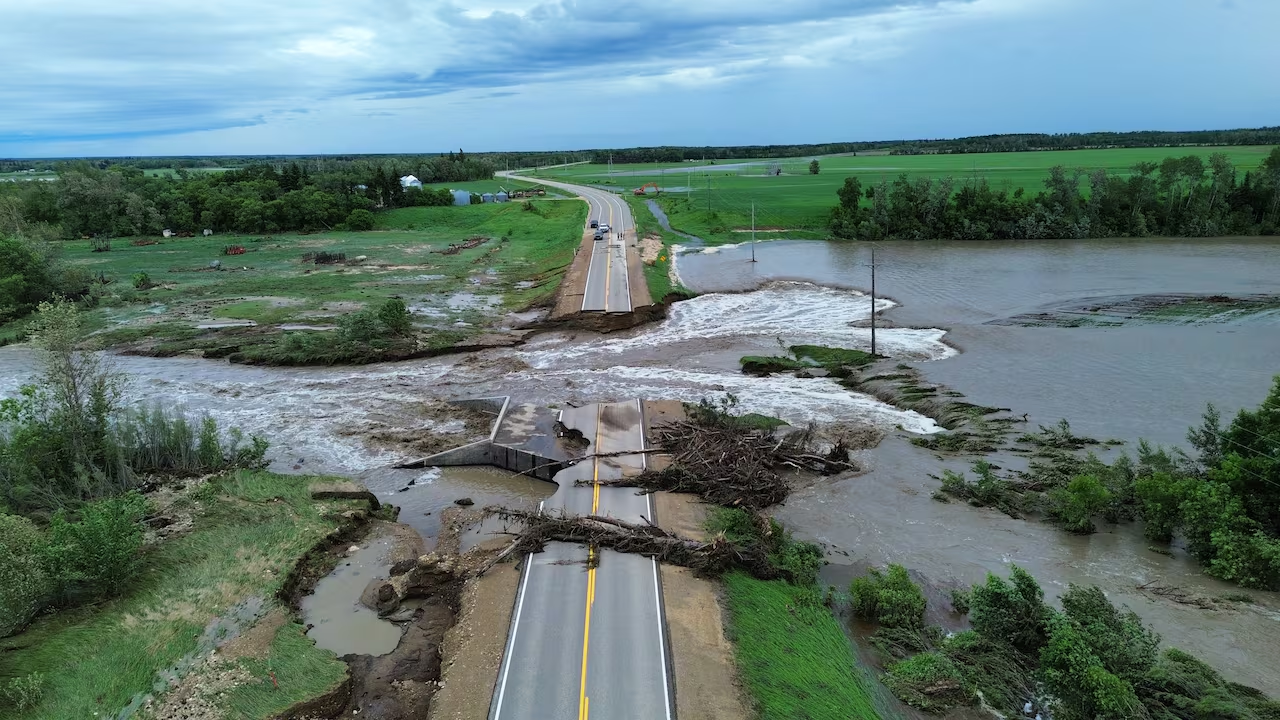
- A drone image shows Highway 10 in western Manitoba’s Parkland area near Pine River washed out entirely by floodwaters
- The Assiniboine River has risen rapidly near Brandon in the past week — though the city says its dike system is holding and water levels have started to fall
- More than 50 Manitoba municipalities declared local states of emergency due to flooding and storm damage
- Saskatchewan communities are still cleaning up after intense weekend windstorms caused significant structural damage
A Record That Stood for 30 Years — Gone in One Storm
Manitoba Public Insurance has been tracking weather-related claims since well before most Canadians were paying close attention to extreme weather trends. The record it set in 1996 — 24,000 claims from a single hailstorm — stood for thirty years.
The June 2026 prairie storms erased it.
More than 30,000 claims were opened by Manitoba Public Insurance following the storms that swept through the province bringing hail, tornadoes, high winds, and torrential rain that led to flash flooding across the region. That is 6,000 more claims than the previous record. A 25 per cent increase over what had been considered an extraordinary event three decades ago.
The number reflects the scale of what happened across Manitoba in June. Vehicles destroyed by hail. Roofs torn off by tornadoes. Basements flooded by rain that overwhelmed drainage systems designed for different conditions. Farms damaged. Roads washed out.
Thirty thousand individual claims means thirty thousand Manitoba families and businesses filing paperwork, waiting for adjusters, arranging repairs, and dealing with the disruption that a major insurance claim brings to a life or a livelihood.
$728 Million — What That Number Actually Means
The Insurance Bureau of Canada’s $728 million figure covers insured damage only. It does not include uninsured losses — vehicles not covered for hail, properties without flood insurance, infrastructure damage paid by governments rather than private insurers, or agricultural losses that fall outside standard insurance products.
The actual economic cost of the June 2026 prairie storms is almost certainly higher than $728 million. Potentially significantly higher.
To put $728 million in context — it is among the most costly weather events in Prairie history by insured damage alone. Canada’s most expensive insured natural disaster on record is the 2016 Fort McMurray wildfire which caused approximately $3.7 billion in insured losses. The 2013 Alberta floods caused approximately $1.7 billion. The June 2026 prairie storms at $728 million are in the same tier of Canadian weather catastrophes — events that reshape how insurers, governments, and communities think about extreme weather risk.
What the Storms Actually Did — Across Both Provinces
The Insurance Bureau of Canada described the June storm system as bringing hail, tornadoes, high winds, and torrential rain that led to flash flooding. Those are four distinct types of severe weather — each capable of causing significant damage individually — occurring in combination across hundreds of thousands of square kilometres of Prairie landscape.
In Manitoba, the damage from the June storms was followed almost immediately by a second major storm system at the end of June that caused widespread flooding in the Parkland Region in western Manitoba.
A drone image released by the Manitoba government shows the scale of what that flooding did to Highway 10 near Pine River in the Parkland area — the road simply washed out, the pavement and gravel base carried away by floodwaters, leaving a gap in infrastructure that serves communities across the region.
More than 50 Manitoba municipalities declared local states of emergency due to the combination of storm damage and flooding. That is not a handful of small communities dealing with isolated incidents. That is more than fifty distinct jurisdictions simultaneously overwhelmed by what the weather had done to their roads, buildings, fields, and drainage systems.
In Saskatchewan, communities are still cleaning up after intense weekend windstorms that caused significant structural damage. Volunteer firefighters and municipal crews worked alongside residents to clear debris, assess damage, and begin the slow process of recovery.
Brandon — The Dike Is Holding, For Now
The heavy rainfall from the June storms and the end-of-June Parkland system caused the Assiniboine River to rise quickly near Brandon, Manitoba’s second-largest city, over the past week.
Brandon has dike infrastructure designed to protect the city from Assiniboine River flooding — infrastructure that was put to the test as water levels climbed. As of Wednesday the city says its dike system is holding and water levels have started to fall.
That is genuinely good news for Brandon. A failure of the city’s dike system at peak river levels would have added a significant urban flooding disaster to what is already a historic insurance event for the province.
The Assiniboine River flooding situation in Brandon bears watching as the July weather pattern continues. Water levels are falling — but the ground across much of the Prairie region is saturated from weeks of above-normal rainfall, meaning any additional significant precipitation has limited capacity to be absorbed before running off into rivers and drainage systems already operating near capacity.
Why This Keeps Getting Worse
Manitoba’s hailstorm record stood for thirty years. It fell in a single event in June 2026.
That kind of record-breaking is not random. It reflects a pattern that meteorologists, insurers, and emergency management officials across Canada have been documenting with increasing concern — the frequency and intensity of severe weather events on the Prairies is increasing.
The combination of factors that produce extreme Prairie storms — warm Gulf of Mexico air pushing north, cold Arctic air pushing south, the flat topography of the Prairies providing no geographical barrier to either — has always made the region susceptible to severe weather. What is changing is how often those conditions align, how intense the resulting systems are, and how much moisture they carry.
For Manitoba and Saskatchewan residents, the June 2026 storms are the latest in a series of events that have made extreme weather an expected rather than exceptional part of Prairie life. The insurance industry is already responding — with higher premiums, changed coverage terms, and growing pressure on governments to invest in infrastructure that can handle conditions the existing systems were not designed for.
The $728 million insured damage figure from June 2026 will shape those conversations for years.
If You Were Affected — What to Do Now
If your home, vehicle, or business was damaged in the June 2026 prairie storms and you have not yet filed an insurance claim:
Contact your insurer or Manitoba Public Insurance as soon as possible. Document all damage with photographs before any repairs begin. Keep all receipts for emergency repairs or temporary accommodations.
If you are dealing with flooding and are unsure whether your property insurance covers overland flooding — call your insurer directly and ask specifically. Overland flood coverage is a separate add-on to standard homeowner’s insurance in Canada and many properties affected by the June events may not have it.
Manitoba Public Insurance: mpi.mb.ca or 204-985-7000
Insurance Bureau of Canada consumer information line: 1-844-2ask-IBC
Manitoba Emergency Management Organization: 1-888-267-8298
Saskatchewan Emergency Management: 306-787-9563
This is a developing story. Maplestime will update this article as the Insurance Bureau of Canada releases more detailed damage breakdowns and as the Assiniboine River situation near Brandon continues to develop.
Have a storm damage story or photo from the Prairie storms? Email [email protected]
Have a correction? Email [email protected]
Was your home, vehicle, or property damaged in the June 2026 prairie storms? Share what you experienced in the comments — and send this to every Prairie resident who needs to know about the record-breaking insurance numbers and what to do if they have not filed a claim yet.
Discover more from MaplesTime
Subscribe to get the latest posts sent to your email.
