


Canadian politics news — Republicans blast Canada over wildfire smoke in 2026, with four Michigan members of Congress sending a sharply worded letter directly to Prime Minister Mark Carney accusing Canada of deliberate inaction on wildfires that are sending hazardous smoke across the northeastern United States for the third consecutive year. One U.S. senator has gone further — threatening to introduce legislation to sanction Canada and Canadian government officials. With 858 active fires burning across Canada as of Thursday and air quality warnings stretching from Minnesota to Maryland, the political pressure on Ottawa is intensifying fast.
By Maplestime News Desk | Canada | July 16, 2026
Sources: CBC News | Canadian Interagency Forest Fire Centre | Environment Canada | U.S. EPA AirNow | Last updated: July 16, 2026, 1:30 PM CDT
What We Know So Far
- Four Michigan Republican members of Congress sent a letter to PM Mark Carney accusing Canada of failing to prevent wildfires and warning the U.S. will act unilaterally if Canada does not
- The letter was signed by John James, Jack Bergman, John Moolenaar, and Lisa McClain — all Michigan Republicans
- Ohio Senator Bernie Moreno announced he will introduce a bill to sanction Canada and Canadian government officials over wildfire pollution — though no specific sanctions were named
- There are 858 active fires across Canada as of Thursday according to the Canadian Interagency Forest Fire Centre
- Ontario alone has 136 active fires in the northwest with 63 classified out of control and 44 more burning in the northeast
- Ontario has seen 483 fires so far this year — well above the province’s 10-year average of 320 by mid-July
- Manitoba has 137 active fires and 261 total fires so far this year
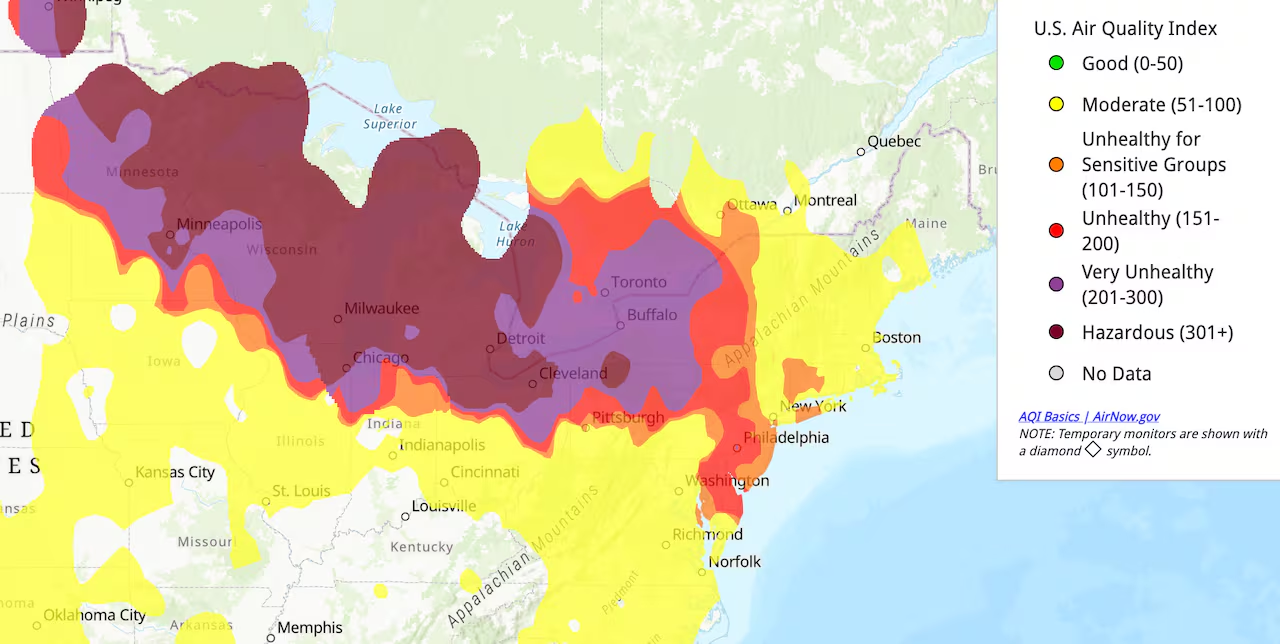
- Air quality warnings stretch from Minnesota to Maryland with the U.S. EPA index ranging from unhealthy to hazardous
- PM Carney responded by pointing to U.S. climate policy failures — specifically Trump administration prohibitions on clean energy including wind power
- U.S. Ambassador Pete Hoekstra took a notably more collaborative tone — calling this a shared challenge demanding a shared response
In This Article
- What the Michigan Republicans actually said
- The 5 most significant threats made against Canada
- The fire numbers behind the dispute
- What Carney said back
- The contrast between Republican politicians and U.S. Ambassador Hoekstra
- What this means for Canada-US relations
What the Michigan Republicans Actually Said

The letter is blunt. Four Michigan Republicans — John James, Jack Bergman, John Moolenaar, and Lisa McClain — addressed it directly to Prime Minister Mark Carney and did not soften their language.
“This is the third consecutive year we have had to write to Canadian officials about a crisis that Canada has the tools to prevent and has chosen not to,” they wrote.
“Our hospitals are once again treating children, dialysis patients and older residents for the effects of smoke that did not originate anywhere near them.”
The letter accused Canada of a failure of sovereignty — arguing that controlling what crosses your border into another country’s airspace is a basic obligation of nationhood that Canada has not met.
“Sovereignty comes with responsibility, and the responsibility to prevent a foreseeable disaster from crossing into another country’s airspace has not been met,” they wrote.
“Our constituents are breathing the consequences of this failure right now, and they deserve better than to be told, again, that it will be handled.”
The Republicans also took direct aim at unnamed provincial leaders who they said were offering excuses instead of results and dismissing the health concerns of Americans. “That attitude is unacceptable from a neighbour and an ally,” the letter stated.
Related: Canada US Relations 2026 — Trade, Tariffs and the New Reality
5 Shocking U.S. Threats Against Canada in This Dispute
Threat 1 — Unilateral Action on Canadian Soil
The most significant line in the Michigan letter is not the criticism. It is the warning about what comes next if Canada does not act.
“The U.S. will look elsewhere, and act on our own,” the four Republicans wrote — a phrase that implies the possibility of the United States taking cross-border fire prevention action inside Canadian territory without Canadian government involvement.
They did not specify what that would look like. They did not need to. The implication is clear enough.
Threat 2 — Sanctions Against Canada and Canadian Officials
Ohio Senator Bernie Moreno went further than the Michigan letter.
Reacting to social media posts about hazardous air quality in Cleveland, Moreno announced he will introduce a bill next week to sanction Canada and the responsible Canadian government officials for what he called an atrocity.
Moreno did not specify what sanctions he has in mind. The announcement was made in a news release that directly echoed the Michigan letter’s language about Canada’s failure to invest in wildfire prevention methods including forest thinning, fuel reduction, prescribed burns, and stronger enforcement against arson.
The threat of formal U.S. sanctions against Canadian officials is a significant escalation in the language of this dispute — even if the practical likelihood of such legislation passing remains uncertain.
Threat 3 — The White House Has Been Contacted
Representative Lisa McClain said in a video posted to X that she has been in touch with the White House about Canada’s wildfire situation.
McClain noted that the U.S. sent foresters and firefighters to Canada last year — adding pointedly that this was because Canada was not really doing much on its own.
White House involvement in what has been framed as a bilateral environmental and health dispute introduces a level of political weight that goes well beyond four members of Congress writing a letter.
Threat 4 — Social Media Escalation
Representative John James — who is running for governor of Michigan — posted excerpts from the letter alongside an image with a message directed at Canada demanding action and no more excuses.
The political optics are deliberate. James is running for governor. Wildfire smoke affecting Michigan residents is a local political issue that resonates with voters. Using Canada as the antagonist in that narrative is effective politics regardless of the scientific complexity underneath it.
Threat 5 — Third Year Running, Patience Exhausted
Perhaps the most telling threat in the letter is the simplest one.
The Republicans say this is the third consecutive year they have written to Canadian officials about this issue. They say they are done accepting apologies in place of action.
The language of exhausted patience — from allies who have been willing to work collaboratively — is its own form of threat. It signals that the window for diplomatic resolution of this dispute through normal channels is narrowing.
The Fire Numbers Behind the Dispute
The Republican criticism does not exist in a vacuum. The scale of Canada’s active wildfire situation in July 2026 is genuinely significant.
There were 858 active fires across Canada as of Thursday according to the Canadian Interagency Forest Fire Centre. Ontario’s situation is particularly acute — 136 active fires in the northwest region alone, with 63 classified as out of control, and another 44 burning in the northeast.
Ontario has recorded 483 fires so far this year. That is up from 351 fires at the same point last year and significantly above the province’s ten-year average of 320 fires by mid-July.
Manitoba is dealing with 137 active fires and 261 total fires so far this year.
The smoke from northwestern Ontario wildfires has caused poor air quality and reduced visibility across much of southern Ontario. It has also triggered air quality warnings across U.S. states close to the Great Lakes — stretching from Minnesota to Maryland — with the U.S. Environmental Protection Agency air quality index ranging from unhealthy to hazardous across much of the northern United States on Thursday.
These are not small numbers. The air quality impact on American communities near the Canadian border is real, documented, and measurable. Children, dialysis patients, and elderly residents in Michigan, Ohio, and neighbouring states are genuinely experiencing health effects from smoke that originated in Canadian forests.
What Carney Said Back
Prime Minister Mark Carney did not directly address the Republican letter when asked about it by reporters on Thursday. Instead he redirected to U.S. climate policy.
“Climate change is everyone’s responsibility — truly everyone’s — including the United States,” Carney said in French during a news conference in London, Ontario.
He contrasted Canada’s investments in clean energy with U.S. prohibitions on clean energy — specifically referencing the Trump administration’s targeting of wind power — as evidence that the United States does not occupy the moral high ground it is claiming on environmental responsibility.
It is a politically effective response domestically. Pointing to Trump’s climate rollbacks when Republicans accuse Canada of environmental inaction plays well with a Canadian audience that views U.S. climate policy under the current administration with deep skepticism.
Whether it moves the needle in Michigan, Ohio, or Washington is a different question entirely.
The Contrast — Hoekstra vs. the Michigan Republicans
The most interesting dimension of Thursday’s dispute is the contrast between the Republican letter-writers and U.S. Ambassador Pete Hoekstra — who also hails from Michigan.
While the four Michigan Republicans were calling Canadian officials negligent and threatening unilateral action, Hoekstra was taking a sharply different tone.
“This challenge knows no borders,” Hoekstra said in a statement Wednesday. “This is a shared challenge, and it demands a shared response.”
He went further. “I commend the outstanding co-operation between the United States and Canada as we confront these fires together. Our two governments are monitoring and sharing information in real time — co-ordination that reflects our partnership at its best.”
The gap between Hoekstra’s collaborative framing and the Republican letter’s accusatory tone reflects a genuine split within the U.S. political approach to Canada in 2026. The ambassador who deals with the bilateral relationship day to day emphasizes cooperation. The politicians who deal with it through the lens of domestic electoral politics emphasize blame.
Both are talking about the same smoke. They are not talking about the same Canada.
This Is Not the First Time
Michigan Republicans made similar complaints about Canada last summer — 2025 — prompting Manitoba Premier Wab Kinew to brand them as attention seekers throwing what he memorably called a timber tantrum.
The phrase landed because it captured something real about the political dynamic — Michigan Republicans using Canadian wildfire smoke as a domestic political issue rather than as a genuine bilateral policy concern requiring collaborative solutions.
The same dynamic is playing out again in 2026. The language is sharper. The threats are more specific. The fire numbers are worse. And the political pressure on both sides of the border is higher.
Whether this year produces a different outcome — actual collaborative forest management agreements, federal investment in Canadian wildfire prevention, or genuine bilateral policy change — or whether it produces another round of letters, counterpunches, and timber tantrums, remains to be seen.
What Ontario and Manitoba Are Doing
Ontario has formally asked the federal government to ensure aircraft and crews could be deployed within 24 hours or less for evacuations as wildfires continue to force people from their homes in First Nations and northern Ontario communities.
Fast-moving fires have destroyed homes in northern Ontario as crews fight flames across the province. Environment Canada has issued yellow and orange air quality warnings for many Ontario regions.
The provincial government acknowledged the scale of the challenge while defending its firefighting investments and emergency response capacity.
This is a developing story. Maplestime will update this article as Senator Moreno introduces his sanctions legislation next week and as PM Carney’s office responds formally to the Michigan Republican letter.
Have a tip or correction? Email [email protected]
Do you think Republicans blasting Canada over wildfire smoke is legitimate criticism or political opportunism? And what do you think Canada should actually be doing differently on wildfire prevention? Share your view in the comments — and send this to anyone following Canada-U.S. relations and Canadian politics news today.
Discover more from MaplesTime
Subscribe to get the latest posts sent to your email.
