


Canada Investment Summit 2026 — Carney Bets $1 Trillion on Toronto to Fix Canada’s Achilles Heel
Canadian business news — the Canada Investment Summit 2026 opens in Toronto on September 14 and 15, and Prime Minister Mark Carney is betting everything on it. Hundreds of global investors controlling trillions of dollars in assets are descending on a downtown Toronto hotel where Carney, his cabinet, and provincial premiers will pitch Canada as the world’s most reliable supplier of energy, critical minerals, and infrastructure in an era of global uncertainty. The backdrop could not be more charged — a trade war with the United States is escalating by the week, Trump compared Canada to Iran just hours ago on the international stage, and Canada’s persistent failure to attract business investment has been called the country’s Achilles heel for two decades. This summit is Carney’s answer to all of it. The question every investor in that room will be asking is whether Canada can actually deliver.
By Maplestime Business Desk | Canada | September 12, 2026
Sources: The Canadian Press — Canada Investment Summit | CPP Investments | C.D. Howe Institute | Last updated: September 12, 2026
In This Article
- What the Canada Investment Summit 2026 actually is
- Why Carney called it Canada’s Achilles heel
- What the provinces are bringing to the table
- What global investors think about Canada right now
- The trade war elephant in the room
- The Maplestime take — can Canada actually deliver
- What happens next
Key Takeaways
- The Canada Investment Summit 2026 takes place September 14 and 15 at a downtown Toronto hotel — Canada’s first-ever national investment summit
- Hundreds of global and domestic investors with trillions of dollars in assets under management will attend
- PM Carney has set a goal of catalyzing $1 trillion in investments in Canada over five years
- Alberta Premier Danielle Smith is bringing a list of 34 proposed projects to pitch to investors
- Saskatchewan Premier Scott Moe will pitch energy, critical minerals, defence, and agriculture sectors
- New Brunswick Premier Susan Holt will push a port expansion, a data centre, and a power plant rehabilitation project
- Foreign direct investment in Canada hit $96.8 billion in 2025 — the highest level since 2007 — despite the trade war backdrop
- Nearly 70 per cent of global investors ranked policy predictability as extremely important or essential in deciding where to invest
- Canada ranked second only to Singapore on policy stability and predictability in a CPP Investment Board survey of 65 major asset managers
- The summit is being co-organized by the Prime Minister’s Office, CPP Investment Board, and Public Sector Pension Investments
What the Canada Investment Summit 2026 Actually Is
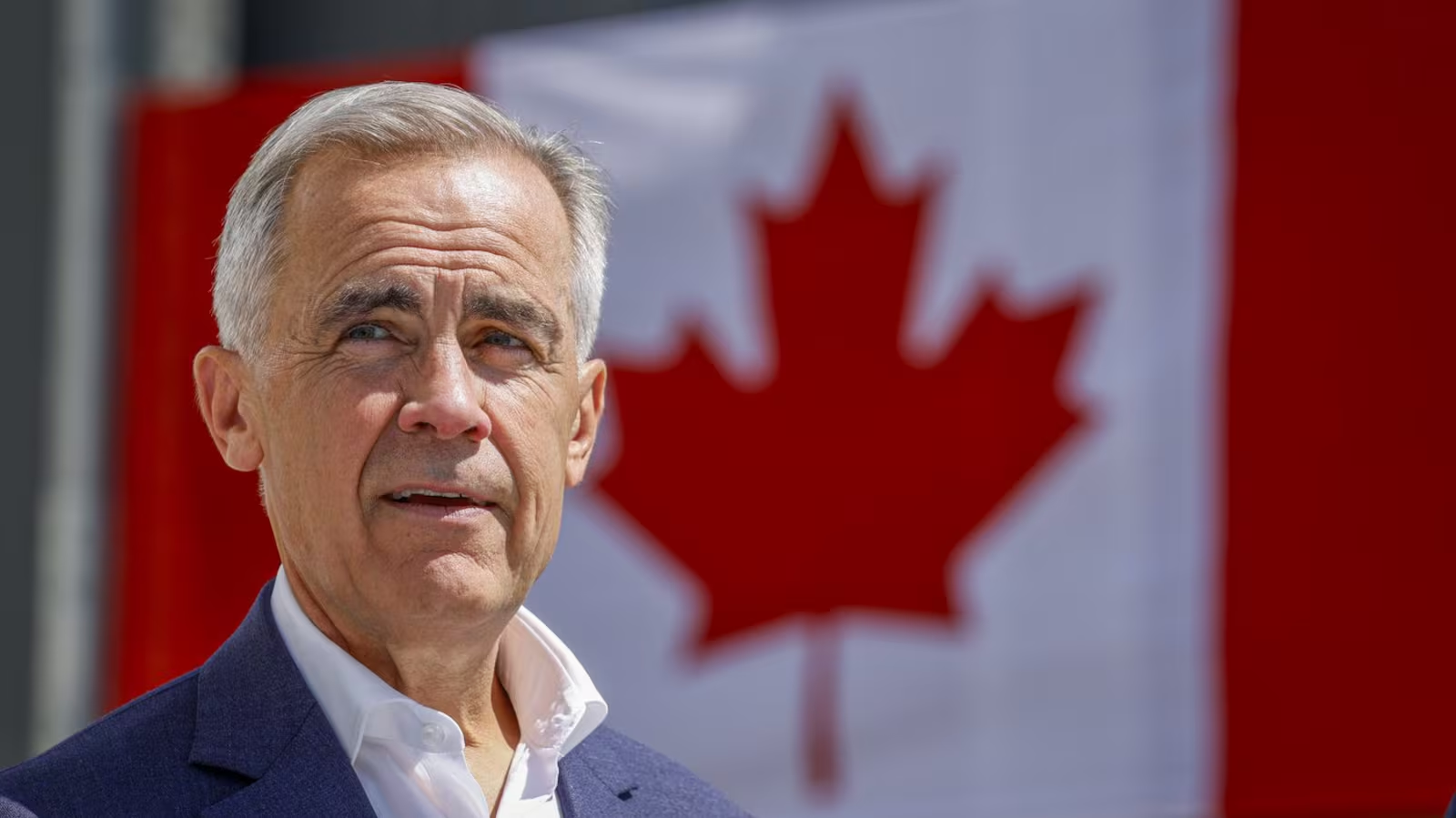
This is not a conference. It is a sales pitch at a national scale.
The Canada Investment Summit 2026 is Canada’s first-ever dedicated national investment summit — an event that has been in the works since Carney took office in March 2025 and began reorienting federal economic policy around a single central argument: Canada has what the world wants, and the world needs to start paying for it properly.
The summit brings together hundreds of global and domestic investors representing some of the world’s largest asset managers to a downtown Toronto hotel on September 14 and 15. Waiting for them will be Carney, his cabinet ministers, provincial premiers, and Canadian business leaders — all carrying lists of projects they want funded, built, and delivered.
The event is being co-organized by the Prime Minister’s Office alongside two of Canada’s largest institutional asset managers: the Canada Pension Plan Investment Board and Public Sector Pension Investments. This is deliberate. Having CPP and PSP as co-organizers signals to global investors that this is not a government PR exercise — it is a serious institutional capital mobilization event with the credibility of the country’s most significant investment vehicles behind it.
Carney set the target clearly when he first took office. He wants to catalyze $1 trillion in investments in Canada over five years. Experts have called this lofty. Carney has called it necessary.
Related: Trump Canada Iran 2026 — 5 Things Every Canadian Must Know
Why Carney Called Canada’s Investment Problem Its Achilles Heel
Canada has a productivity problem. It has had one for most of the past two decades. And at the root of that productivity problem is a persistent, well-documented failure to attract the kind of business investment that builds new capacity, creates quality jobs, and generates the tax base that funds public services.
Mahmood Nanji, a fellow with the Ivey School of Business at Western University, was direct about it. Canada has suffered from a well-documented dearth of business investment for much of the past decade, which has fed into weak productivity and sluggish growth. “This has been a bit of Canada’s Achilles heel over the last couple of decades. And this is why I think Prime Minister Carney, upon being elected, this was his big bet on rebuilding the Canadian economy,” Nanji said.
The causes are familiar to anyone who follows Canadian business and politics. Regulatory burdens that stretch project timelines by years. Approval processes that create uncertainty even for viable projects. Interprovincial trade barriers that fracture what should be a single national market. A history of policy reversals that taught global investors Canada could not be trusted to follow through on what it started.
The numbers tell the story. While foreign direct investment in Canada hit $96.8 billion in 2025 — the highest level since 2007, which is genuinely encouraging — BMO chief economist Doug Porter noted that most of this inflow has come through mergers and acquisitions. Not greenfield investments. Not new projects being built from scratch. Companies buying existing Canadian assets rather than building new ones.
That distinction matters. A merger does not create a new port. A new port creates jobs, opens export routes, and generates economic activity that compounds for decades. The Canada Investment Summit 2026 is specifically designed to attract the kind of capital that builds new things rather than simply changing the ownership of things that already exist.
What the Provinces Are Bringing to the Table
The summit is not a federal government show. Every province that participates is bringing its own pitch — its own list of projects, its own value proposition to global capital.
Alberta Premier Danielle Smith is bringing the most aggressive list — 34 proposed projects she will be shopping to investors at the summit. Alberta’s pitch centres on energy, where Canada’s profile as a global supplier is strongest, and on critical minerals, where demand from battery manufacturers, defence contractors, and technology companies is accelerating globally.
Saskatchewan Premier Scott Moe is pitching his province’s energy, critical mineral, defence, and agriculture sectors — a combination that speaks to both the resource extraction opportunities that have historically defined Saskatchewan’s economy and the newer defence and technology sectors that Carney’s government has been working to grow.
New Brunswick Premier Susan Holt has a different kind of list — a port expansion, a data centre in Lorneville, and the rehabilitation of the Mactaquac power plant. New Brunswick’s pitch is about infrastructure and energy stability on the Atlantic coast — a different value proposition from the Prairie provinces but one that complements the national picture Carney is trying to present.
Together these provincial pitches tell a story about Canada that goes beyond any single sector or region. From Atlantic port infrastructure to Prairie energy to Pacific mineral extraction — Canada is presenting itself as a country with investable opportunities in every corner of its geography.
Related: Canada Counter Tariffs September 8 2026 — What Gets More Expensive
What Global Investors Actually Think About Canada Right Now
The CPP Investment Board’s Insights arm published a report on Monday that surveyed 65 of the world’s largest asset managers on how they view Canada’s investment opportunities. The findings are both encouraging and sobering.
On the positive side Canada ranked second only to Singapore on policy stability and predictability — the single factor that nearly 70 per cent of investors ranked as extremely important or essential in deciding where to invest their capital. That is a remarkable result for a country that has spent much of the past decade being criticized for exactly that kind of predictability.
Canada also ranked well on openness to capital and on execution in the energy transition — two categories that align directly with the kinds of projects that will be pitched at the summit next week.
On the negative side the energy sector — Canada’s strongest card in the global investment deck — also came with the sharpest risks in investors’ minds. Fears of policy reversals, regulatory fragmentation, and scale or liquidity constraints were cited prominently by the asset managers surveyed.
Jeremy Kronick, president and CEO of the C.D. Howe Institute, acknowledged that Carney has made real progress in signalling that Canada is open for business. The major projects office and the One Canadian Economy Act are concrete steps toward streamlining approvals for nation-building projects. But Kronick was clear that changing tone is easier than changing regulatory processes. “I think there’s been enough done on the change in tone. I think regulatory processes are harder to change,” Kronick said.
The investors coming to Toronto next week know this. They are not showing up because they believe Canada has already solved its investment climate problems. They are showing up because the global environment has shifted enough — through the U.S. trade war, through resource scarcity, through the energy transition — that Canada’s problems look more manageable than the alternatives.
The Trade War Elephant in the Room
It would be dishonest to write about the Canada Investment Summit 2026 without addressing what is happening simultaneously in the Canada-U.S. relationship.
On the same day that Carney’s government is promoting an investment summit designed to attract global capital to Canada, the American president is in Dublin comparing Canada to Iran. The September 8 counter-tariffs are in effect. Formal trade talks are not scheduled. Trump has threatened to extend tariffs to steel, aluminum, and automotive sectors.
All of the experts who spoke to The Canadian Press said the escalation of the tariff war over the past few weeks will definitely be part of the conversation at the summit. But it might not be a deal-breaker — and here is why.
Many of the projects being pitched to investors at the summit are not primarily about exporting to the United States. Ports on the Atlantic and Pacific coasts, pipelines to tidewater, critical mineral extraction for global battery supply chains — these are investments that open Canadian goods to markets other than America. That reorientation is exactly what Carney has been arguing Canada needs to pursue regardless of how the trade war resolves.
Nanji made the point plainly. “Some of the investors might be a little bit jittery about this relationship with the United States — but if some of these projects are going to be exporting goods to other markets, that may not necessarily factor into their decision.”
The trade war is not only a threat to the investment summit. It is also, paradoxically, an argument for it. If Canada can demonstrate to global capital that it has export infrastructure and regulatory stability that connects Canadian resources to markets beyond the United States — that pitch becomes more compelling, not less, in a world where American trade policy has become unpredictable.
Carney made exactly this argument at the Liberal cabinet retreat in Banff on Thursday. “Canada is about so much more than being next to the United States, OK? We have what the world wants.”
The Maplestime Take — Can Canada Actually Deliver
Maplestime is going to say what the business press will dance around.
The Canada Investment Summit 2026 is the right idea at the right time. Canada has genuine competitive advantages — in energy, in critical minerals, in political stability, in rule of law, in geography — that global investors need right now. The timing of this summit, during a period when U.S. trade policy has made American partnerships less reliable, is not coincidental and is not wrong. Canada has an opening and Carney is trying to walk through it.
But Canada has opened these doors before and failed to close the deals.
The regulatory timeline problem is real. A mining project in Canada that takes 15 years to get from discovery to production approval is not competitive with the same project in a jurisdiction that takes five. A pipeline proposal that triggers a decade of litigation before a single metre of pipe is laid is not a reliable investment for a fund with a specific return horizon. Indigenous consultation processes that are done badly — as a box-ticking exercise rather than as genuine partnership — create both legal risk and reputational risk that sophisticated global investors price into their decisions.
Carney’s government has acknowledged all of this. The One Canadian Economy Act, the major projects office, the reorientation of the federal budget toward infrastructure — these are real policy moves in the right direction. Whether they are enough to actually shift the investment climate in a measurable way over a five-year horizon is still an open question.
The $1 trillion target is ambitious. Whether it is achievable depends not just on what gets announced at the Toronto hotel over the next two days but on what gets built, approved, and delivered over the five years that follow.
The world is watching. More importantly, the investors in that room are watching — and they have seen Canada make promises before.
What Happens Next
September 14, 2026  — Canada Investment Summit 2026
                      opens in Toronto

September 15, 2026  — Summit concludes — watch for
                      major investment announcements

Coming weeks        — Watch for specific project
                      commitments from attending
                      investors and premiers

Coming months       — Watch for regulatory process
                      changes that back up the
                      summit's promises

Ongoing             — FDI figures from Statistics
                      Canada will be the ultimate
                      scorecard
The summit opens in 48 hours. Carney will stand in that room and tell the world’s investors that Canada has what they need. The investors will listen. Whether they write the cheques — and whether Canada can deliver on what it promises when they do — is the story that matters more than anything that gets said on stage this weekend.
Canada has what the world wants. The question is whether Canada can get out of its own way long enough to sell it.
Maplestime will provide updates from the Canada Investment Summit 2026 as announcements are made September 14 and 15.
Have a tip about investment projects being pitched at the summit? Email [email protected]
Have a correction? Email [email protected]
Do you think Canada’s investment summit will actually move the needle on business investment — or is this another promise that will not survive contact with Canada’s regulatory reality? Tell us in the comments. And share this with every Canadian following the economy and the trade war this weekend.
