




Canadian business news — every three months, the Canada Revenue Agency deposits money into the bank accounts of millions of Canadians to help offset the sales tax they pay on everyday purchases. Some people call it the GST credit. Some call it the quarterly benefit. The government recently renamed it the Canada Groceries and Essentials Benefit. Whatever you call it, the question is the same — are you getting yours? An estimated 10 to 12 per cent of eligible Canadians never receive this credit because they did not file a tax return or did not know it existed. If your household income is under approximately $58,000 this year, there is a real chance you are leaving money on the table every quarter. Here is exactly how it works, what you get, and how to make sure it lands in your account.
By Maplestime Business Desk | Canada | May 25, 2026 Sources: Canada Revenue Agency | Wealthvieu | LifeMoney.ca | Last verified: May 25, 2026
Key Takeaways
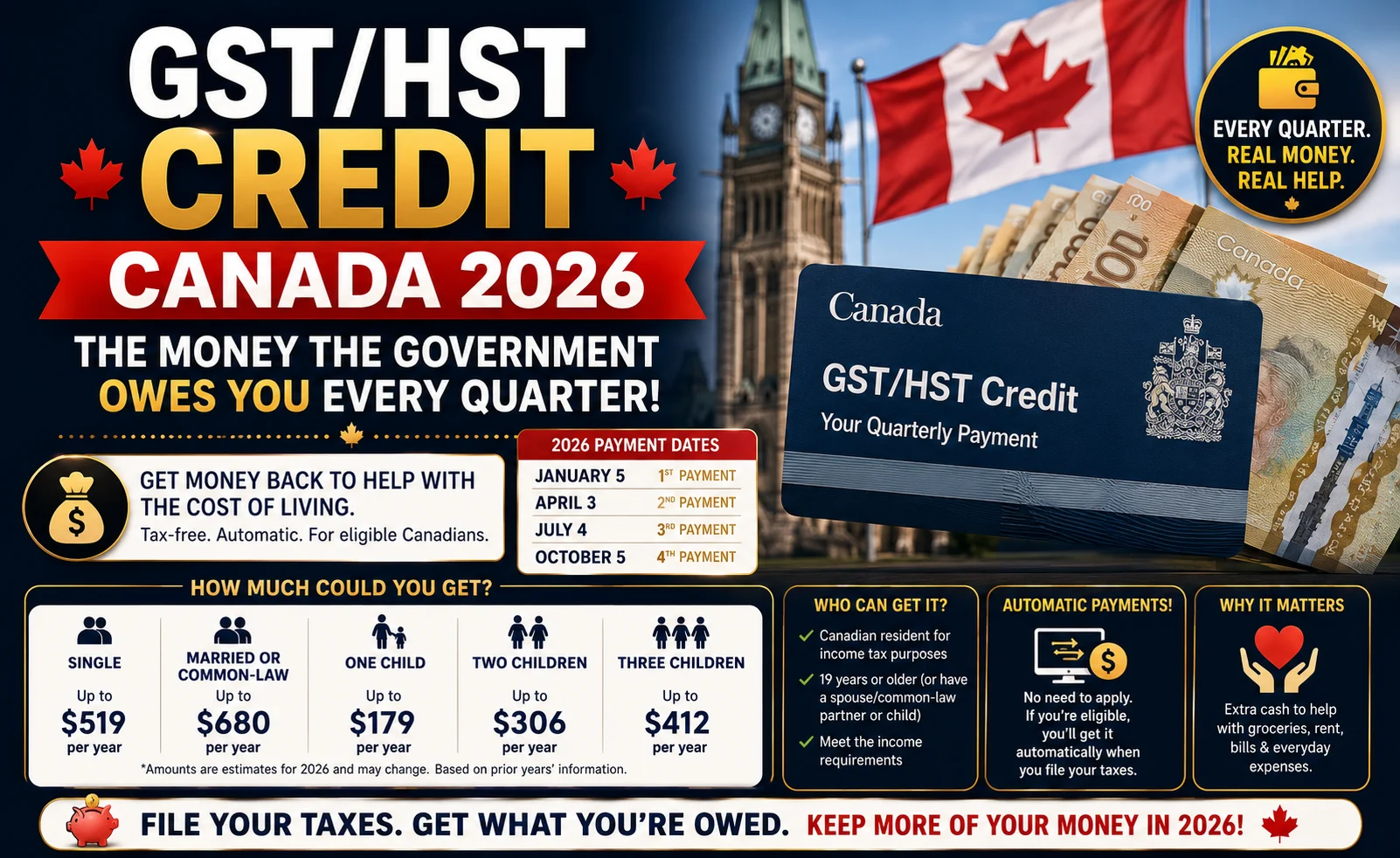
- The GST/HST credit for the July 2025 to June 2026 benefit year pays up to $519 per year for single adults, $680 for couples, and $179 per child under 19
- Starting July 2026 the government is increasing the credit by 25% for five years under the new Canada Groceries and Essentials Benefit — the biggest single increase to this program since it launched
- A one-time top-up equal to 50% of the 2025 to 2026 value was issued to eligible recipients no later than June 2026
- The four official 2026 payment dates are January 5, April 2, July 3, and October 5
- You do not need to apply — the CRA calculates and pays the credit automatically when you file your tax return
- The credit begins to phase out when adjusted family net income exceeds approximately $44,000 for singles or $58,000 for families
- Newcomers who have not yet filed a Canadian tax return can apply immediately using Form RC151 — you do not have to wait until tax season
- RRSP contributions reduce your net income and can directly increase the amount of GST credit you receive
The Quarterly Deposit Most Canadians Take For Granted
Fatima had been in Canada for eleven months when she first noticed it. A deposit appeared in her bank account on a Tuesday morning. $127.50. No explanation in the notification. She called the bank. They told her to check the CRA website.
It was her first GST credit payment.
She had filed her tax return six months earlier — her first Canadian return, which she had submitted mostly to establish her record with the CRA. She had earned modest income in her first year. She had not expected to receive anything back. And then one Tuesday morning $127.50 arrived, and three months later it arrived again, and three months after that again.
By the end of her second year in Canada, Fatima had received $510 in GST credit payments. Not a life-changing amount. But real money that offset real grocery bills during a year when every dollar counted.
This is what the GST/HST credit actually is in practice. A quiet quarterly reminder from the federal government that the tax system is trying, at least partially, to account for the fact that sales tax hits lower-income households proportionally harder than higher-income ones.
Related: Canada Child Benefit 2026 — How Much You Get, Every Payment Date, and How to Apply
Related: How to File Taxes in Canada for the First Time — The Complete 2026 Guide
Related: How to Start a Small Business in Canada in 2026 — The Complete Honest Guide
What Changed in 2026 — The Biggest News
Before getting into how the credit works, there is a significant 2026 update worth understanding because it affects every eligible Canadian.
The Government of Canada is increasing the Canada Groceries and Essentials Benefit — formerly the GST/HST credit — by 25% for five years starting in July 2026.
This is the biggest single increase to this program since it launched in 1991. A single adult who was receiving the maximum $519 per year will receive approximately $649 starting in July 2026. A couple at the maximum $680 will receive approximately $850. Per-child amounts increase proportionally as well.
There is also a one-time top-up. A one-time top-up payment equal to 50% of the 2025 to 2026 value was issued to eligible and entitled recipients of the January 2026 payment no later than June 2026. If you were receiving the credit in January 2026, this top-up should have already arrived in your account. Check your CRA My Account if you are not sure whether you received it.
The July 2026 payment will be the first at the new higher rate. If you have been receiving the credit, expect a noticeably larger deposit in July than you received in April.
How Much You Get — The 2026 Amounts
The GST/HST credit in Canada for 2026 pays a maximum of $519 per year for a single adult, $680 for a couple, and $179 per child under 19 for the July 2025 to June 2026 benefit year.
Payments are divided into four equal quarterly instalments. So a single adult receiving the maximum $519 per year receives $129.75 per quarter. A couple with two children under 19 receiving the maximum $680 plus $358 in child supplements receives $259.50 per quarter.
These amounts are for the current benefit year running through June 2026. Starting July 2026, those amounts increase by 25 per cent under the Canada Groceries and Essentials Benefit rebrand.
The Income Thresholds — Where the Credit Starts Phasing Out
The credit is income-tested. It does not disappear suddenly once you earn above a threshold — it gradually reduces as income rises.
The credit begins to phase out when your family net income exceeds approximately $44,000 for singles or $58,000 for families. The phase-out rate is 5% of net family income above the threshold — meaning for every $1,000 of income above the threshold, your credit decreases by $50.
Here is what that looks like in practice for a single adult:
| Adjusted Net Income | Annual GST Credit |
|---|---|
| Under $44,000 | Up to $519 (maximum) |
| $44,000 | Begins phasing out |
| $50,000 | Approximately $219 |
| $54,360 | $0 — fully phased out |
For a couple with two children the threshold is higher and the credit phases out more gradually because the per-child additions extend eligibility further up the income scale.
The practical takeaway is that the credit is not just for people with very low incomes. A family of four earning $70,000 may still receive a partial credit. If you have never checked your eligibility because you assumed you earn too much — check again.
The Four 2026 Payment Dates
The GST/HST credit payment dates in 2026 are January 5, April 2, July 3, and October 5.
Mark these four dates in your calendar or set reminders in your phone. If the expected payment has not arrived within five business days of each date, contact the CRA — either through My Account online or by phone at 1-800-387-1193.
A note on the July payment: this is the most important one each year. The July payment is the first of the new benefit year and is calculated based on your previous year’s tax return. If your income changed significantly — went up or went down — the July payment reflects that change. Filing your tax return early in the spring ensures the CRA has your current income information when calculating the July amount.
If you filed your taxes after the July calculation date, you must wait until the CRA has assessed your tax return to determine if you are entitled to receive the credit. If any entitled credit amounts were missed, you will receive retroactive payments in the next scheduled payment.
The January and April 2026 payments were based on your 2024 tax return. The July and October 2026 payments are based on your 2025 tax return. This is why filing your 2025 return early matters — the sooner CRA processes it, the sooner the July payment reflects your current income.
Who Qualifies — The Eligibility Rules
To receive the GST/HST credit, you must be a resident of Canada for tax purposes at the start of the payment month, and you must be at least 19 years old — or younger if you have a spouse, common-law partner, or are a parent.
If you turn 19 during the year, you must file your tax return for the previous year to ensure you start receiving the GST/HST credit soon after your birthday. File your tax return even if you have no income to report — the CRA will automatically determine your eligibility based on the previous year’s return and issue your first payment on the payment date that comes after your 19th birthday.
The citizenship and residency requirements are broader than most people assume. You do not need to be a Canadian citizen. You need to be a resident of Canada for tax purposes — meaning you have established residential ties in Canada including a home, a bank account, or family connections. Permanent residents, refugees, and many temporary residents including work permit holders and some student visa holders qualify.
How to Apply — Or More Accurately, How Not to Miss It
Here is the part that surprises most first-time filers. You do not apply for the GST credit separately. You do not need to apply — the CRA calculates the credit automatically when you file your T1 return.
That is it. File your tax return. The CRA assesses your eligibility automatically, calculates your amount based on your income and family situation, and starts paying it quarterly. There is no separate form, no additional application, and no deadline beyond the standard April 30 tax filing deadline.
The only action required is filing your tax return every single year without fail. The CRA cannot assess your eligibility without a filed return. An estimated 10 to 12 per cent of eligible Canadians miss out on this credit every year simply because they did not file a tax return — often because they believed they had no income to report and therefore no reason to file.
If you have no income and are a Canadian resident aged 18 or older — file anyway. A zero-income return takes twenty minutes to file through Wealthsimple Tax for free and triggers the GST credit assessment, RRSP room accumulation, and eligibility for provincial benefits all at once.
For Newcomers — Do Not Wait Until Tax Season
This section specifically matters for anyone who arrived in Canada recently.
If you are a newcomer who has not yet filed a Canadian tax return — because you arrived mid-year or recently — you do not have to wait until next April to start receiving the GST credit.
Newcomers can file Form RC151 on arrival to start payments before their first Canadian tax return.
Form RC151 is a GST/HST Credit Application for Individuals Who Become Residents of Canada. Filing it tells the CRA you are a new resident and allows them to assess your GST credit eligibility before your first full tax return is filed. You can download it at canada.ca/rc151 or pick it up at any Service Canada location.
This matters most for newcomers who arrive in the first half of a calendar year. If you arrive in March and do not file RC151, you wait until April of the following year to file your first return, and then until July before the first GST credit payment arrives — a wait of sixteen months from arrival. Filing RC151 immediately after landing shortens that timeline significantly.
The RRSP Strategy — Increasing Your GST Credit
Here is a connection most Canadians do not make until someone explains it to them.
RRSP contributions reduce your net income, which can increase both the GST/HST credit and the Canada Workers Benefit you receive.
If your income sits just above the GST credit phase-out threshold — say $46,000 as a single adult when the phase-out starts at $44,000 — contributing $2,000 to your RRSP reduces your net income to $44,000, bringing you back to the maximum credit amount. The $2,000 RRSP contribution generates a tax refund at your marginal rate AND increases your quarterly GST credit. Two benefits from one contribution.
This is particularly relevant for middle-income Canadians who assume they earn too much to receive the GST credit. A meaningful RRSP contribution can bring net income below the threshold and unlock the full credit — or at minimum increase a partial credit — while simultaneously building retirement savings.
The Provincial Top-Ups — Extra Money Alongside Your Federal Credit
The federal GST credit is not always the only payment arriving on those four quarterly dates. Several provinces deliver their own credits alongside the federal payment.
British Columbia — BC Climate Action Tax Credit
In 2026, BC adults receive up to $447 annually in Climate Action Tax Credit, with an additional $111.50 per child. This arrives in the same quarterly payments as the federal GST credit for eligible BC residents.
Ontario — Ontario Sales Tax Credit
The Ontario Sales Tax Credit forms part of the Ontario Trillium Benefit and is paid monthly to eligible Ontario residents. The OSTC specifically offsets the provincial portion of sales tax for low and moderate income households.
Nova Scotia — Affordable Living Tax Credit
A quarterly tax-free benefit that supplements the GST/HST credit for low-income Nova Scotians.
Alberta
Alberta has no provincial sales tax, but the province has introduced its own affordability relief measures that work alongside the federal credit for Alberta residents.
The key principle across all provinces: always file your taxes, and file on time. Many provincial credits require the federal return as their foundation, and late filers may miss payment windows even if they are entitled to the money.
What Happens If You Miss a Payment
If a payment date passes and the expected amount has not arrived, wait five business days before taking action — banking delays and federal holidays can shift timing slightly.
After five business days, check your CRA My Account first. The payment history section shows every GST credit payment issued, the amount, and the method. If a payment shows as issued but has not arrived in your bank account, verify that the banking information on file with the CRA matches your current account number. A change of bank account that was not updated with the CRA is the most common reason for missed payments.
If no payment shows as issued — and you filed your return and believe you qualify — contact the CRA at 1-800-387-1193. Have your SIN, your most recent notice of assessment, and your current banking information ready.
The Canada Groceries and Essentials Benefit — The New Name Explained
Starting July 2026, the GST/HST credit is officially being rebranded as the Canada Groceries and Essentials Benefit. The name change reflects the federal government’s intent to signal that this payment exists specifically to help with the cost of everyday essentials — groceries, household goods, the things affected by sales tax.
The mechanics are identical to the GST/HST credit. The eligibility rules, payment dates, and income thresholds remain the same. The only things changing are the name, the 25 per cent increase in payment amounts, and the five-year commitment to maintain that increase rather than reverting to the previous amounts.
For existing recipients, nothing action is required. Payments continue automatically on the same quarterly schedule. The July 2026 payment will simply be 25 per cent larger than the April 2026 payment.
For Canadians who have been receiving zero because they have not been filing — July 2026 is the best moment in the history of this program to start. File your 2025 return now if you have not already. The CRA will assess your eligibility in time for the July payment at the new higher rate.
Official Resources — GST/HST Credit Canada 2026
| Resource | Link |
|---|---|
| CRA GST/HST credit main page | canada.ca/gst-credit |
| 2026 payment dates — official | CRA payment dates |
| Form RC151 — newcomer application | RC151 download |
| CRA My Account — check payments | CRA My Account |
| Canada Groceries and Essentials Benefit | canada.ca/groceries-benefit |
| Free tax filing — Wealthsimple Tax | wealthsimple.com/tax |
| CRA phone — benefit enquiries | 1-800-387-1193 |
Sources: Canada Revenue Agency — GST/HST Credit Payment Dates | CRA — Canada Groceries and Essentials Benefit Announcement | Wealthvieu — GST/HST Credit 2026 | LifeMoney.ca — GST/HST Credit Canada 2026 | Canada Tax Calculator — GST/HST Credit 2026 | Data current as of May 25, 2026.
This article is for informational purposes only and does not constitute financial or tax advice.
Have a correction? Email [email protected]
Did you know the GST credit was being renamed and increased by 25% in July 2026? Are you currently receiving it or did you just discover you qualify? Share in the comments — and send this to every Canadian who might be missing out on money the government owes them every quarter.
Enjoying Maplestime? Support independent Canadian journalism — no paywall, no corporate owners.