



Canadian lifestyle news — when David moved to Edmonton from London with his family in 2025, the first practical question he had after sorting out his SIN and bank account was also the most personal one. Where does a Muslim family find halal food in Alberta? Not as a tourist. Not for a week. As people building a permanent life here, who needed to feed four children every day from a grocery budget and the occasional restaurant meal, in a city they were still figuring out. The answer, it turned out, was better than he had expected — and more nuanced than any single article had prepared him for. This guide is the one he wishes had existed on his first day.
By Maplestime Lifestyle Desk | Canada | May 25, 2026 Sources: HalalCodeCheck | The Halal Food Canada | HMA Canada | ISNA Halal | Last verified: May 25, 2026
Key Takeaways
- Canada’s halal food market is projected to exceed $4.3 billion by 2029, driven by a growing Muslim population and rising interest from health-conscious consumers
- Canada has over 1.8 million Muslims — making halal food infrastructure in major cities genuinely substantial
- The two most trusted halal certification bodies in Canada are HMA — Halal Monitoring Authority — and ISNA Canada — Islamic Society of North America
- Specialist halal grocers in Toronto, Ottawa, Montreal, Calgary, and Vancouver are the most reliable option for certified halal meat and grocery staples
- No Frills and FreshCo carry halal meat at stores located in areas with large Muslim communities — but availability varies significantly by location
- Kosher certification is not a substitute for halal — there are key differences around alcohol content and slaughter methods
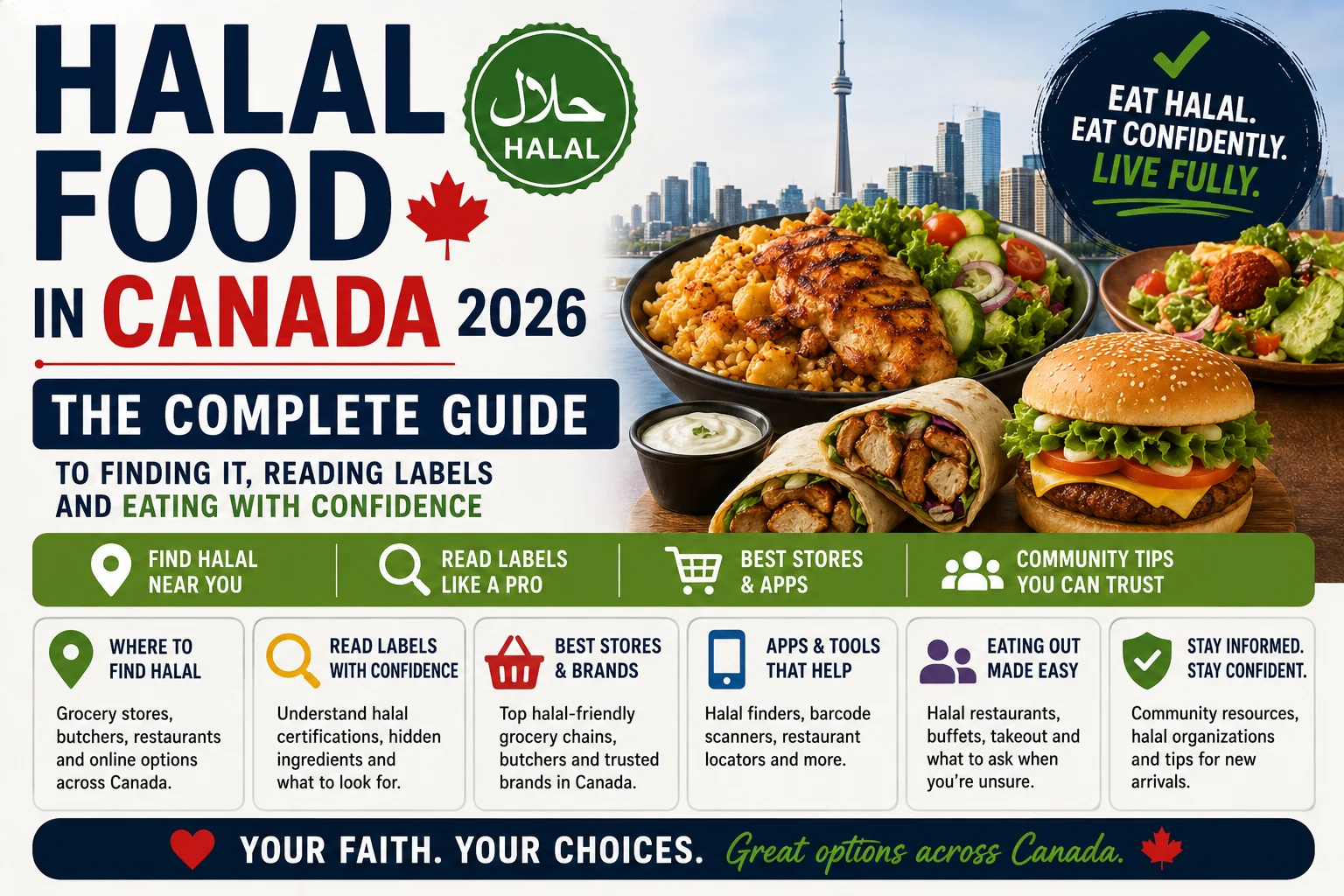
- Halal grocery stores across Canada carry fresh meats, imported spices, frozen halal prepared foods, and specialty ingredients from Middle Eastern, South Asian, and African cuisines
- Halal Eats Canada and The Halal Food directory are the best online tools for finding certified halal restaurants near you across every Canadian city
The Question Every Muslim Newcomer Asks First
 David’s family landed in Edmonton on a Thursday evening in September. They had done their research. They knew about the cold. They had arranged temporary accommodation. His wife had a nursing job starting the following Monday.
What they had not fully solved before landing was the food question.
Their eldest daughter was twelve and had never eaten non-halal meat. Their youngest was four and ate everything. They needed to know, within the first forty-eight hours of Canadian life, where to buy halal chicken for Sunday dinner.
They asked their temporary accommodation host — a kind retired teacher who had welcomed several newcomer families over the years. She gave them an address in the Mill Woods neighbourhood of Edmonton. An Islamic grocery store three bus stops away that the community had been using for fifteen years. They went Saturday morning. The store was full of families who looked like them, spoke languages they recognised, and sold chicken, lamb, and beef with certification stamps David recognised from back home.
By the following week he had found two halal butchers, one Pakistani grocery, and a Middle Eastern restaurant that quickly became his family’s Saturday tradition.
Canada’s halal food infrastructure is not perfect everywhere. But it is significantly better than most newcomers from Muslim-majority countries expect — and growing rapidly every year.
Related: Best Cities to Live in Canada 2026 — The Honest Guide to Where Life Actually Works
Related: Best Free Things to Do in Canada 2026 — The Complete City by City Guide
Related: Cheapest Grocery Stores in Canada 2026 — The Honest Ranking That Will Actually Save You Money
Understanding Halal Certification in Canada — Who to Trust
This is the most important section for anyone who takes halal seriously. Not all halal labels in Canada carry the same weight. Understanding which certification bodies are rigorous and which are not is the foundation of confident halal shopping.
In Canada, the most recognised and rigorous certification organisations are HMA and ISNA Canada. A halal logo from either of these organisations on the front or back of a package is the fastest verification.
HMA — Halal Monitoring Authority
For over 20 years, HMA has served Muslim communities nationwide, delivering assurance through authentic halal certification. The Jami’yyatul Ulama Canada — a federally registered non-profit — established HMA in March 2004 to provide clear, consistent, and trustworthy halal oversight as the Muslim community and halal industry grew rapidly.
HMA is considered by many Canadian Muslim scholars and community leaders to be the most stringent certification body in the country. Their process includes surprise audits — unannounced inspections of facilities to verify ongoing compliance rather than just compliance at the time of certification. Products certified by HMA carry their logo clearly on packaging.
Find HMA-certified restaurants, butchers, and grocery stores at hmacanada.org.
ISNA Canada — Islamic Society of North America
ISNA Halal has been serving the community since 1988. ISNA emphasises continuous compliance through meticulous record-keeping and planned inspections. The ISNA logo on food labels and restaurant windows is widely recognised across Canadian Muslim communities.
ISNA Canada certifies restaurants, meat processors, grocery stores, and packaged food manufacturers. Their certification covers meat processing, packaged foods, nutraceuticals, and pharmaceuticals — a broader scope than some other bodies.
ISNA Canada’s approach uses planned inspections with detailed documentation requirements. The ISNA Halal logo is one of the most widely recognised halal certification marks in Canadian retail.
Other Canadian Halal Certification Bodies
Several regional and community organisations also provide halal certification in Canada. The Islamic Food and Nutrition Council of Canada, the Halal Transactions of Omaha, and various mosque-based certification programs operate in specific regions or for specific product categories.
For unfamiliar certification logos — particularly on packaged goods in mainstream grocery stores — a quick search of the certification body’s name alongside “Canada” and “halal” will tell you whether they are a recognised organisation.
The Warning About Self-Declared Halal
Some restaurants and food producers claim to be halal without any third-party certification. This is legal in Canada — there is no federal law requiring third-party halal certification. For observant Muslims this means the word “halal” on a sign or menu without a certification logo requires additional verification — asking the restaurant directly which certification they use, which slaughterhouse supplies their meat, and whether alcohol is used in food preparation.
Restaurants in heavily Muslim-populated areas that have served the community for years and are known within the community often operate with implicit community trust even without formal certification. But for a newcomer without established community knowledge — a recognised certification logo is the most reliable shortcut.
Reading Canadian Food Labels — What to Look For
Between confusing certification logos, unrecognised E-codes, and ingredients that vary by manufacturer, knowing what is actually halal at a Canadian supermarket is harder than it should be.
Here is the practical label-reading guide for Canadian grocery shopping.
Step One — Find the Certification Logo
Look for the HMA or ISNA Canada logo on the front or back of the package. Other recognised logos include those from regional Canadian certification bodies and internationally recognised bodies from the UK, Australia, and the US.
If there is no certification logo — move to step two.
Step Two — Check the Ingredient List for Common Concerns
Gelatin — Often derived from pork unless specifically labelled as beef or fish gelatin. Appears in gummy candies, marshmallows, yogurt, cream cheese, and many desserts. If the source is not specified, the safest assumption is that it may be pork-derived.
Emulsifiers and additives with E-codes — The E-code system numbers food additives. The ones most likely to be of animal origin:
E120 (Carmine/cochineal) — derived from insects. Considered non-halal by many scholars.
E441 — gelatin-based.
E470 to E495 — fatty acid derivatives. May be of animal origin. Look for plant-derived alternatives.
Alcohol in flavourings — Natural flavourings in processed food sometimes contain alcohol as a carrier. This is more common in vanilla extract and certain fruit flavourings. Look for “alcohol-free” labelling if this is a concern.
Rennet in cheese — Traditional cheese uses animal rennet which may not be halal. Look for “microbial rennet” or “vegetable rennet” on cheese packaging, or purchase cheese with a halal certification.
The Kosher Question
Kosher food is sometimes used as a proxy for halal in Canada, especially for products where halal certification is hard to find. While kosher certification ensures pork-free ingredients and proper slaughter for beef, there are key differences. Alcohol is present in some kosher products — not halal. Kosher is a useful signal but not a substitute for halal certification.
The practical guidance: for packaged goods where halal certification is unavailable and the ingredients appear clean — kosher can be a useful secondary signal. For meat specifically, kosher slaughter methods and halal slaughter methods have meaningful differences that make them non-interchangeable for strict halal adherence.
Where to Find Halal Food — City by City
Toronto and the GTA — The Best Halal Infrastructure in Canada
Toronto has the most developed halal food ecosystem in Canada. The combination of a large Muslim population concentrated in Mississauga, Brampton, Scarborough, North York, and the downtown core has produced a halal food market of genuine depth and variety.
Specialist halal grocers across the GTA carry fresh meats, imported spices, frozen halal prepared foods, and specialty ingredients from Middle Eastern, South Asian, and African cuisines. Alsham Food Market and similar family-owned Middle Eastern grocery stores provide both halal-certified fresh meat and an extensive range of specialty ingredients.
Mississauga’s halal restaurant and grocery scene is particularly strong — a concentration of Pakistani, Middle Eastern, East African, and South Asian halal establishments that rivals anything in many major international cities. The Erin Mills and Hurontario corridors specifically have become informal halal food districts.
How to find halal in Toronto: The Halal Food directory at thehalalfood.ca and Halal Eats Canada at halaleatscanada.com both maintain searchable databases of certified halal restaurants and grocery stores across the GTA. Search by neighbourhood, cuisine type, or certification body.
Ottawa — Halal in the Capital
Ottawa has a meaningful and growing Muslim population concentrated in areas including Orleans, Barrhaven, and Gloucester. The city has a well-established halal food scene anchored by Pakistani, Moroccan, Lebanese, and Somali communities.
Ottawa Kabab is one of the most well-known halal establishments in the city — certified, community-trusted, and a popular choice for both individual meals and catering. The Carling Avenue and Richmond Road corridors have concentrations of halal restaurants. Barrhaven specifically has become a suburb with significant Muslim community presence and corresponding halal food infrastructure.
For halal groceries in Ottawa, Pakistani and Middle Eastern grocery stores in the Bayshore, Gloucester, and Orleans areas carry halal-certified meat and a wide range of imported specialty products.
Calgary — The Prairie Halal Hub
Calgary’s Muslim population has grown significantly over the past decade. The city’s halal food infrastructure has expanded to match — with Pakistani, Afghan, Somali, and Middle Eastern communities having established a meaningful network of halal restaurants and grocery stores.
The International Avenue in Forest Lawn — 17th Avenue SE — is Calgary’s most ethnically diverse commercial strip and home to a concentration of halal restaurants and grocery stores serving South Asian, East African, and Middle Eastern communities. The Marlborough Mall area also has significant halal food retail.
In Northwest Calgary, the community around the Sarcee Trail corridor has seen growth in South Asian halal establishments. Muslim Link Canada maintains a Calgary-specific halal directory that is updated regularly.
Vancouver and Surrey — West Coast Halal
Vancouver’s Muslim community is smaller than Toronto’s or Calgary’s but concentrated and well-served. Surrey BC specifically — where a large South Asian Muslim community has established deep roots — has one of the most developed halal food ecosystems in Western Canada.
The Fleetwood and Newton neighbourhoods of Surrey have concentrations of Pakistani, Afghan, and Indian Muslim halal restaurants and grocery stores. Whalley in Surrey is another neighbourhood with meaningful halal food retail.
In Metro Vancouver proper, halal options are concentrated in East Vancouver and around Commercial Drive. The Halal Food directory covers Vancouver and Surrey with a growing database of certified establishments.
Winnipeg — The Underrated Halal Scene
Winnipeg’s Muslim community is smaller than Canada’s largest cities but has grown meaningfully over the past decade — driven partly by refugee resettlement programs that have brought significant numbers of Somali, Iraqi, and Afghan families to Manitoba.
Alsham Food Market in Winnipeg is a family-owned Middle Eastern grocery store offering a wide range of halal-certified products.
The North End of Winnipeg — historically a neighbourhood of successive waves of immigration — has seen growth in Muslim community presence. William Avenue and the surrounding north end area have halal food options including Somali restaurants and Middle Eastern grocery stores.
The Masjid Ibrahim mosque community on Bannerman Avenue and the Manitoba Islamic Association on Inkster Boulevard both serve as community hubs that can direct newcomers to trusted halal food sources in Winnipeg when community-based knowledge is the most reliable guide.
Smaller Cities — What to Expect
In smaller Canadian cities — Saskatoon, Regina, Fredericton, Halifax, Thunder Bay, and similar — halal food infrastructure is less developed but not absent. Muslim student associations at universities often maintain local halal food resources. Mosques in smaller cities invariably know where community members are sourcing halal meat. Social media groups for Muslims in smaller Canadian cities are often the most current and practical source of local halal information.
The practical advice for smaller cities: find the local mosque first. The community knowledge about where halal food is available in your city will be far more current and specific than any national directory.
Halal Shopping at Canadian Mainstream Grocery Stores
Most mainstream Canadian grocery chains carry some halal-certified products but the availability varies significantly by location and category.
Meat — The Most Important Category
No Frills and FreshCo carry halal meat at stores located in areas with large Muslim communities — but availability varies significantly by location.
The strategy: call ahead to the specific store location before making a trip specifically for halal meat. Ask specifically whether their meat section carries HMA or ISNA-certified halal chicken, beef, or lamb. Stores in Mississauga, Brampton, Scarborough, Edmonton’s Mill Woods, and Calgary’s Forest Lawn area are more likely to carry halal meat in mainstream stores than locations in less diverse neighbourhoods.
Specialty halal butchers remain the most reliable option for fresh halal meat. A dedicated halal butcher sources exclusively from certified slaughterhouses, maintains segregated equipment and storage, and typically has community accountability that mainstream retailers do not.
Packaged and Frozen Foods
The halal certified packaged food market in Canada has expanded considerably. Frozen and prepared halal foods — from samosas to falafel, vine leaves to kebab patties — are available through specialist halal grocery stores.
In mainstream stores, look for HMA or ISNA certification logos on packaged goods. Frozen halal chicken brands including Zabiha Halal and Sunrise Farms are distributed to many mainstream Canadian grocery locations. The Zabiha Halal brand in particular has broad distribution across Ontario and is increasingly available in other provinces.
The Apps That Help
Halal Eats Canada at halaleatscanada.com — searchable database of halal restaurants across Canada with cuisine type, location, and certification information.
The Halal Food at thehalalfood.ca — covers both restaurants and grocery stores with community-updated listings.
Muslim Pro — widely used by Muslim communities globally, includes a halal restaurant finder with Canadian coverage.
Zabihah at zabihah.com — one of the oldest halal restaurant directories globally with meaningful Canadian coverage in major cities.
The Fastest Way to Find Halal Food in a New City
When David arrived in Edmonton he eventually figured out a three-step process that any Muslim newcomer can apply in any Canadian city on day one.
Step one — Find the nearest mosque. Google “mosque near me” or “Islamic centre” with your city name. The mosque community will know every halal food resource in the city — restaurants, butchers, grocery stores — and community members are genuinely generous with this information to new arrivals.
Step two — Check the halal directories. Halal Eats Canada and The Halal Food cover major cities. Search for your city and filter by category — restaurant, grocery, butcher.
Step three — Join the local Muslim community Facebook group or WhatsApp group. In virtually every Canadian city with a Muslim community, there is an active social media group where community members share recommendations, warn about quality issues, and help newcomers navigate local halal resources. These groups are invariably more current than any published directory.
A Note for Non-Muslim Canadians Reading This
Halal food in Canada is not exclusively consumed by Muslims. Halal certification has become a quality and ethics marker that appeals to a broad range of consumers — people who want assurance about how their food was produced, people who avoid pork for various reasons, and people who simply appreciate the transparency that certification provides.
Canada’s halal food market is driven not only by the growing Muslim population but also by rising interest from health-conscious consumers who associate halal certification with quality standards.
Halal restaurants in Canada — particularly Pakistani, Middle Eastern, Somali, and North African establishments — are among the most underrated dining destinations in the country regardless of a diner’s religious background. The food is genuinely excellent, the hospitality is typically warm, and the value relative to other dining options is consistently strong.
Official Resources — Halal Food Canada 2026
| Resource | What It Offers | Link |
|---|---|---|
| HMA Canada | Certified halal restaurants and stores directory | hmacanada.org |
| ISNA Halal | Certified products and food businesses | isnahalal.com |
| The Halal Food Canada | National halal restaurant and grocery directory | thehalalfood.ca |
| Halal Eats Canada | Restaurant-focused halal directory | halaleatscanada.com |
| Zabihah | Global halal restaurant finder with Canadian coverage | zabihah.com |
| Muslim Link Canada | Canadian Muslim community news and local directories | muslimlink.ca |
Sources: HalalCodeCheck — Halal Food in Canada Guide 2026 | The Halal Food Canada — Grocery Directory | HMA Canada — About HMA | ISNA Halal — About ISNA | The Halal Food Canada — Top Certification Issuers | Data current as of May 2026.
Have a correction or a halal food recommendation for your city? Email [email protected]
Where do you find the best halal food in your Canadian city — and what is the one restaurant or grocery store you would recommend to every Muslim newcomer arriving there for the first time? Share in the comments. And send this guide to every Muslim family navigating halal food in Canada for the first time.
Enjoying Maplestime? Support independent Canadian journalism — no paywall, no corporate owners.