


Canadian lifestyle news — James landed in Winnipeg on the second of January. He had packed what he considered a heavy coat. It was a wool coat he had bought specifically for the trip, the warmest thing he had ever owned, and he was proud of it. He walked out of the James Armstrong Richardson International Airport into minus twenty-seven degrees Celsius and understood within thirty seconds that the coat was essentially decorative. The cold was not like cold he had known before. It had texture. It had presence. It moved through the wool like the fabric was not there. By the time the taxi arrived he had learned something that no amount of reading had prepared him for — Canadian winter is a completely different category of experience from anything that merely sounds cold. This guide gives you everything James had to learn the hard way.
By Maplestime Lifestyle Desk | Canada | May 25, 2026 Sources: RBC My Money Matters | WiseMove Canada | VisaVio Immigration | Winnipeg Economic Development | Last verified: May 25, 2026
Key Takeaways
- Canadian winters vary enormously by region — Winnipeg regularly hits minus forty with wind chill while Vancouver barely gets snow and is mostly cold rain
- The three-layer system is the only technique you need — base layer wicks moisture, middle layer traps heat, outer layer blocks wind and water
- Never wear cotton — cotton retains moisture and makes you colder, risking frostbite
- Five non-negotiable items prevent hypothermia — insulated waterproof boots rated to minus thirty Celsius, a toque, insulated gloves or mittens, a neck gaiter, and a proper winter coat
- Wind chill is what actually hurts you — minus fifteen with strong wind feels like minus twenty-eight on exposed skin
- Avoid alcohol before going outside in serious cold — it makes you feel warm while your body loses heat faster
- Vitamin D supplementation is medically important from October through April — the Canadian sun is too weak for natural synthesis during winter months
- Your second winter will feel completely manageable — the first one is the one that tests you
The Thing Nobody Warns You About
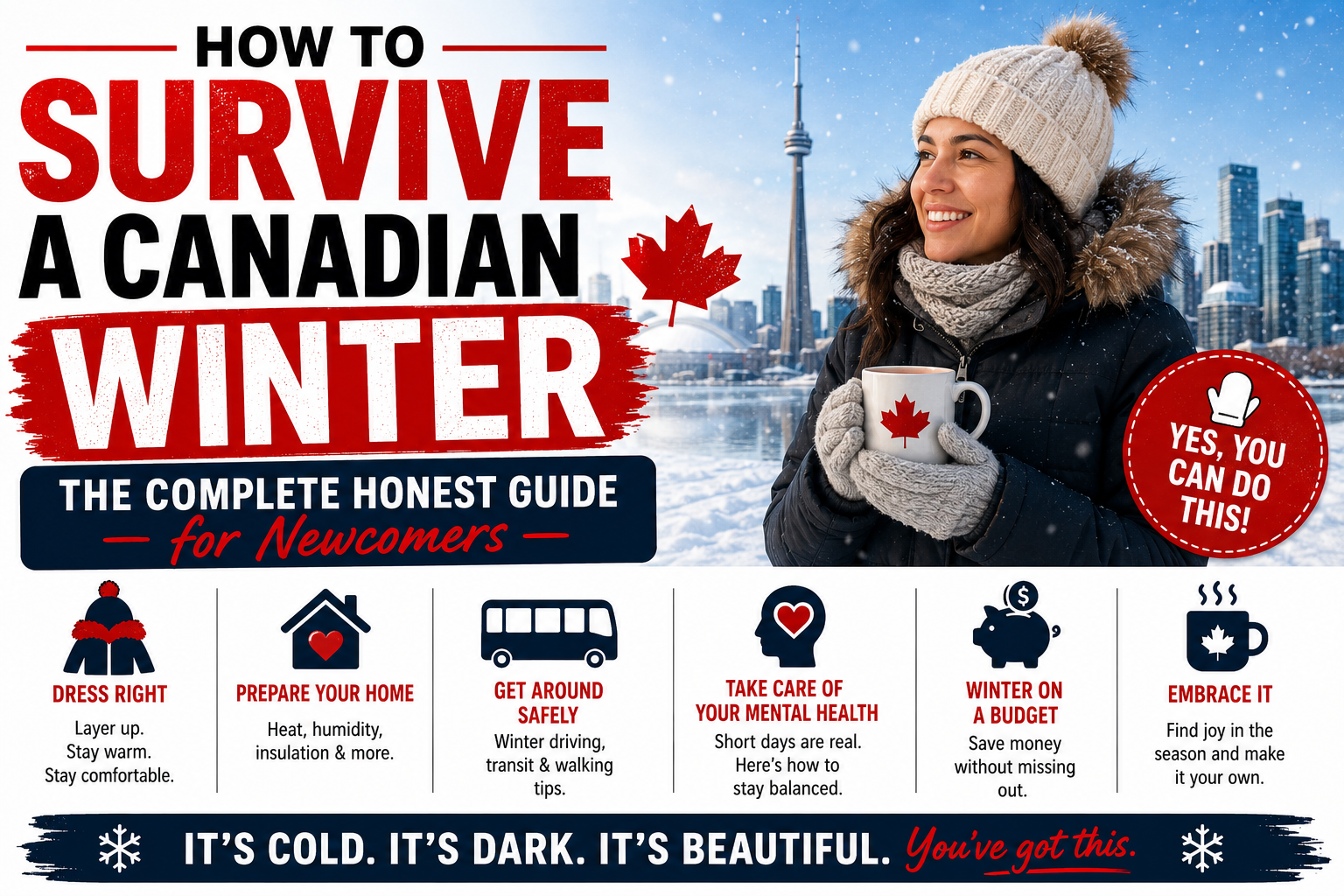
The cold is not actually the hardest part. That sounds impossible but it is true.
The cold is solvable. Canadians have spent generations figuring out how to dress for it, how to heat their homes against it, how to commute at minus twenty-five without losing feeling in their fingertips. The knowledge exists. The gear exists. The systems work beautifully once you understand them.
What nobody warns newcomers about is the darkness.
From November through February in most of Canada the sun sets before five in the afternoon. By December in Winnipeg, sunrise is around eight and sunset is around four. You leave for work in the dark and you come home in the dark and entire days pass without meaningful natural light. This is the part that quietly wears people down who were not expecting it.
Both problems are solvable. The cold through gear and layering technique. The darkness through Vitamin D, light therapy lamps, deliberate outdoor time on cold days, and the understanding that February always ends.
By his second winter James had figured all of this out. He bought the right boots. He learned the three-layer system. He started taking Vitamin D in October. He joined a recreational hockey league — he had never played hockey before in his life — and showed up every Sunday night at an arena in St. James where nobody cared that he was a complete beginner. By March he was genuinely looking forward to the following winter. By his third year he was the person at work explaining wind chill to newer colleagues.
Here is everything he learned.
Related: Seasonal Affective Disorder Canada — What It Is and How to Cope
Understanding Canadian Cold — The Numbers Mean Different Things Here
Before the gear list you need to understand how Canadian cold actually works. Because the temperature on your phone’s weather app is only half the story.
The Temperature Scale
Canada uses Celsius. Zero degrees is the freezing point of water. Minus ten is cold. Minus twenty is very cold. Minus thirty and below is dangerous for exposed skin within minutes. Minus forty — which Winnipeg, Saskatoon, and parts of Alberta regularly reach during January — is a temperature where the Celsius and Fahrenheit scales coincide and both numbers are equally alarming.
Ignoring regional differences is one of the biggest newcomer mistakes. Vancouver winter gear will not work in Winnipeg. Research your specific region’s climate patterns and prepare accordingly.
Where you live in Canada determines your entire winter reality:
Winnipeg, Saskatoon, Regina, Edmonton — The coldest major cities in Canada. Sustained periods at minus twenty to minus thirty-five are routine from December through February. Wind chill regularly pushes the felt temperature below minus forty. This is serious cold that demands serious preparation. No compromises on gear.
Toronto, Ottawa, Montreal — Cold and genuinely snowy but less extreme than the Prairies. Minus ten to minus twenty is typical January territory. Wind chill matters significantly. Real winter gear is absolutely necessary.
Halifax and Atlantic Canada — Cold and damp. Temperatures often hover around freezing with significant snow and ice. The wet cold penetrates clothing more aggressively than dry Prairie cold — it feels colder than it looks on paper.
Vancouver, Victoria — Mild by Canadian standards. Temperatures rarely drop below minus five. Rain is the primary winter challenge rather than snow. A high-quality waterproof jacket matters far more than extreme insulation here.
Wind Chill — The Number That Actually Matters
Wind chill is the felt temperature on exposed skin accounting for how wind strips heat from your body. This is what determines frostbite risk — not the thermometer reading alone.
At minus fifteen Celsius with winds at sixty kilometres per hour the felt temperature on your exposed face is minus twenty-eight. When temperatures drop to minus twenty degrees Celsius or below with wind chill, add extra layers for warmth. Mittens trap more heat than gloves for keeping fingers warm and a face covering protects cheeks and nose from harsh winds.
Check the Environment Canada weather app every morning. The wind chill number sits in the forecast alongside the actual temperature. The wind chill is your real number. If it shows minus twenty-five or below — every centimetre of skin gets covered before you step outside.
The Three-Layer System — The Only Technique You Need
Every experienced Canadian winter person — whether they grew up here or learned the hard way like James — uses the same fundamental approach. Three layers. Three distinct jobs. All three working together.
Use the three-layer method to retain heat and stay dry.
Think of it as three employees doing three different jobs simultaneously. Hire the right ones and you can stand outside at minus twenty-five for an hour and feel genuinely comfortable. Miss one and the whole system fails regardless of how expensive everything else is.
Layer One — The Base Layer
The base layer sits directly against your skin. Its only job is moving moisture — your sweat — away from your body and outward. It has nothing to do with keeping you warm directly. It keeps your skin dry, and dry skin retains heat. Wet skin loses heat twenty-five times faster than dry skin.
Wear thermals or moisture-wicking base layers that draw sweat off your skin. Cotton is not the best thing to wear as it retains moisture and in turn can make you cold.
This is the most important rule in all of Canadian winter dressing. Write it somewhere. Cotton kills in cold weather. Not always literally but the physics are real. A cotton t-shirt under a Canada Goose jacket will leave you colder than a merino wool base layer under a fifty-dollar Columbia jacket from Winners.
Merino wool or thin cashmere are best for the base layer as they are warm but do not scratch against the skin.
Buy merino wool long johns and a long-sleeved merino top. Canadian Tire, Sport Chek, MEC, and Costco all sell affordable merino base layers. The expensive outdoor brand versions and the affordable Costco version perform similarly — both beat cotton completely.
Layer Two — The Middle Layer
The middle layer traps warm air generated by your body and holds it close. This is where the actual warmth comes from. The middle layer is not about repelling wind or water — that is layer three’s job. It is purely about insulation.
Wear a warm wool cardigan, turtleneck, or thick hoodie as a middle layer when dressing for Canadian winters.
A thick fleece sweater, a wool pullover, or a down vest all work well. The key is thickness and the ability to trap still air — because it is the still air inside the fibres that keeps you warm, not the fibres themselves.
For extremely cold days — below minus twenty-five — layer two can be doubled. A thin wool sweater plus a thick fleece is more effective than either alone. This takes some getting used to but becomes second nature by January.
Layer Three — The Outer Layer
The outer layer shields you from wind, snow, and freezing rain. It needs to be windproof and water-resistant. Its job is protection rather than warmth — the warmth comes from layers one and two.
What a proper Canadian winter coat needs:
A real hood — not decorative, not optional. When wind chill is minus thirty and you are walking from a parking lot to a building, a hood that properly covers your head changes everything about that walk.
Insulation rating — look for coats rated to at least minus twenty-five Celsius. Sorel, Canada Goose, Moose Knuckles, and Arc’teryx are Canadian brands built for actual Canadian conditions. For more accessible prices, The North Face, Columbia, and Eddie Bauer all make well-insulated coats that handle Canadian winters competently.
Length — a longer coat covering your hips and upper thighs matters enormously in Winnipeg or Saskatchewan. A hip-length coat in minus forty exposes significant body surface area to serious cold.
The Five Things You Cannot Leave the House Without
Five non-negotiable items prevent hypothermia and frostbite during Canadian winters. Insulated waterproof boots rated to minus thirty Celsius are your feet’s foundation on ice and snow.
One — Winter Boots Rated to Minus Thirty
Regular shoes in a Canadian winter will not just be uncomfortable — they will actively harm you. Snow gets inside. Cold penetrates thin soles instantly. Ice turns every step into a genuine hazard.
Sorel and Kamik are the two most trusted Canadian winter boot brands. Both are made specifically for Canadian conditions. Both are widely available at Sport Chek, Mark’s Work Wearhouse, and Canadian Tire.
Budget approximately $150 to $250 CAD for a pair that will last five to ten years. This is not an area to economise. Your feet are your primary transportation and they will be on ice and snow from November through March.
Look for boots with a temperature rating of at least minus thirty Celsius, a waterproof exterior, a non-slip rubber sole — black ice on Canadian sidewalks is invisible and unforgiving — and a removable liner for drying indoors overnight.
Two — The Toque
You lose approximately thirty per cent of body heat through your head. A toque in a Canadian winter is not a fashion choice — it is a medical device worn on your head.
Wear essential accessories such as gloves or mittens, scarves, hats, and warm wool-blend socks to prevent frostbite and maintain body heat during extreme cold.
Wool or fleece toque. Pull it down fully over your ears. If you are below minus fifteen with any wind — pull it down to cover your forehead as well. Frostbite on ears begins in under thirty minutes in extreme cold and hurts considerably when it heals.
Three — Insulated Mittens or Gloves
Mittens are warmer than gloves because your fingers share heat inside a single chamber. Gloves provide more dexterity. For days below minus twenty-five, mittens win the argument completely.
We recommend mittens instead of gloves for trapping heat and keeping fingers warm at extreme temperatures.
Some people use liner gloves — thin wool gloves worn under mittens — which allows brief mitten removal for phone use or keys without fully exposing bare hands to the air.
You can buy touchscreen gloves which allow you to use your phone without taking them off.
Four — A Neck Gaiter or Scarf
Your neck, chin, and lower face are highly vulnerable to wind and cold. A neck gaiter — a tube of fleece or merino that pulls over your head — is the most practical option. A traditional scarf also works but can come loose in wind. On very cold days pull the gaiter up over your nose and mouth. Breathing minus-thirty air directly stresses your lungs and throat in ways that feel uncomfortable for days afterward.
Five — Wool Socks
Wear warm socks, gloves, a hat and scarf in cold weather. Stay dry — peel off layers when you get too hot to avoid moisture. If you get wet, change into dry clothing as soon as possible.
Cotton socks inside winter boots are almost as dangerous as cotton base layers. Merino wool socks are the answer. Smartwool is the most well-known brand in Canada. Costco sells affordable wool socks in multipacks. Wear them. Your feet will genuinely thank you every single winter morning.
Frostbite and Hypothermia — What to Actually Watch For
Most newcomers know vaguely that these conditions exist. Fewer know how to recognize the early warning signs — which is precisely when treatment is still simple.
Frostbite — The Warning Signs
Frostbite begins with frostnip — the stage before tissue actually freezes. Frostnip appears as numbness and redness in the affected area — usually ears, nose, cheeks, fingers, and toes. The skin may look pale or slightly grey.
At the frostnip stage the treatment is simple. Get inside immediately and warm the area gently with body heat — hands cupped over ears, fingers tucked under your arms. Do not rub the area. Do not apply direct heat like a heater or very hot water. Gentle warmth only.
If the skin becomes hard, white, and completely without sensation — that is actual frostbite and requires medical attention. Go to a walk-in clinic or emergency room.
To prevent frostbite, take precautions by keeping fingers, toes, ears, and nose covered and protected and take breaks to warm up indoors.
Hypothermia — The Subtle Danger
Hypothermia — when your core body temperature drops dangerously low — can begin before you feel alarmingly cold. The early signs are persistent shivering, confusion, slurred speech, and unusual fatigue. If you or someone with you shows these signs get inside immediately. Remove wet clothing. Warm the person gradually with blankets and warm drinks. Call 911 if symptoms are severe.
Avoid alcohol before going outside in cold weather. If you drink before going out it could increase the risk of hypothermia because of increased blood flow to your extremities. You may actually feel warm even though you are losing heat, as Health Canada warns.
This is one of the most important and least-known Canadian winter safety facts. Alcohol makes you feel warmer while your body is actually losing heat faster. Never drink and then spend significant time outdoors in serious Canadian cold.
Your Home in Winter — Keeping the Heat Inside
Seal up drafts in your home. Look for gaps around windows, doors, and chimneys and seal them with weatherstripping, caulk, or foam insulation. Always keep your curtains and blinds closed at night and on significantly cold days — this traps warm air inside your home.
Practical home winter tips for newcomers:
Set your thermostat to at least 20 Celsius during the day and no lower than 18 at night. In a Prairie winter a home that gets too cold can develop frozen pipes — a repair that costs thousands of dollars.
Turn your thermostat down when you are asleep or away and only heat the rooms in use. Close the doors to unused rooms. Let the sun in when it is shining.
If you are renting, ask your landlord before your first winter about the heating system — how it works, who is responsible for the bill, and what to do if it fails. Knowing this in October is significantly better than discovering a broken furnace at minus thirty in January.
The pipes warning: If temperatures drop severely and your home has older pipes, leave taps dripping slightly on extremely cold nights. Moving water does not freeze as easily as still water. A burst pipe causes serious water damage and typically costs thousands of dollars to fix.
Getting Around in Winter — The Practical Reality
Walking on Ice
Black ice — a thin transparent layer of ice on pavement that is nearly invisible — is responsible for more Canadian winter injuries than any other single hazard. It forms when overnight temperatures drop below freezing and surface water refreezes.
Walk with shorter steps. Keep your weight centred over your feet. Wear boots with non-slip rubber soles. Shuffle your feet rather than lifting them fully when a sidewalk looks wet on a cold morning. Slow down approaching building entrances and intersections where foot traffic compacts snow into ice.
Driving in Winter
If you drive in Canada, winter tires are essential — legally mandatory in Quebec and on BC mountain highways, and strongly recommended everywhere else. Winter tires remain flexible and grippy below seven degrees Celsius where all-season tires stiffen and lose traction significantly.
If you feel nervous about winter driving, take a driving lesson in the snow with a certified driving instructor. The peace of mind will take a lot of your winter driving stress away.
The basic rules: accelerate slowly from stops. Brake earlier than instinct suggests — stopping distances on snow and ice are four to ten times longer than on dry pavement. Increase following distance significantly. If you begin to skid, take your foot off the gas, steer toward where you want to go, and avoid hard braking.
Pack an emergency kit in your car during the winter. Keep fresh water, blankets, snacks, a headlamp, batteries, and a small power bank to charge your phone.
Canadian weather can strand you unexpectedly — being prepared prevents emergencies.
Public Transit in Winter
Public transit is a great way to get around in winter. The drivers are professionals. You do not have to worry about winter roads. Buses and trains run reliably throughout the winter although sometimes delays happen during harrowing storms.
If you are waiting at an outdoor bus stop — and bus stops in Winnipeg in January at minus thirty are genuinely challenging — find out where the enclosed heated shelters are in your area. Download your city’s transit app for real-time arrival information so you can minimise time standing outside in extreme cold.
Vitamin D — The Winter Supplement You Actually Need
Supplements including Vitamin D and C are important for staying active and healthy during Canadian winters.
In Canada from October through April the sun’s angle is too low for your skin to synthesize Vitamin D naturally — even on clear bright days. This is a physiological reality that affects everyone in Canada but hits people from sunnier climates particularly hard and particularly fast.
Vitamin D deficiency contributes directly to fatigue, low mood, weakened immune function, and over longer periods, bone density loss. It is one of the primary drivers of seasonal depression during Canadian winter months.
The solution is completely simple. Take a Vitamin D supplement — 1,000 to 2,000 IU daily — every day from October through April. Available at Shoppers Drug Mart, Rexall, Walmart, and any Canadian pharmacy for approximately $10 to $15 for a full winter supply. Your doctor or pharmacist can advise the specific dose appropriate for your situation.
The Mental Side of a Canadian Winter
Nobody warns newcomers about this part sufficiently. The physical cold is manageable with the right gear. The psychological weight of a long Canadian winter is a different challenge entirely.
November through March is a long time. The darkness accumulates. Social plans tend to reduce. The temptation to stay inside and avoid the cold entirely grows stronger each week — and fully acting on it makes the winter significantly harder to endure.
The research on winter mental health is consistent. People who engage with winter rather than simply endure it report dramatically better outcomes. This means going outside regularly even when cold. It means skating, snowshoeing, tobogganing, or even just a twenty-minute walk properly bundled. It means finding the parts of winter that are genuinely beautiful — fresh snow on a quiet morning, the way cold air smells different from warm air, the remarkable coziness of coming inside from the cold into a warm home.
Canadian winter festivals are perfect chances to experience Canadian culture. Winterlude in Ottawa, Carnaval de Québec, and various holiday markets across the country all offer ways to embrace the season rather than retreat from it.
James — the man from our opening story who stood at the Winnipeg airport in his decorative wool coat on January second — is now in his fourth Canadian winter. He owns proper Sorel boots. He has a merino base layer system that cost him less than his first inadequate coat. He plays recreational hockey every Sunday night and has somehow become the person who shows up early to help flood the ice.
He recently told a newer colleague at work — a woman from the Philippines who had just arrived and was nervous about her first winter — that the cold would not break her. It would just make her Canadian.
He was right.
The Complete Shopping List Before Winter Arrives
| Item | Budget Option | Mid-Range Option | Where to Buy |
|---|---|---|---|
| Winter boots | Kamik ~$100 | Sorel ~$200 | Sport Chek, Mark’s |
| Winter coat | Columbia ~$150 | Canada Goose ~$900 | Sport Chek, Winners |
| Merino base layer | Costco ~$30 | Smartwool ~$80 | Costco, MEC, Sport Chek |
| Toque | Any wool ~$15 | Roots Canada ~$40 | Anywhere |
| Mittens | Canadian Tire ~$20 | Burton ~$60 | Canadian Tire, Sport Chek |
| Neck gaiter | Generic ~$10 | Buff ~$30 | Sport Chek, MEC |
| Wool socks | Costco 6-pack ~$20 | Smartwool ~$25/pair | Costco, Sport Chek |
| Vitamin D | Kirkland ~$10 | Any brand ~$15 | Costco, Shoppers |
| Hand warmers | Canadian Tire ~$8 | HeatMax ~$15 | Canadian Tire |
| Lip balm with SPF | Burt’s Bees ~$5 | Any brand ~$5 | Any pharmacy |
Sources: RBC My Money Matters — How to Dress for Canadian Winter | WiseMove Canada — Canadian Winter Survival Guide | VisaVio — Canadian Weather Guide for Newcomers | Winnipeg Economic Development — Winter in Winnipeg | Catholic Community Services — How to Dress for Winter | CBC — Deep Freeze Tips | Data current as of May 2026.
Have a correction or a winter tip we missed? Email [email protected]
What was the most shocking thing about your first Canadian winter — and what piece of advice or gear made the biggest difference? Share in the comments. And send this to every newcomer you know who is about to experience their first Canadian winter without a roadmap.
