


The premier laughed and reportedly made barking noises at the Opposition leader during a policy meeting. The justice minister took 30 minutes to answer a single question. And a political scientist who studies Manitoba politics says the toxic atmosphere in the legislature is getting worse, not better. This week at the Manitoba Legislature was something else.
By Maplestime News Desk | Winnipeg, Manitoba | May 22, 2026 Source: CBC News Manitoba | Last updated: May 23, 2026
Key Takeaways
- Manitoba Premier Wab Kinew laughed and made what Tories described as barking noises at Opposition Leader Obby Khan during a Tuesday estimates committee meeting
- The exchange occurred as Khan questioned the premier about a government policy he said infringes on the rights of non-union workers
- Justice Minister Matt Wiebe took 30 minutes to respond to a single question from Independent MLA Mark Wasyliw about the cost of the premier’s security detail
- Wiebe suggested he takes questions more seriously from members of registered political parties — Wasyliw was removed from NDP caucus in 2024
- University of Manitoba political scientist Christopher Adams called the behaviour a sign of deeply rooted dysfunction at the committee level
- Premier Kinew defended himself by saying he likes to have fun and that the PCs are “very downer”
- House Speaker Tom Lindsey has already been trying to rein in deteriorating behaviour in the chamber
What Actually Happened at Tuesday’s Committee Meeting
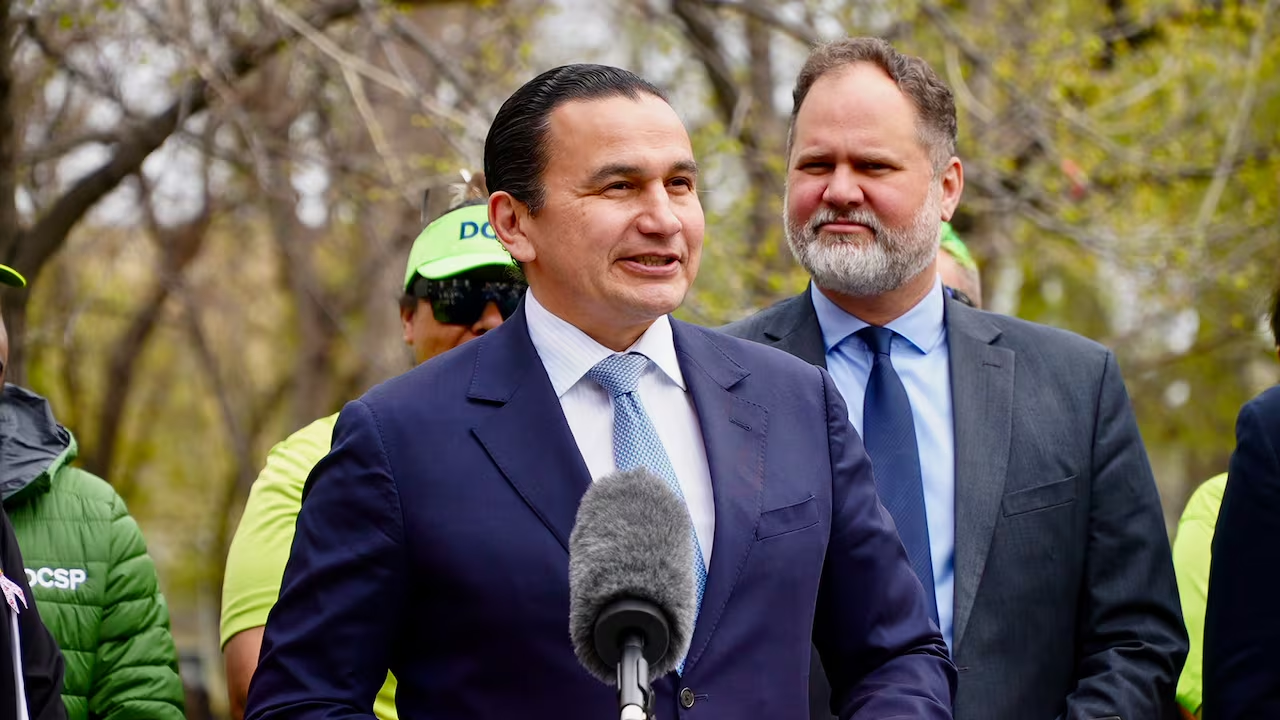
Manitoba’s legislature estimates meetings are meant to be serious business. They are the sessions where Opposition and independent MLAs get to question cabinet ministers directly about government spending, policy decisions, and accountability. They are not question period — not the theatrical daily sparring match most Canadians picture when they think of politics. They are supposed to be the part that actually works.
Tuesday’s meeting was not that.
During an estimates session, Progressive Conservative Leader Obby Khan was questioning Premier Wab Kinew about a government policy on large infrastructure projects — specifically Khan’s claim that the policy infringes on the rights of non-union workers. A few seconds after Khan made his case, Kinew began laughing.
“Again, you know,” Khan said.
“Oh man,” Kinew replied.
Khan asked the premier to be respectful while he asked questions on behalf of Manitobans. Kinew then, according to the Tories and what is audible on the legislature’s video feed, started barking.
“This is unbecoming of the premier. It is unfortunate,” Khan said.
The Progressive Conservatives posted the exchange on social media, accusing Kinew of acting like a child. The premier’s response when asked about it Thursday was characteristically unapologetic.
“I like to have fun,” Kinew said after an unrelated news conference.
“The PCs are very downer,” he added, before pivoting to criticize the party for threatening to hold up the budget implementation bill.
This Is Not the First Time — The History Between Kinew and Khan
The animosity between these two leaders is not new and it is not subtle.
At an estimates meeting last May, Kinew called Khan a “joke,” mocked him for crying during an earlier media scrum and told him to call him “dad.” Khan, for his part, has repeatedly called Kinew a “bully” and told him to look in the mirror if he wanted to see a joke.
The relationship between the leaders of Manitoba’s two main political parties has become one of the most openly hostile in the province’s recent political history. What changed this week is the setting. Heckling and sharp exchanges during question period are baked into the design of the legislative system. Estimates committees are a different environment entirely — smaller, more procedural, and intended for genuine policy scrutiny rather than performance.
Christopher Adams, a political scientist who teaches at the University of Manitoba and has written a book on Manitoba politics, said heckling is a routine part of question period but estimates meetings traditionally involve more substantive policy exchanges. “Committees are supposed to work,” he said. “It’s not grandstanding for the public eye or for the media, but it just shows you how deeply rooted this toxic atmosphere is.”
Adams also addressed the core issue directly. “It’s not the government’s role to denigrate the Opposition, or to heckle to the point where the person can’t ask questions.”
The Justice Minister and the 30-Minute Non-Answer
If the premier’s behaviour was the headline, what happened in a separate committee meeting the same day was arguably more concerning from a democratic accountability standpoint.
Independent MLA Mark Wasyliw asked Justice Minister Matt Wiebe a question about the cost of Premier Kinew’s security detail. It is a reasonable question — public money, public safety, public interest. Simple enough that a prepared minister sitting with his department staff should be able to answer it in minutes.
Wiebe took 30 minutes.
During the wait, there were periods when the minister and staff spoke amongst themselves. At other times, Wiebe was on his phone.
Cabinet ministers are legally permitted to take as much time as they want to respond at estimates. The Legislature’s rules even allow up to 45 days to respond in writing. Wiebe did not use that option either.
“He didn’t want to answer, and he wanted to make sure that the time was wasted, and he succeeded,” Wasyliw said afterward.
“The whole point of estimates is to hold the government accountable,” Wasyliw said. “And you’d think a minister would have the ability and the confidence to defend their record. This minister has shown that he can’t do that.”
Wiebe’s response to the criticism was pointed in its own way. “When it’s a serious question from a serious member and from a registered political party here in the province of Manitoba, I do everything I can to get that information,” he said.
The implication was clear — Wasyliw, having been removed from NDP caucus in 2024, was not being treated as a sufficiently serious member to deserve a prompt response. Whether a minister gets to decide which MLAs deserve accountability based on their party affiliation is a question that cuts to the heart of what legislative committees are supposed to be for.
A Legislature Already Under Strain
Tuesday’s events did not happen in a vacuum. Manitoba’s legislature has been dealing with a decorum crisis for months.
House Speaker Tom Lindsey tried to get a handle on deteriorating behaviour last month by barring MLAs from calling each other racist, bigot, misogynist, homophobe, or being transphobic.
Other recent incidents include PC MLA Wayne Ewasko saying “quit drinking, Wab” to the premier — a comment the NDP alleged was a form of anti-Indigenous racism, which Ewasko denied.
Khan also made what the Speaker called a “hateful” remark when he said “You are a terrible person, whatever you are” to Uzoma Asagwara, Manitoba’s non-binary health minister.
These incidents span both sides of the aisle. This is not a problem with one party or one person. It is a broader cultural problem in how Manitoba’s elected officials are choosing to engage with each other — and by extension, with the democratic institutions they were elected to serve.
The Speaker presides over question period, but as this week demonstrated, committee meetings operate differently. A fellow MLA acts as chairperson at committee meetings and usually does not interrupt the heckling as frequently. That structural gap — less oversight, less accountability for conduct — is part of why this week’s behaviour was able to unfold the way it did.
Why This Matters for Manitobans
Estimates meetings exist for one reason — to let elected representatives ask hard questions of the government on behalf of the people who voted for them. When a premier uses that time to laugh and bark at the Opposition, and a minister uses it to sit on his phone for 30 minutes, something real is being lost.
It is not just about manners. It is about whether the tools of democratic accountability are functioning the way they are supposed to.
Political science professor Adams put it plainly. The atmosphere in Manitoba’s legislature is deeply rooted and it is not improving. The question for Manitobans watching from the outside — and there are many who pay attention to how their elected officials behave — is what they think is acceptable from the people they put in office.
Premier Kinew says he likes to have fun. The PCs say it is unbecoming. The independent MLA says accountability is being deliberately undermined. The political scientist says committees are supposed to work.
They cannot all be right. But they cannot all be entirely wrong either.
Source: CBC News Manitoba | Data current as of May 23, 2026.
Have a correction? Email [email protected]
What do you think about behaviour at Manitoba’s legislature? Is this just political theatre or does it cross a line? Share your thoughts in the comments — and send this to any Manitoban who follows provincial politics.
Discover more from MaplesTime
Subscribe to get the latest posts sent to your email.
