




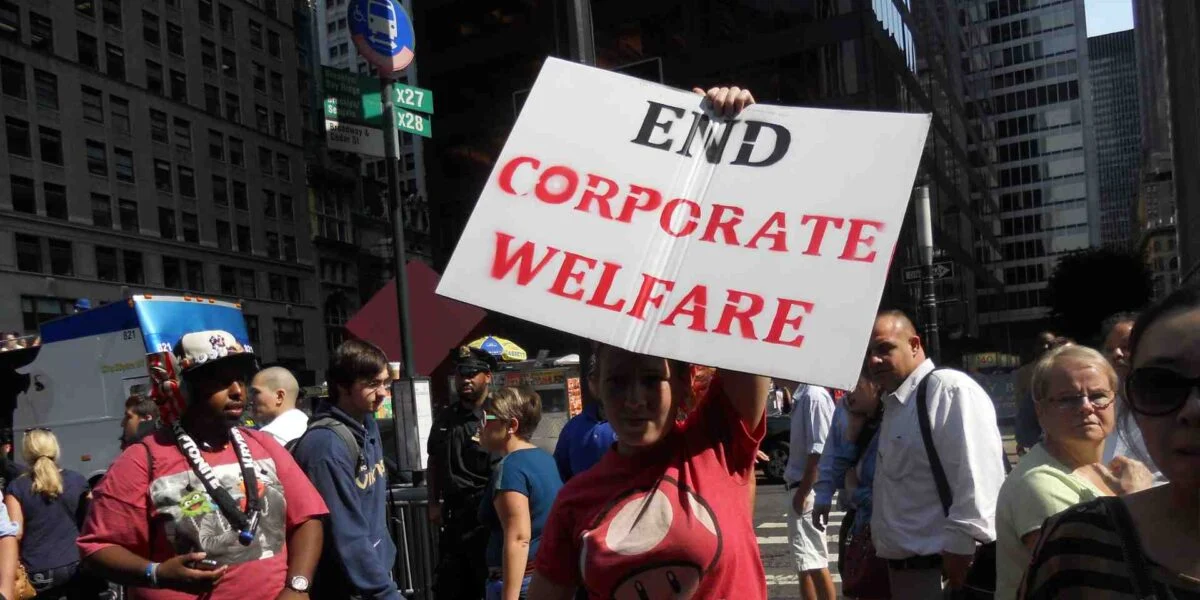
Canadian business opinion — during the 1972 election campaign, federal NDP leader David Lewis published a book that condemned tax breaks, subsidies and other financial support that governments give big businesses. The book was titled “Louder Voices: The Corporate Welfare Bums.” Half a century later, Canadians don’t just tolerate corporate welfare — they actively want it. What changed?
By Maplestime News Desk | Ottawa, Ontario | September 19, 2026
Sources: Angus Reid Group, Innovative Research Group, Vector Research | Last updated: September 19, 2026
Key Takeaways
- In 1991, just 27% of Canadians thought governments “should provide incentives and subsidies to help Canadian businesses become more competitive internationally”
- Today, only 3 in 10 say governments shouldn’t try “to pick winners with taxpayers’ money” — down from 8 in 10 a decade ago
- The 2009 auto bailouts ($13.7B in loans, $5.4B recovered) helped normalize “too big to fail”
- Governments have promised $7B to Volkswagen, $5B to Stellantis, $5B to Honda, $2B to GM, and $1.8B to Ford for Ontario EV projects
- The author argues subsidies should come with strings: R&D partnerships, diversity commitments, union neutrality, whistleblower protections
When “Corporate Welfare Bums” Was a Fighting Word
For half a century after Lewis’s book, Canadians distrusted what he called corporate welfare. In 1991, in a poll conducted by the Angus Reid Group, just 27 per cent thought governments “should provide incentives and subsidies to help Canadian businesses become more competitive internationally.” In 2004, in a survey conducted by the Vector Poll, only 39 per cent agreed governments should help industries that “the government feels have a good future, and not help industries the government feels are in decline.”
Then came the collapse of General Motors and Chrysler in the 2009 global recession. Political leaders began to regard some companies as too big to fail. The Liberal Ontario government and the Conservative federal government rescued the auto makers. The federal government’s auditor-general reported later that the two governments had given the auto makers $13.7 billion in loans and got back merely $5.4 billion.
The Great Opinion Flip
Public opinion changed dramatically 40 years after David Lewis ostracized “corporate welfare bums.” In 2014, in a Vector Poll, 67 per cent agreed that “since other countries give companies funds if they invest in those countries, our governments have no choice but to give companies money to invest here.” Doubts remained, however: around the country, 79 per cent still felt “governments should not try to pick winners and losers.”
That last doubt is now gone. Compared with eight in 10 a decade ago, this year in a poll conducted by Innovative Research Group, only three in 10 said governments should not try “to pick winners with taxpayers’ money.” And 49 per cent agreed governments should help firms “compete in the world with incentives to encourage research and development, training programs, and other initiatives to support high-potential industries.”
With no need to fear a voter backlash, politicians gladly stand alongside corporate CEOs to announce government giveaways to entice manufacturers to build and expand their operations in Canada.
The Billions Flowing Now
In 2023, the Ontario and federal governments promised Volkswagen $7 billion to build an electric vehicle battery plant in St. Thomas, ON. The two governments have committed a combined $5 billion to Stellantis, $2 billion to General Motors, and $1.8 billion to Ford in incentives and tax breaks to build electric vehicles in Ontario.
At a Honda plant in Alliston, ON in May, Prime Minister Justin Trudeau and Ontario Premier Doug Ford announced their governments will contribute $5 billion in subsidies and tax credits to support four new Honda facilities in the province, including the firm’s first electric vehicle assembly plant and an EV battery factory. Trudeau and Ford said the plants will mean 1,000 new jobs.
To rationalize its generosity to Honda and the other auto firms, in newspaper ads and TV commercials the Ontario government assured voters: “The future is electric — Making electric vehicles and batteries creates jobs now and for the future.”
What Taxpayers Should Get in Return
But are the bureaucrats and politicians negotiating the best deals they can get? They seem to pass out taxpayers’ money with few strings attached. What more could they ask in return?
They could require companies receiving government aid to fund research and development partnerships with colleges and universities in the province. They could insist the firms commit to diversity, whether it’s hiring hourly-paid employees or management. They could demand that corporations taking government handouts promise to stay neutral and not fight their employees’ efforts to join a union. Governments could require companies to pledge not to retaliate against employee whistleblowers who go public with evidence of ethical violations, unsafe working conditions and other corporate misconduct.
Related: Valuing exponential growth isn’t “progress” and isn’t sustainable
Related: Newfoundland Wind Storm 2026 — Weekend Gusts Knock Out Power Across the Island
Related: MADD PEI Memorial Monument 2026 — 12 Impaired-Driving Victims Honoured in Charlottetown
Almost no one today scolds companies and CEOs as “corporate welfare bums” for accepting government financial aid. But voters could change their opinions again if they don’t see dividends from the money their governments shell out.
Maplestime will provide updates from Canada’s industrial subsidy debate as announcements are made.
Have a tip about government subsidies to corporations? Email [email protected]
Have a correction? Email [email protected]
If we’re handing billions to Volkswagen and Honda, shouldn’t taxpayers at least get R&D, diversity, and union neutrality in return? Tell us in the comments. And share this with everyone who remembers when “corporate welfare” was a dirty word.
Enjoying Maplestime? Support independent Canadian journalism — no paywall, no corporate owners.