


Forty years. That is how long it has been since Canada last played at a men’s FIFA World Cup. Now they are not just playing — they are hosting. The 2026 tournament kicks off June 12 in Toronto, and Canada’s opener is the most anticipated Canadian soccer match in a generation. Here is everything you need to know about the team, the group, the injuries, and whether this squad can actually advance.
By Maplestime Sports Desk | Canada | May 25, 2026 Sources: Canada Soccer | CBC Sports | Goal.com Canada | The Globe and Mail | Last updated: May 25, 2026
Key Takeaways
- Canada is in Group B with Bosnia and Herzegovina, Qatar, and Switzerland — a genuinely winnable group
- Canada’s official 26-man roster will be announced Friday May 29 at 7:00 PM ET on TSN, CTV, Crave, and RDS simultaneously
- Alphonso Davies injured his hamstring playing for Bayern Munich on April 6 — coach Jesse Marsch does not expect him to play the June 12 opener but believes he will feature in the tournament
- Jonathan David — now at Juventus — is Canada’s most dangerous attacking player and carries enormous weight as the squad’s primary goal threat
- Stephen Eustáquio and Ismaël Koné form the engine room in midfield — both in strong club form heading into the tournament
- Canada’s three group stage matches are June 12 in Toronto, June 18 in Vancouver, and June 24 in Vancouver
- The top two teams from each group advance — plus the eight best third-place finishers — giving Canada multiple paths through
- This is only Canada’s third-ever men’s World Cup appearance — and their first on home soil
Why This Moment Is Different

Canada has been to the men’s World Cup exactly twice before. The 1986 tournament in Mexico — where they lost all three group matches and were eliminated without scoring a goal. And Qatar 2022 — where they qualified after a 36-year absence, showed genuine quality in patches, but again went home from the group stage.
This is only the third time the men’s team will appear at the World Cup, and it will feel a unique kind of pressure of securing a win. With the sport still gaining momentum in the country, the squad has a pivotal opportunity as co-hosts to make some history. It has the talent and the experience to do it.
The difference in 2026 is context. Canada is not a surprise qualifier anymore. The generation of players coming through — many of whom grew up idolizing the Qatar 2022 team — are playing at the highest levels of European club football. The infrastructure around the program has matured. Jesse Marsch, the head coach, has managed in the Bundesliga, Premier League, and MLS. This is a professional outfit.
And for the first time in four decades, they are playing at home. In Toronto. With 50,000 Canadians screaming at the opener.
That matters more than any tactical analysis.
Group B — Canada’s Path to the Round of 16
Group B of the 2026 FIFA World Cup consists of Canada (co-host), Bosnia and Herzegovina, Qatar, and Switzerland. The group stage runs from June 12 to 24, 2026.
This is a genuinely favorable draw for Canada. There is no Brazil, no Argentina, no France, no Spain in this group. Every single game is winnable.
Bosnia and Herzegovina — Canada’s June 12 opener in Toronto. Bosnia qualified through the UEFA playoff, meaning they had to earn their place the hard way. They are a dangerous opponent — technically capable with good individual quality — but they are playing in an unfamiliar environment against a home crowd of 50,000 Canadians. This is Canada’s best opportunity for a crucial opening win.
Qatar — The defending hosts from 2022, who were eliminated in the group stage without a win. Qatar qualified automatically as the previous host and represents Canada’s most straightforward path to points. Canada has never faced Qatar in a competitive fixture — but Qatar’s squad does not match the level of the European and South American teams in this tournament.
Switzerland — The most technically challenging opponent in the group. Switzerland is a seasoned European team with strong defensive organization and players spread across top European leagues. A draw against Switzerland would be a respectable result for Canada.
The realistic target for Canada: beat Bosnia on June 12, beat or draw Qatar on June 18, and head into the Switzerland match on June 24 knowing that a draw is enough to advance. The top two teams from each group advance to the knockout rounds, along with the eight best third-place finishers — giving Canada multiple paths through even without winning the group.
The Full Schedule — Dates, Times, Cities
Game 1 — Canada vs Bosnia and Herzegovina Friday June 12, 2026 — 3:00 PM ET Toronto Stadium (BMO Field area), Toronto, Ontario
Game 2 — Canada vs Qatar Wednesday June 18, 2026 — 6:00 PM ET BC Place, Vancouver, British Columbia
Game 3 — Canada vs Switzerland Wednesday June 24, 2026 — 3:00 PM ET BC Place, Vancouver, British Columbia
The June 12 opener in Toronto is the match every Canadian soccer fan needs to be watching. It is the first competitive home game for Canada’s men’s national team in a World Cup — in 40 years — in front of a sold-out stadium on a Friday afternoon.
The Injury Crisis — The Shadow Over Canada’s Preparation
The honest assessment of Canada’s World Cup preparation is this: it has been significantly disrupted by injuries to key players. Marsch’s list of walking wounded and players returning from injury is extensive — including Alphonso Davies, Promise David, Moïse Bombito, Alfie Jones, Ali Ahmed, Jacob Shaffelburg, Ralph Priso, Luc de Fougerolles, Derek Cornelius, and Alistair Johnston.
That is not a short list. That is nearly half the first-choice squad managing some form of fitness concern heading into the tournament.
The most significant injury is the one that has dominated every Canadian soccer conversation for the past seven weeks.
Alphonso Davies — Canada’s Captain
Davies injured his hamstring earlier this month while playing for Bayern Munich. Coach Jesse Marsch included Davies in the 32-player training camp roster but he will not join the team until the end of May to allow him to continue his recovery.
Canada coach Jesse Marsch believes captain Alphonso Davies will play in the World Cup, although it is unlikely he will be ready for the team’s opener on June 12.
Davies is not just Canada’s best player. He is the symbol of what this generation of Canadian soccer has become. The 24-year-old left back from Bayern Munich — one of the most explosive wide players in European football at his peak — represents everything the program has built since the dark days of 2022 qualification.
If healthy, Davies will play every single minute for Canada at this World Cup, likely at left back. He helped the country snap a 36-year World Cup appearance drought back in 2022 and remains the face of Canadian soccer globally.
The scenario Canada’s coaching staff is hoping for: Davies misses June 12 against Bosnia, returns for June 18 against Qatar, and is fully available for June 24 against Switzerland and any potential knockout rounds. That timeline would give Canada their captain for the matches that matter most.
The Players to Watch — Canada’s Key Men
Jonathan David — The Goal Machine
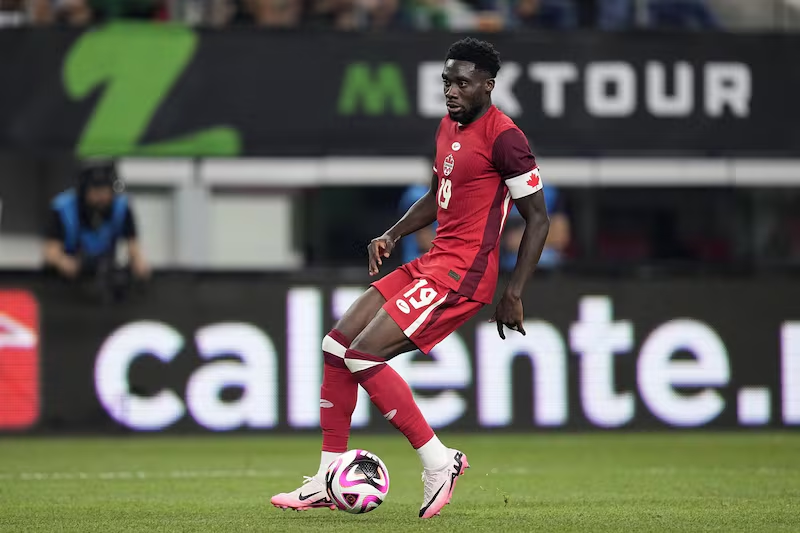
Jonathan David will start up top. Given Davies’ injuries, David has become the face of Canada’s World Cup hopes and will be under immense pressure to score.
David is arguably the most naturally gifted finisher in CONCACAF soccer right now. His move to Juventus in Serie A confirmed his European elite status — and while his numbers at Juventus showed room for improvement, his quality in front of goal has never been in question.
At international level, David’s partnership with Cyle Larin defined Canada’s Qatar 2022 qualifying campaign. At the 2026 World Cup, with Davies limited in the opening match, David’s goals will determine how far this team goes. The duo of Cyle Larin and Jonathan David defined Canada’s path to the 2022 World Cup and it appears the pair will once again lead the line for Canada.
Stephen Eustáquio — The Engine

The LAFC midfielder is the heartbeat of Canada’s best performances. Technically refined, physically aggressive, and capable of driving forward into dangerous positions — Eustáquio is the player who connects Canada’s defense to attack and gives the team its shape and intensity in the middle of the pitch.
Stephen Eustáquio is certain to start in midfield after missing the March camp due to injury and recently returning to LAFC’s lineup.
His return to fitness is arguably as important to Canada’s chances as Davies’ own recovery. Without Eustáquio in the starting lineup, Canada’s midfield loses its primary creative outlet and its best box-to-box presence.
Ismaël Koné — The Breakout Star

Ismaël Koné has enjoyed a breakout season with Sassuolo and will play alongside Eustáquio in midfield. bb
Koné is the kind of player who makes the jump at major tournaments. Young, physical, technically confident, and playing with the freedom that comes from genuinely having nothing to lose at his first World Cup. If Canada reaches the knockout stages, Koné’s performances in the group stage will be a significant reason why.
Cyle Larin — The Veteran Anchor

Cyle Larin is a virtual certainty to start. While he has not scored in his last 11 matches for Canada, his nine goals in 21 EFL Championship matches with Southampton make him undroppable.
Larin is Canada’s most experienced striker and brings a physical presence in the penalty area that no other Canadian forward replicates. International form can diverge significantly from club form — and Larin has repeatedly proven capable of delivering for Canada when it matters most.
Tajon Buchanan — The Pace

Buchanan at Villarreal brings electric pace and directness on the right side of Canada’s attack. At his best he is unplayable over short distances — a nightmare for any left back who has to manage him for 90 minutes. If Canada is chasing a game or needs to create from wide positions, Buchanan is the player Marsch will turn to.
Alistair Johnston — Defensive Rock

Alistair Johnston is among the players returning from injury but is expected to be part of the final squad.
Johnston has established himself as one of Canada’s most reliable defenders and brings the kind of professional composure and reading of the game that Canada’s back line needs when facing organized European opposition like Switzerland.
The Official 32-Player Training Camp Roster
Canada Soccer confirmed the 32-player group reporting to camp in Charlotte, North Carolina on May 25. The final 26-man roster will be announced Friday May 29 at 7:00 PM ET.
Goalkeepers: Maxime Crépeau, Milan Borjan, Dayne St. Clair
Defenders: Zorhan Bassong, Moïse Bombito, Derek Cornelius, Alphonso Davies, Luc de Fougerolles, Alistair Johnston, Alfie Jones, Jamie Knight-Lebel, Richie Laryea, Ralph Priso, Niko Sigur, Joel Waterman
Midfielders: Ali Ahmed (Norwich City), Tajon Buchanan (Villarreal), Mathieu Choinière (LAFC), Stephen Eustáquio (LAFC), Marcelo Flores (Tigres UANL), Ismaël Koné (Sassuolo), Liam Millar (Hull City), Jayden Nelson (Austin FC), Jonathan Osorio (Toronto FC), Nathan-Dylan Saliba (Anderlecht), Jacob Shaffelburg (LAFC)
Forwards: Jonathan David (Juventus), Promise David (Royale Union Saint-Gilloise), Daniel Jebbison (Preston North End), Cyle Larin (Southampton), Tani Oluwaseyi (Villarreal), Jacen Russell-Rowe (Toulouse)
Training players: Nathaniel Abraham, Zayne Bruno, Tim Fortier, Maël Henry, Dylan Judelson, Elijah Roche
Canada Soccer’s Men’s National Team FIFA World Cup 2026 roster will be unveiled on Friday May 29 in a primetime special airing simultaneously on TSN, CTV, Crave, and RDS at 7:00 PM ET / 4:00 PM PT.
Can Canada Actually Advance?
The honest assessment: yes — and it is not a stretch.
Canada has the talent and the experience to make some history at the 2026 World Cup. As co-hosts, they carry the weight of a nation’s expectation but also the advantage of home crowds, familiar venues, and the energy of playing in Toronto and Vancouver.
The path is clear. Beat Bosnia in Toronto on June 12 — which a healthy Canada squad should do with home advantage and crowd behind them. Beat or draw Qatar in Vancouver on June 18 — Qatar have not won a World Cup game in their history. Head into the Switzerland match on June 24 needing only a draw to advance with certainty.
The variable is fitness. A fully healthy Canada — with Davies, Eustáquio, Johnston, Bombito, and Promise David all available — is a genuinely competitive team at this level. An injury-depleted Canada faces a significantly harder road.
The pre-tournament friendlies against Uzbekistan (June 1) and Ireland (June 5) will tell us a great deal about what shape this squad is actually in when the tournament begins.
How to Watch Canada’s World Cup Matches in Canada
 Television: TSN and CTV — all Canada matches are broadcast nationally. CTV coverage is free over-the-air.
Streaming: Crave and TSN Direct — subscription required. RDS for French-language coverage.
Free option: CTV’s broadcast of Canada matches is available free on the CTV website and app for Canadian viewers. No subscription required.
At the venue: Toronto Stadium for June 12, BC Place Vancouver for June 18 and June 24. Limited tickets remain through FIFA’s official resale marketplace at fifa.com/tickets.
This article will be updated Friday May 29 when Jesse Marsch announces Canada’s official 26-man World Cup roster.
Sources: Canada Soccer official announcement | CBC Sports | The Globe and Mail | Goal.com Canada | Fox Sports | Data current as of May 25, 2026.
Have a correction? Email [email protected]
Are you watching Canada’s World Cup opener on June 12? Are you heading to Toronto Stadium or watching from home? Tell us your predictions in the comments — and share this with every Canadian soccer fan who is counting down the days.
Discover more from MaplesTime
Subscribe to get the latest posts sent to your email.
